

The serpentine belt transfers power to the critical components of your vehicle. Once it wears out or cracks, you may need a replacement to avoid further costly repairs. But how can you deroute and route the belt? In this guide, we’ll talk about the serpentine belt diagram and how you can make a serpentine belt replacement yourself. Let’s get started!
What Is A Serpentine Belt?
A serpentine belt, aka alternator belt before the mid-1990s, is a critical component that loops around various pulleys on the engine. It is designed to drive all engine components and accessories at once on most modern vehicles. A serpentine belt typically powers accessories, including the alternator, power steering pump, A/C compressor and water pump. In some cases, the engine may have a separate belt for one or more components in addition to the primary serpentine belt. These belts are powered by the engine’s crankshaft and play a crucial role in keeping engine-driven systems functioning.
Serpentine Belt Diagram
Here is an example of a serpentine belt diagram for your reference.
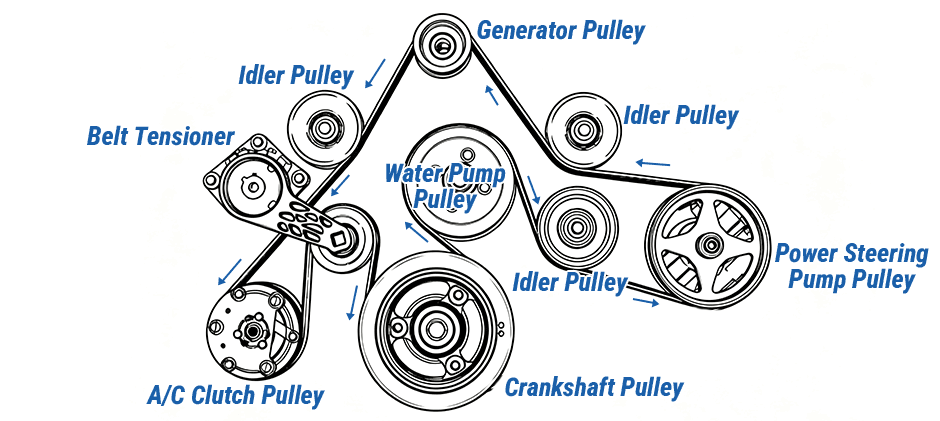
This serpentine belt diagram shows the routing for an automotive engine accessory drive system. The belt follows an S-shaped path connecting 9 components:
- Belt Tensioner: maintains automatic belt tension via spring load
- Two Idler Pulleys: guide the belt direction
- Generator Pulley: powers the charging system
- Power Steering Pump Pulley: provides hydraulic steering assist
- Water Pump Pulley: circulates engine coolant
- Crankshaft Pulley: serves as the primary power source
- A/C Clutch Pulley: drives the air conditioning compressor
To memorize the belt path, think of a “W” pointing down and to the left as you face the engine (right side of the vehicle).
Signs You Need A Serpentine Belt Replacement
Serpentine belts are made from either neoprene rubber or ethylene propylene diene monomer (EPDM) synthetic rubber. Although the EPDM belts are more robust than neoprene belts, either belt can wear out over time. You may need a serpentine belt replacement right away to avoid a breakdown if you notice the following signs of a bad serpentine belt:
- Squealing or chirping from the belt area
- Visible cracks, fraying, rib separation, or missing chunks
- Shiny glazed belt surface or “polished” ribs
- Battery not charging well / electrical instability under load
- Engine running hot or temperature creeping up during work
- Belt “walks” off-center, wobbles, or has dust buildup around pulleys
- Accessory performance drops
- Slapping/flapping noise or sudden belt break
Can I Replace the Serpentine Belt Myself?
Replacing a serpentine belt can be somewhat daunting. It’s worth a try if you’re a DIYer. But if you easily get frustrated and haven’t replaced a belt yourself, you might turn to a YouTube video of someone replacing a belt on an engine like yours. If you have the tools and the know-how, you can do this job on your own. All you need to do before you start is prepare a serpentine belt diagram so you can refer to it. Always take some photos to help you remember the routing.

How to Replace the Serpentine Belt & Belt Tensioner?
Changing the serpentine belt and tensioner is not always straightforward but the following steps can help you do it more easily.
Locate Your Serpentine Belt
Before you start, turn off your vehicle, lift the hood and let the engine cool down. The belt will be the first thing to come off and the last thing to go back on. You must find the routing of your serpentine belt. You can usually find it in your owner’s manual or somewhere in the engine compartment. Always take a picture of the diagram so you’ll have it available and sketch the belt routing before removal to mark where the tensioner is located. Then, rotate the tensioner to relieve tension and slip off the belt.
Remove the Old Serpentine Belt
Rotate the belt tensioner in the opposite direction of its travel to relieve tension on the belt with your ratchet and socket. Then, you are able to slip the belt off one of the pulleys. You can use a breaker bar in place of a ratchet for more leverage to relieve the belt tension. If your vehicle has a manual tensioner instead of a spring-loaded automatic tensioner, you may need to tighten the bolt to keep it in place once tension is relieved. When the belt is off the tensioner pulley, you can remove your ratchet from the tensioner and remove the belt completely.
Remove the Old Belt Tensioner
To remove the tensioner, you need to remove the bolts securing it. Make sure to keep those bolts in case your new tensioner needs it. Always note the orientation of the old tensioner and any locating pins or areas on the engine for easy installation.
Install the New Belt Tensioner and Idler Pulley
Install your new belt tensioner in place and make sure any alignment pins are properly placed. Then, torque the bolt to the manufacturer’s specifications. On some vehicles, the idler pulley is installed on the tensioner itself, but an idler pulley can be separate from the tensioner and is typically held in place by a single bolt. To remove most idler pulleys, simply remove the bolt in the center with your ratchet and socket.
Change the Idler Pulley
Be sure your pulleys are clean before the belt installation. Check and clean off oil or grease on all the accessory pulleys. A greasy pulley can contaminate the belt and reduce its service life. You can use soap and water to clean and degrease the pulleys before installation of the new serpentine belt. Shop for quality idler pulleys here.
Install the New Serpentine Belt
Refer to your routing diagram and start routing your new serpentine belt from the bottom. Get the belt looped onto all pulleys but the tensioner pulley. You’ll need your ratchet to turn the belt tensioner enough to slacken the belt and get the belt on the tensioner pulley. After the replacement, check if the pulleys are properly seated.
Check the New Serpentine Belt
Now, you can start up your engine and look from a safe distance to ensure the serpentine belt is staying seated as it should be with the vehicle running.
Final Words
A serpentine belt is a crucial component that drives all the engine accessories. Once it fails, it may cause many undesirable issues. You can replace the serpentine belt yourself by referring to the serpentine belt diagram and YouTube videos on replacing the belt on an engine like yours. At FridayParts, you can explore a vast range of quality serpentine belts and serpentine belt tensioners for your vehicles. Stay tuned to our blogs and learn more about your equipment.
You Might Also Like
Stop Choosing the Wrong Belts: NR, CR, NBR, EPDM Explained
Why Does My Serpentine Belt Squeal?
