

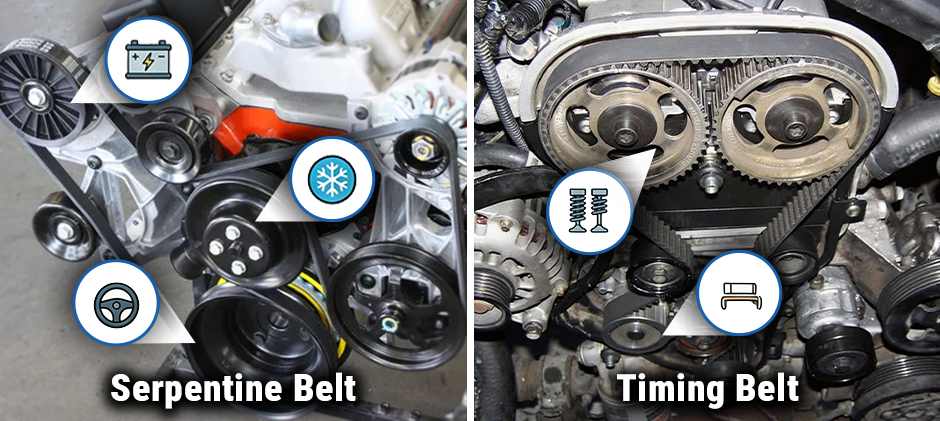
Knowing the difference between a serpentine belt vs timing belt helps you understand what happens when one fails and how to prevent bigger damage. A serpentine belt runs the external accessories like the alternator and cooling fan. A timing belt keeps the crankshaft and camshaft moving together so the engine runs at the right time.
Serpentine Belt vs Timing Belt: What Is a Serpentine Belt?
A serpentine belt drives several parts outside the engine — the alternator, power steering pump, A/C compressor, and sometimes the fan or water pump.
It snakes around multiple pulleys and can be seen easily when you open the hood or engine panel.
Clear note: When the serpentine belt comes off, stop the engine and don’t keep working.
Serpentine Belt vs Timing Belt: What Is a Timing Belt?
A timing belt is inside the engine. It links the crankshaft and camshaft so valves open and close at the right moment.
It keeps the engine firing smoothly.
You can’t see it without removing the covers. Replacing it takes more time and precision because the camshaft and crankshaft must stay in perfect sync.
Clear note: The timing belt doesn’t drive accessories — it controls internal engine timing.
5 Key Differences Between Serpentine and Timing Belts
Here’s a quick comparison:
| Feature | Serpentine Belt | Timing Belt |
|---|---|---|
| Job | Drives external accessories | Controls valve timing |
| Location | Outside the engine | Inside, behind covers |
| Failure Result | Loss of alternator, A/C, and steering | The engine stops or runs rough |
| Common Symptoms | Squealing, slipping, cracks | Hard start, rough idle, no-start |
| Repair Difficulty | Quick and simple | Complex and time-sensitive |
“If you can see it easily, it’s the serpentine belt — not the timing belt.”
When Does a Serpentine Belt Show Problems?
- Squealing or chirping that changes with speed
- Reduced charging or steering assist
- Belt cracks, missing ribs, or shiny (glazed) spots
- Belt riding off-center on pulleys
- Burnt rubber smell after heavy work
- Overheating if the belt drives the fan or water pump
Clear note: A new belt will still make noise if the tensioner or idler pulleys are worn.
When Does a Timing Belt Cause Problems?
Timing belt issues are harder to notice but more serious.
When it slips or breaks, the engine can completely stop or lose power.
Common signs:
- Hard starting or no-start
- Rough idle or misfiring
- Weak power when digging, climbing, or pushing
- Engine warning light or error code
- Ticking sound from the timing cover area
- Unknown service history (high risk if never replaced)
Clear note: If you don’t know when it was last changed, replace it as soon as possible.
Why a Broken Timing Belt Can Destroy an Engine
Some engines are interference-type, meaning valves and pistons can hit each other if timing is lost.
When the timing belt breaks, valves can bend, and pistons can get damaged — leading to a full rebuild.
“A broken serpentine belt is an inconvenience.
A broken timing belt can ruin the engine.”
How to Know Which Belt Your Machine Has
Off-road machinery uses different engines, so you can’t assume.
Check these three things:
- Read the engine plate for the exact engine model.
- Look in the service manual for the belt type and replacement schedule.
- Open the engine panel — if there’s a large plastic cover on the front, it may hide a timing belt.
Clear note: Don’t assume “diesel = timing chain.” Check your manual to be sure.
When to Replace Each Belt
Follow the manufacturer’s schedule for your engine, not just mileage or hours.
Rubber belts age with time, heat, and dust — even if the engine runs little.
Consider off-road work as severe use — high dust, long idle hours, and heat cycles mean you should inspect more often.
“Hours, heat, and dirt wear belts faster than you think.”
How to Quickly Check a Serpentine Belt
A 60-second look can prevent big repairs.
Inspect the belt every few weeks:
- Look for cracks, frayed edges, shiny spots, or missing ribs
- Check for oil or coolant leaks near pulleys
- Spin tensioner and idler pulleys by hand when the belt is off — they should be smooth and quiet
Clear note: If the pulley grinds or wobbles, the belt will fail again soon.
What to Replace With a Timing Belt
Timing belt service should replace more than just the belt.
Change these at the same time:
- Tensioner pulley
- Idler pulleys
- Water pump (if driven by the timing belt)
“If you’re already in there, replace the related parts. It saves time and money later.”
7 Quick Tips Before Ordering Belts or Parts
- Use the exact engine model and serial number.
- Count belt ribs and measure length if unsure.
- Confirm if the engine uses a belt, chain, or gears.
- Check with or without A/C – layouts can differ.
- Compare pulley sizes or bracket types.
- Replace old pulleys on high-hour machines.
- Take photos before disassembly to match the routing later.
Clear note: The right belt is the one that fits your exact engine setup — not just the brand name.
Final Thoughts
The serpentine belt runs your machine’s accessories, while the timing belt runs the engine’s internal timing.
- If you hear squealing or slipping, check the serpentine belt first.
- If your machine won’t start or runs rough, check the timing belt.
When planning maintenance, use trusted parts built for your engine and working conditions. FridayParts offers serpentine belts, timing belts, and belt tensioners for a wide range of off-road engines.
