

If your machine has vibration, bearing failure, or oil leaks, the cause may be shaft misalignment. A flexible shaft coupling helps prevent this problem. It connects rotating parts while allowing a little flexibility — protecting your equipment from stress and early failure.
What Problem Does a Flexible Coupling Solve?
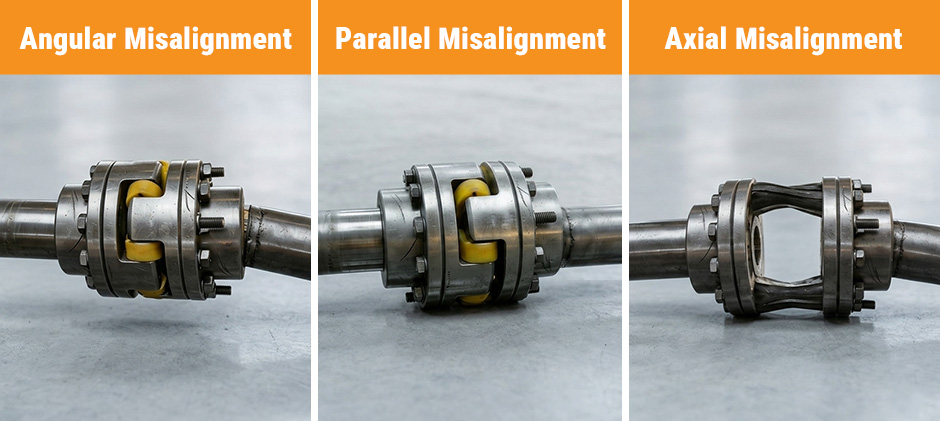
Every machine has small misalignments between its rotating shafts. These can be:
- Angular: Shafts meet at an angle.
- Parallel: Shafts are offset.
- Axial: Shafts move in and out slightly.
Without flexibility, these misalignments cause serious wear on bearings and seals.
How Does a Flexible Coupling Work?
A flexible shaft coupling has a middle element that bends or compresses to transmit torque while accommodating misalignment.
It absorbs vibration and movement, stopping those forces from damaging nearby parts.
Materials like rubber, plastic, or flexible metal are used depending on the power level and environment.
“A flexible coupling is low-cost protection for your entire powertrain.”
What Are 3 Main Types of Flexible Shaft Couplings?
While this guide covers the main categories, there are many specific designs. For a more detailed overview, you can explore the 10 Common Types of Shaft Couplings and Their Uses or start with the basics in our guide, “What Is a Mechanical Coupling?“.
1. Elastomeric Couplings (e.g., Jaw, Tire)
Made with rubber or plastic. They reduce vibration and soften shock loads.
Common in most construction machines.
2. Metallic Couplings (e.g., Gear, Disc, Beam)
Made from steel or aluminum. Perfect for high-torque, high-heat jobs.
Used in heavy-duty engines or pumps.
3. Mechanical Movement Couplings (e.g., Gear, Universal Joint, Oldham)
This type is composed of rigid components that slide or pivot against each other to accommodate misalignment.
Used in heavy-duty industrial equipment, off-road vehicles, and drivelines where large misalignments are expected.
A Note On Flexible PVC or Rubber Couplings
It is crucial to distinguish these from shaft couplings. It is crucial to distinguish these from shaft couplings. These are for pipes, not rotating shafts.
They seal fluids and connect stationary pipes, not transmit power.
Conclusion
Using the right flexible shaft coupling keeps your machine healthy. It reduces vibration, lowers repair costs, and extends bearing life. Less downtime means more productivity on every job. To explore more types and learn which models fit best with your specific machinery setup, check the flexible coupling section at FridayParts for detailed specs and fitment information.
