

Pipes carry vital fluids like coolant, fuel, or air in every piece of heavy equipment. When one leaks or cracks, a pipe coupling becomes the quickest way to fix the problem and keep working. Unlike shaft couplings that transfer rotation, pipe couplings are built to seal flow and prevent leaks. By knowing the main types—rubber, PVC, and mechanical—and when to use each, you can repair damage quickly and keep your machine’s systems sealed and reliable.
When Do You Need to Use a Pipe Coupling?
You’ll use a pipe coupling when:
- Repairing a broken pipe — Join the two ends or add a new section.
- Connecting different materials — Like joining steel to PVC.
- Joining new pipe runs — Connect straight lengths quickly on-site.
What Are 3 Common Types of Pipe Couplings?
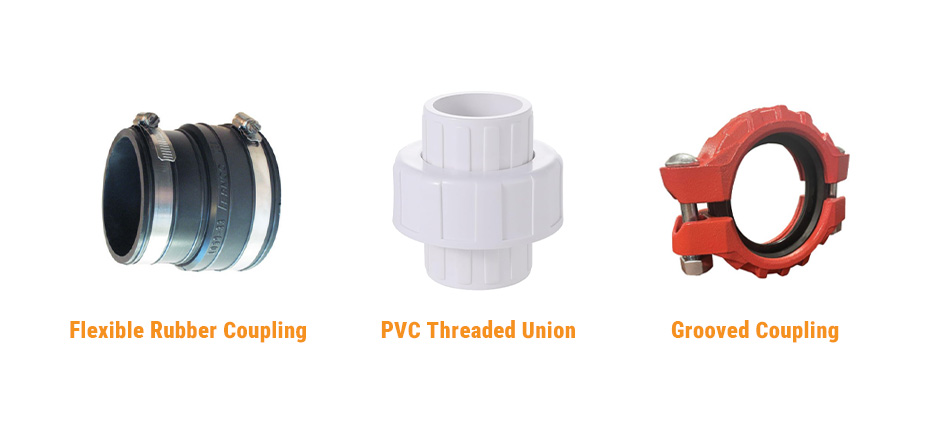
Rubber Flexible Couplings
Made from rubber with metal clamps.
They can join almost any material and are perfect for low-pressure lines like drains or coolant pipes.
PVC Couplings
Used for PVC piping only.
Choose glued (solvent) for permanent joints or threaded for temporary ones.
Mechanical/Grooved Couplings
Also called Victaulic-style.
Strong metal housings and gaskets make them ideal for high-pressure systems like hydraulics or fire lines.
How to Install a Rubber Transition Coupling in 5 Steps
- Clean the pipes – Wipe away dirt and rough edges.
- Slide the coupling on – Push it fully onto one end.
- Align the pipes – Leave a small gap in between.
- Center the coupling – Cover both pipe ends evenly.
- Tighten the clamps – Use a torque wrench, not too tight.
“A rubber flexible coupling is one of the most useful tools for field repairs — it saves time and trips back to the shop.”
Summary
Each repair requires the correct size and type based on pressure, diameter, and material.
If you need to find a dependable replacement fast, visit the coupling and connector section at FridayParts — an easy starting point for reliable pipe and shaft connectors in one place.
