

One seized bolt on tractors, combines or excavators can stop your whole repair job. When you need a penetrating spray, most people pick PB Blaster vs WD-40. Neither one is always better. It all depends on your situation. Let’s go over their differences so you can pick the right one and free rusty bolts fast.
PB Blaster vs WD-40: What’s the Difference?
At first glance, these two sprays look like they do the same job, but they’re built totally differently. Folks often argue about which one is better, yet their formulas tell you exactly what each is for.
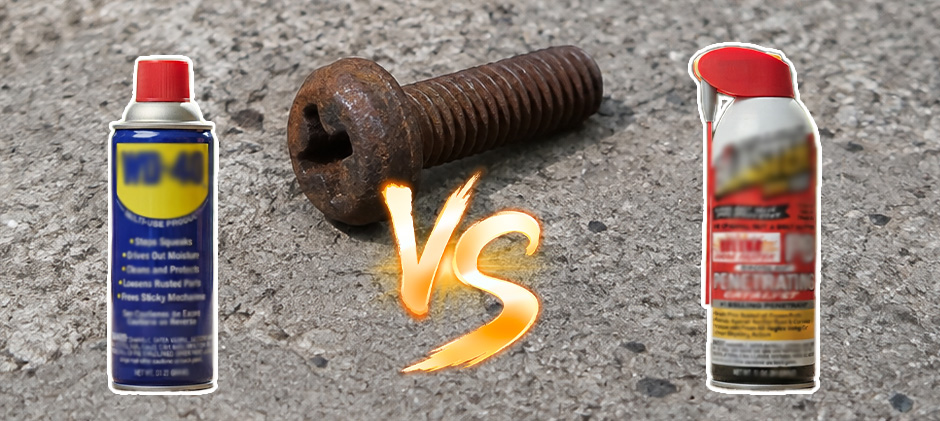
The classic blue-and-yellow WD-40 wasn’t made mainly to bust rust loose. Its full name means Water Displacement, 40th formula. Back in the 1950s, it was created to stop missile outer shells from rusting. Its main job is to push water off metal. It’s an all-in-one mix of lubricants, anti-rust additives and solvents for cleaning, protecting and lubricating metal. It can work on lightly rusted stuck parts, but that’s just a bonus feature, not what it’s designed for. Mechanics keep it handy for squeaky hinges or wiping grease off tools — it’s your general-purpose workshop helper.
PB Blaster is built for one job only. It’s real penetrating oil. It creeps into tiny gaps on bolt threads and chemically breaks apart rust. It’s way thinner than regular WD-40, so it seeps deep into stuck threads where other sprays can’t reach. It has special ingredients that target rust directly. That’s why pros and DIYers grab it for frozen bolts on old equipment. Once it loosens things up, it leaves a thin protective film to slow new rust from forming.
Which Is Better for Stuck Bolts?
Got a rust-locked bolt on heavy machinery that’s sat outside for years? Which spray should you grab? It all comes down to how stuck the bolt really is.
If there’s only light surface rust and the bolt is just a little tight, regular WD-40 will probably get the job done. Its lubricant can beat that small amount of friction and free the bolt. It also pushes away extra moisture causing rust. But once the bolt is totally seized solid, you need something stronger.
For heavily rusted bolts on plow frames or excavator arms that’ve been stuck for seasons, PB Blaster works way better. It’s super thin, so it creeps against gravity into tiny gaps between the bolt and metal housing. Strong solvents break down rust that basically glues the metal parts together. Here’s an easy way to think about it: using regular WD-40 on a fully seized bolt is like trying to clean a tough grease stain with plain hand soap. You might get it after lots of effort, but a proper degreaser works quicker and easier. PB Blaster is that heavy-duty option built just for bad rust.
One thing to remember: WD-40 also sells their Specialist Penetrant. This one is made specifically for breaking rust, and it performs close to PB Blaster. But the original multi-purpose WD-40 isn’t made for those really tough, rust-locked bolts.
How to Remove a Rusted Bolt With Penetrating Oil?
Using penetrating oil the right way matters just as much as picking the right product. If you just spray it and try to twist the bolt right away, you’ll probably get frustrated and snap the bolt head. Follow these steps for better results.
- Get the area ready: Before spraying, grab a wire brush and scrub around the bolt head and exposed threads. Clear away loose dirt, gunk and flaky rust so the oil can get in easily.
- Spray on the oil: Generously apply penetrating oil like PB Blaster right where the bolt meets the metal. Don’t hold back. Fully soak the spot, let the oil pool and seep down into the threads.
- Take your time: Penetrating oil needs time to work. For bolts that are only a little stuck, wait at least 15 to 20 minutes. For really seized bolts on farm machines left outdoors for years, wait 30 minutes. Sometimes you’ll need to re-spray and leave it overnight.
- Tap it to add vibration: Once the waiting time is up, use a hammer to tap the bolt head firmly a few times, then tap the metal around the bolt. The vibration breaks up rust bonds and helps the oil sink deeper into threads.
- Try to remove the bolt: Use a good six-point socket or wrench that fits tight on the bolt, so you don’t round off the head. Apply slow, steady force to loosen it. If it won’t turn, try twisting it slightly tighter first. This back-and-forth movement can crack the rust free.
- Reapply when needed: If the bolt still won’t move, don’t keep forcing it or you’ll break it. Just add more penetrating oil, wait longer and test again. Patience is key here.
Which One Should You Use?
Here’s an easy cheat sheet so you know exactly which spray to pick.
Classic WD-40 works best for:
- Pushing moisture away from electrical parts like spark plug wires and battery terminals
- Light lubrication on hinges, cables and linkages
- Wiping grease, dirt and sticky residue off tools and machines
- Keeping bare metal from rusting
- Loosening parts with only light surface rust
PB Blaster (or WD-40 Specialist Penetrant) works best for:
- Breaking free badly rusted, locked-up nuts and bolts
- Jobs where you need to dissolve tough, deep rust
- Taking apart old farm gear, construction machines and auto components
- Pre-treating bolts you know will be hard to remove down the line
Conclusion
There’s no clear winner between PB Blaster and WD-40. It all comes down to picking the right one for your job. And if you end up snapping a fastener, having a good, affordable source for replacement parts really helps. FridayParts keeps huge stock, so you can find parts for almost every major brand.
