

Are you new to a tractor and going to explore attachments like loaders or flail mowers? It’s essential to know the 3-point hitch system. In this guide, you will know what a three-point hitch is and how it functions, helping you make informed decisions for your land management needs.
What Is A Three Point Hitch
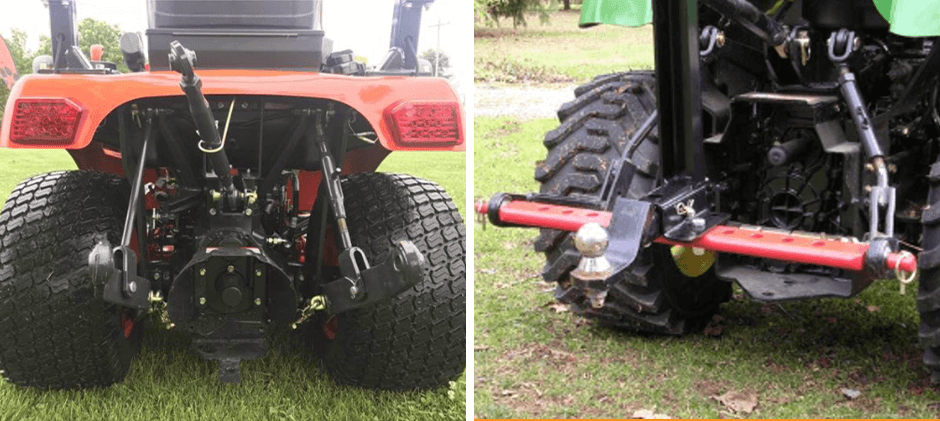
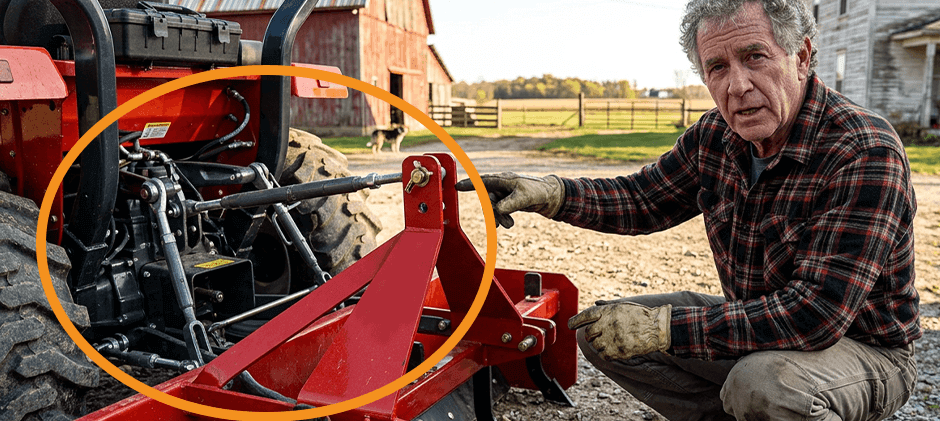
The three-point hitch or three-point linkage is a type of hitch for attaching implements to the rear of a tractor. A 3-point hitch looks like a triangle, consisting of two lower lift arms and an upper center link. It provides stability and allows for efficient power transfer from the tractor to the implement.
This three-point hitch system is commonly used with various attachments like mowers, tillers, loaders and blades. Once the implement is fixed in place with respect to the tractor and the arm position of the hitch, your tractor will carry some or all of the implement’s weight.
The other mechanism for attaching a load is through a drawbar. This is a single point, pivoting attachment where the implement or trailer is not in a fixed position with respect to the tractor. Its main benefit is to transfer the weight and resistance of an implement to the tractor’s drive wheels. This gives more traction than it would otherwise have, given the same weight, power and fuel consumption. Shop high-quality Tractor 3-Point Hitch Parts here.
What Are the Differences Between the Three Point Hitch Categories
There are several things to consider when buying a tractor. Size, condition and price are important, but you also need to know what jobs you expect it to handle. For this, you should know the difference between the 3-point hitch categories. Three-point hitch categories tell you what size implements can be used with a specific tractor. The higher category hitches have sturdier lift arms and larger connector pins. Choosing the wrong category may lead to installation failure or potential risks when installed.
Why 3-Point Hitch Categories Matter
Knowing the differences in hitch categories is essential because a mismatch can lead to poor performance, excessive wear, or even safety hazards. A Category 1 tractor does not refer to a specific brand or model line. Instead, it is defined by the size and specifications of its hitch. This classification determines which implements the tractor can safely lift and operate. By understanding what a Category 1 tractor is and the implements it supports, property owners, hobby farmers, and contractors can make informed purchasing decisions that maximize efficiency and equipment longevity.
Table for the Standard Size Categories
The table shows the size, specifications and applications of the five hitch categories.
| Category | Tractor Power | Top link pin diameter | Lift arm pin diameter | Lower hitch spacing | Typical Use | Users |
|---|---|---|---|---|---|---|
| 0 | Up to 20HP | 5⁄8 in (16 mm | 5⁄8 in (16 mm) | 20 in (510 mm) | Garden tractors and very small implements | Hobbyists and gardeners |
| 1 | 20-45 HP | 3⁄4 in (19 mm) | 7⁄8 in (22 mm) | 28 in (710 mm) | Compact and small utility implements | Small farms, property maintenance |
| 2 | 40-100 HP | 1 in (25 mm) | 1 1⁄8 in (29 mm) | 34 in (860 mm) | Larger utility or row-crop implements | Commercial farmers |
| 3 | 80-225 HP | 1 1⁄4 in (32 mm) | 1 7⁄16 in (37 mm) | 40 in (1,000 mm) | High-capacity implements | Commercial agriculture |
| 4 | Over 180 HP | 1 3⁄4 in (44 mm) | 2 in (51 mm) | 48 in (1,200 mm) | Very large implements | Industrial or large-scale agriculture |
What Is A Limited Category 1 Hitch
On some sub-compact tractors, such as John Deere 1 Series, you may have heard of the limited category 1 hitch. A limited category 1 hitch still works for 20-45 HP sub-compact tractors, but the hitch is lower to the ground and may not lift as high or open as wide as standard full-size category 1 hitches. Implements like Frontier BB20L Box Blade are designed to work with the hitch.
How to Hook up A 3-point Hitch
The 3-point hitch is a standardized device on today’s tractors. If you’re struggling with getting a 3-point implement attached to your tractor, here are the steps for you.
- Step 1: Back Your Tractor Up to the 3-Point Hitch
- Step 2: Adjust the Height of the Lift Arms
- Step 3: Attach the Non-Adjustable Lift Arm
- Step 4: Attach the Adjustable Lift Arm
- Step 5: Attach the top link
- Step 6: Return Stabilizer Arms to Proper Tension
Watch the video by John Deere to learn how to make using a 3-point hitch easier.
Pros and Cons of the 3-Point Hitch System
The 3-point hitch system has many benefits.
- Universal Compatibility: The 3-point hitch system is widely adopted to be compatible with a vast range of attachments across different brands.
- Efficient Power Transfer: The 3-point hitch provides efficient power transfer, enhancing the performance of equipment like mowers and loaders.
- Improved Maneuverability: The close coupling of the implement to the tractor provides better control and maneuverability, especially in tight spaces or uneven ground. It is very helpful for mowers to navigate around obstacles or along the field edge.
- Adjustable Cutting Heights: Many mowers can offer adjustable cutting heights via a 3-point hitch. This enables a tailored cut to your specific needs. It not only facilitates mowing a lawn or clearing overgrown areas, but also protects your deck from scalping on uneven terrain.
Set against these advantages are pitfalls to watch for.
- Initial Learning Curve: For tractor beginners, attaching implements using the 3-point hitch can be challenging at the beginning. It requires practice and time to align the arms and secure the connections.
- Likely Wear and Tear: Improper installation or overloading can cause increased wear on both the tractor and the implement itself. It is crucial to match the implement’s specifications with the tractor’s capabilities for long-term performance.
- Limited Visibility: Rear-mounted implements can reduce visibility, making it harder to monitor the implement’s operation. To enhance safety during mowing or tilling, it is recommended to use mirrors or cameras during operation.
Final Thoughts
Hopefully, this brief article has helped you get a very basic understanding of what a three-point hitch is and how it works. There is a lot more to learn. Always read your operator’s manual before operating any piece of equipment and follow the operating and safety instructions. For a slew of knowledge and expertise on tractor maintenance, troubleshooting and repairs, check out our extensive blogs here and browse our vast selection of high-quality tractor parts to keep your tractor back up to the field.
You May Also Like
What Is A Differential Lock and How It Works on Your Tractor
