

New to operating a tractor? You’ve probably noticed a pedal or level labelled “Diff Lock” and wondered what it actually does and when you’re supposed to use it. You’re not alone. This is a common confusion among many new tractor owners. This guide breaks down everything you need to know about the differential lock, including how it works, when to use it or avoid it, and how to engage it correctly.
Understanding the Basics of Differential Lock
Modern tractors come with many advanced features. A differential lock is one of the features farmers can choose for themselves. Before discussing the different locks, let’s know about the differential in a tractor.
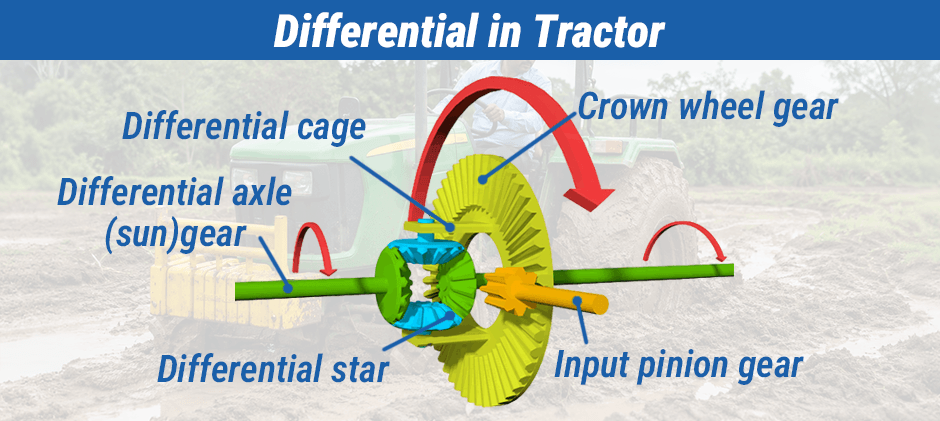
What Is A Differential and Why Does It Matter
Let’s understand the differentials first. When you turn your tractor, the outside wheel has to travel a greater distance than the inside wheel. A differential is a set of gears in the rear axle which allows the left and right wheels to rotate at different speeds. This makes turning smoother, reduces the stress on the drivetrain, and prevents tyres from scrubbing and tearing up the ground during a turn. Yet, along with the features comes a significant drawback. The differential always sends power to the wheel with the least resistance. In simple words, if one rear wheel loses traction, sitting in mud, on ice or on a wet patch of grass, all the engine power will flow to the spinning useless wheel. The wheel that still has grip gets nothing. At this point, your tractor budges to move. This is where a differential lock is designed to solve. Shop differentials for your tractor here.
What Is A Differential Lock
A differential lock, or diff lock, is a mechanism that overrides the differentials and forces both rear wheels to rotate at exactly the same speed despite the traction conditions. When engaged, both wheels receive equal power and turn together. Instead of one wheel spinning uselessly while the other sits idle, both wheels work together to push the tractor forward.
A differential lock can be found on most compact and utility tractors of brands like Kubota, John Deere, New Holland and CASE. It is typically operated by a foot pedal or a hand lever. The diff lock only affects the real axle. The diff lock will not engage if your tractor has a front differential.
How Does A Differential Lock Work
The function of a differential lock is to stop the differential unit from working. It is a small pedal at the side of a hydraulic lever. You can press to engage and disengage the lock. If your tractor is stuck in muddy conditions, a differential lock is used to free it from the mud. You can stop the working of the differential by applying a diff lock. This allows equal power on both wheels and helps the tractor get out of the mud
A differential lock is used to stop the differential unit from working. A differential lock is a small pedal provided at the side of a hydraulic lever, which can be engaged and disengaged by pressing it and vice versa. Suppose your tractor is stuck in a muddy condition; then a differential lock is used to take it out of the muddy condition. Since one wheel is stuck in the mud, it requires an equal amount of power as the other wheel to come out of the mud. So, it is important to stop the working of the differential unit, which can be done by applying a differential lock. It allows equal power on both wheels and helps the tractor get out of the mud.

When Should I Use the Differential Lock
A differential lock is a recovery and traction tool. Here are situations you should use it.
- Soft Muddy Ground: When one rear tire starts to sink and spin, engage the diff lock before you lose all momentum. Better yet, engage it just before you enter a muddy section if you can see it coming.
- Slippery Slopes: When climbing or descending a wet or icy incline, the diff lock gives you more consistent drive. That said, on a very slippery slope, locking the rear wheels can sometimes cause the rear of the tractor to slide sideways — more on this in the cautions section.
- Getting Unstuck: If you’ve already sunk into a soft spot, just engage the diff lock before trying to reverse or push forward. Trying to free a stuck tractor with only one wheel spinning is a losing battle.
- Snow & Ice: Winter operation is another situation. Ice and packed snow create the exact conditions where the differential will rob you of traction. The diff lock keeps both wheels pulling together.
- Anticipating Trouble: Experienced operators engage the diff lock before they hit the problem. If you’re approaching a mud hole, a soft patch, or a slick creek crossing, lock it up beforehand. It’s far easier to engage it before you lose traction than to try and recover after.
Dos and Don’ts for Using a Differential Lock
A differential lock is easy to use. But you have to take some precautions while using it. If not used properly, it can cause damage to tractor parts.
- Make sure your tractor moves at the slowest speed after engaging the differential lock.
- Keep the steering straight until the diff lock is engaged.
- Disengage the differential lock once you come out of the mud.
- Never use the diff lock while turning, even a gentle turning, in case of damage to axle shafts, tyres, drivetrain and the turf.
- Don’t use the diff lock on hard, dry surfaces for extended periods to avoid drivetrain bind and accelerated wear.
- Be cautious on the side slopes because engaging the diff lock on a slippery hillside can cause the rear of the tractor to swing downhill.
How to Properly Engage and Disengage the Diff Lock
Always slow down or stop before engaging. Locking spinning gears can cause damage. Once slowed, press the diff lock pedal or lever steadily. If it doesn’t click in right away, don’t force it. Just hold gentle pressure and creep the tractor forward slightly, and the gears will find their own way into mesh.
On most modern tractors, the diff lock releases automatically when you tap either rear brake. You’ll hear a click when it lets go. On older machines with a hand lever, you’ll need to release it manually. Keep in mind the golden rule: before you steer, unlock.
Should I Choose A Tractor With A Differential Lock
For most operators, the answer is yes. The benefits of a differential lock far outweigh its limitations. Whether you’re dealing with muddy fields, wet grass, loose soil, or uneven terrain, the diff lock gives you a reliable safety net when traction gets unpredictable. It also reduces stress on your drivetrain by eliminating wheel spin, which means less wear and lower maintenance costs over time. However, if the lock is used incorrectly or left engaged when it shouldn’t be, it can reduce steering ability and cause potential drivetrain stress. With even a basic understanding of when to lock and when to release, these downsides are largely avoidable.
Final Thoughts
The differential lock is one of the most useful features on any tractor. Understanding how it works, when to reach for it and when to leave it alone will make you a safer, more confident operator and will protect your equipment from unnecessary wear. As a tractor beginner, the golden rule is: engage it early, go straight while it’s locked and always release before you turn. Follow the rule and the diff lock will get you out of trouble far more often than it gets you into it. FridayParts specialises in aftermarket tractor parts and commits to providing a great deal of expertise for tractor maintenance, troubleshooting and repairs. Pay attention to our blogs and get the latest information about agricultural equipment.
Recommended Reading
2WD or 4WD Tractor? Which Is Best For My Farm
