

Torque converters take power from the engine, smooth it out, and send it to the machine’s drivetrain. They use hydraulic fluid to transfer power to the transmission in a flexible way. They let the machine idle steadily while in gear, boost torque for heavy loads when starting up, and deliver smooth takeoff and acceleration. But how does a torque converter work?
Introduction to Torque Converters
A torque converter is a device that uses hydraulic oil to transfer power. It’s installed between the engine and transmission, and works much like the clutch in a manual vehicle. Heavy equipment works in tough conditions with constantly changing loads. A regular mechanical clutch can’t hold up long, so most construction machines use a torque converter instead.
It doesn’t rely on solid mechanical connection — it moves power through hydraulic fluid. This lets the engine keep running smoothly even when the machine is in gear but the wheels or tracks aren’t moving. When the machine starts up, pushes dirt, loads material, or climbs slopes, the torque converter boosts engine torque. It gives the machine more pulling strength, softens sudden impacts, and makes power delivery much smoother.
All in all, the torque converter transfers engine power, absorbs shocks, and helps heavy equipment pull harder under heavy loads.
How Does a Torque Converter Work?
A torque converter is a sealed, ring-shaped part. The engineering inside is complicated, but the basic idea is easy to get.
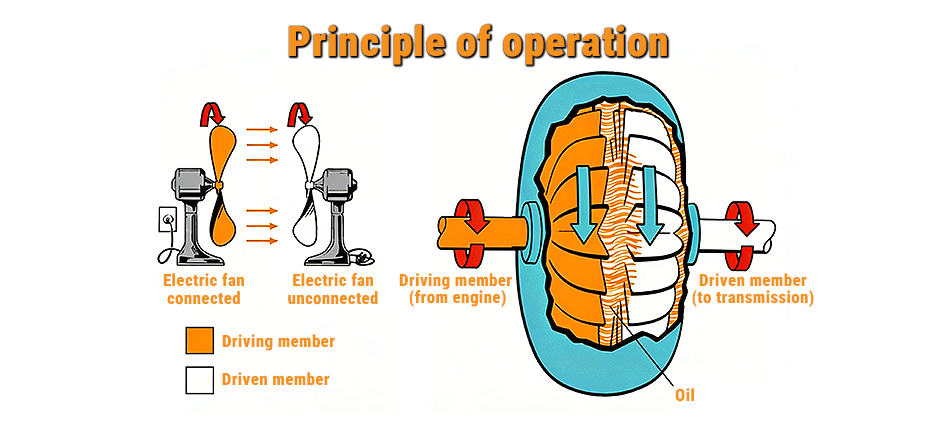
Think of two strong fans facing each other in a closed room. Turn one fan on, and the air it blows will make the second fan spin. That’s how a basic fluid coupling works. Now swap the air for thick, non-compressible transmission oil. Oil is way heavier than air, so it moves with way more force from one fan to the other. A torque converter uses this same trick, with three main parts inside a tough steel case working together:
- Impeller (or Pump): Think of the impeller as the “driving side.” It’s bolted right to the engine’s flywheel, so it spins at the same speed as the engine. It acts just like an oil pump: it pulls transmission fluid in from the center, then flings the oil outward with its spinning force to make a fast, strong flow of fluid.
- Turbine: The turbine is the “driven side.” It’s connected to the transmission’s input shaft. The high-speed oil from the impeller hits the turbine’s blades, making it spin. That’s how engine power moves through the fluid to the transmission, then to the machine’s wheels or tracks.
- Stator: This is the key part that turns a basic fluid coupling into a real torque converter. It sits right between the impeller and the turbine. After the oil hits the turbine, it flows back toward the center. Without a stator, this returning oil would bash into the back of the impeller’s blades, work against the engine, and waste a ton of power.
This redirection gives the oil an extra boost—and that’s how the torque converter makes the engine’s torque stronger. That’s why excavators can dig so hard, and loaders can push right into big piles of gravel.
The stator is on a one-way clutch. It locks in place to redirect the fluid only when the impeller spins way faster than the turbine—mostly when the machine is speeding up. Once the machine is going at a steady speed, the stator spins freely, and the torque converter works just like a regular fluid coupling.
The Lock-Up Clutch
Modern heavy equipment torque converters come with one key extra feature: a lock-up clutch.
Fluid power works great for boosting torque and delivering smooth power, but it’s never fully efficient. There’s always a bit of slip — the turbine spins a little slower than the impeller. This creates extra heat and burns more fuel.
To fix this, manufacturers add a lock-up clutch inside the torque converter. When the machine runs at a steady speed with light loads, the clutch locks up. It creates a direct one-to-one mechanical link between the engine and transmission. This gets rid of slip, cuts down heat, and saves a lot of fuel. When you need more power or slow the machine down, the clutch releases. The torque converter goes back to normal fluid drive mode again.
Signs of a Failing Torque Converter
A faulty torque converter always shows obvious warning signs.
- Sluggish performance and slipping: You may see the engine RPM go up high, but the machine feels slow and lacks power. It’s like the engine power isn’t fully reaching the wheels or tracks. This is especially noticeable when climbing slopes or pushing heavy loads. It usually means worn internal parts stop the torque converter from transferring power properly.
- Transmission overheating: Too much slipping inside the converter creates lots of extra heat. If your transmission temperature gauge runs into the red zone during regular work, a bad torque converter is likely the culprit. You may also smell burnt transmission fluid — that’s a clear sign of overheating.
- Strange noises: A broken torque converter makes abnormal sounds. When you start the machine, you might hear a whirring or whining noise that changes with engine RPM. A grinding or rattling sound is even more serious. It usually means internal bearings or turbine blades are damaged and coming loose inside the sealed unit.
- Shudder and vibration: If you feel obvious shaking or shuddering in the machine — especially when speeding up or when the lock-up clutch should engage — there’s likely a problem. It feels like running over small bumps nonstop. This usually happens when the lock-up clutch is worn out, slipping or catching roughly instead of engaging smoothly.
Conclusion
Torque converters act as a flexible, reliable link between the engine and transmission. They directly affect your machine’s power and efficiency. If you spot any warning signs, fix the issue right away to avoid more damage. When you need a replacement, shop at FridayParts. We have a wide range of high-quality, cost-effective torque converters that fit most heavy equipment brands. Get your machine back to stable performance in no time.
