

When the mower suddenly stops cutting grass or won’t move, it’s usually a worn or broken belt. But it can be not easy to tell which one is bad. The two main belts: deck belt vs drive belt. They look similar but do completely different work. This guide will show you how to tell them apart.
What Is the Deck Belt?
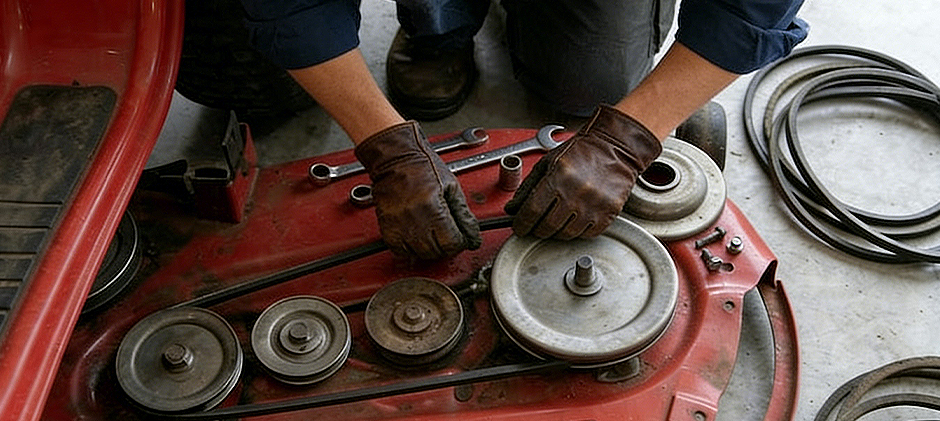
The deck belt spins the mower blades. It’s the key belt that makes your mower cut grass. If this belt breaks, the engine still runs, but the blades won’t move — so you can’t cut anything. Also called a blade belt, it runs from the engine pulley to the cutting deck.
Inside the deck, it loops around several spindles that hold the blades. When you start the engine and engage the PTO (blade switch), the belt powers the spindles to spin the blades fast for cutting. Since it drives multiple blades and wraps around many pulleys and idlers, this belt follows a complicated path. That means it needs to be strong and flexible.
Characteristics
- Length: Usually long, mostly in the 42 to 160-plus inch range, suitable for large mowing tables with multiple blades.
- Design: Use more common V-belts or notched (cogged) V-belts. The notches can help the belt bend more easily on small pulleys, making it less likely to crack or overheat, and very suitable for complex routing paths.
- Applicable models: Mainly used on riding mowers with mowing tables, zero-turn mowers and lawn tractors.
What Is the Drive Belt?
If the deck belt cuts the grass, the drive belt makes the mower move. It’s what lets your riding mower go forward and back. People often call it a transmission belt because it connects the engine straight to the transmission.
The drive belt usually has a simpler path than the deck belt. It goes from the engine pulley to the transmission pulley. When the mower moves by pressing a pedal or moving a lever, the belt tightens and sends power from the engine to the transmission, which then turns the wheels.
Whether the mower uses a basic gear drive or a smooth hydrostatic drive, the drive belt is the key part that moves the machine.
Common Features of Drive Belts
- Length: Usually shorter than deck belts, around 14 to 90 inches, because the route from engine to transmission is more direct.
- Design: Most are standard V‑belts, strong and durable enough to handle the torque to move the mower and the operator.
- Use: Fits all self‑propelled machines, including riding mowers, lawn tractors, and self‑propelled walk‑behind mowers.
The Difference Between a Deck Belt and a Drive Belt
Both belts drive parts of the mower, but their functions, designs, and positions are totally different. Mixing them up means you might buy the wrong part to fix your mower. Here are the main differences:
Main Job
- Deck Belt: Only runs the cutting blades. If it breaks, your mower won’t cut grass.
- Drive Belt: Moves the wheels through the transmission. If it breaks, your mower won’t go anywhere.
Location & Path
- Deck Belt: Attached to the cutting deck. It comes off when you remove the deck. It has a complicated path, looping around multiple blade spindles and pulleys.
- Drive Belt: Mounted on the mower frame. It stays on even when you take off the deck. Its route is simple, connecting the engine to the rear transmission.
Size & Build
- Deck Belt: Usually longer and thinner. It often has cogs to make tight bends, and stands up to grass, dirt, and heat under the deck.
- Drive Belt: Normally shorter and often wider or thicker. It’s built to handle strong torque without stretching or slipping, since it moves the whole mower.
Signs of a Bad Belt
- Bad Deck Belt: Uneven cutting, blades that won’t spin or spin slow, loud squealing under the deck, or the belt slipping off pulleys.
- Bad Drive Belt: Mower loses power, struggles uphill, moves slowly, or stops completely. You may also hear squealing or smell burning rubber when speeding up.
Lawn Mower Belt Maintenance
Belts are wear items and won’t last forever. But simple regular care can make them last way longer and stop your mower from breaking down mid-job.
- Check often: Look over the belts a few times each season. Watch for cracks, frayed edges, shiny spots, or stiffness. A good belt stays flexible, not hard.
- Correct tension: Keep belts neither too loose nor too tight. A loose belt slips and overheats. A too-tight belt strains engine and transmission parts, leading to costly repairs. Follow your manual for the right tension.
- Clean and align pulleys: Before fitting a new belt, clean dirt, grass and rust from pulley grooves. Make sure pulleys are aligned and spin freely. A wobbly or stuck pulley will destroy a new belt fast.
- Replace worn belts early: Waiting for them to snap can damage other parts — and they always break at the worst possible moment.
Final Thoughts
Knowing the difference between a deck belt and a drive belt helps you quickly find and fix mower problems. At FridayParts, we offer a wide range of affordable, good-quality replacement belts for your mower.
FAQs
What are the two belts on a riding mower?
The deck belt (blade belt) and the drive belt. The deck belt spins the blades. The drive belt moves the wheels.
How do I know if the deck belt is bad?
Check for cracks, frayed edges, missing pieces, or a shiny surface. If the blades squeal, spin slow, or cut unevenly, the belt may be worn. A loose belt or one that slips off is also a sign.
How often should I replace the drive belt?
No fixed time. Usually every 1–3 seasons or 200–500 hours. Check it yearly, and replace it if it’s worn or the mower loses power.
How Many Belts Does a Mower Have?
It depends on what you’re pushing (or riding):
- Riding Mowers & Tractors: Usually two. One for the blades and one for the wheels. High-end or extra-large models might have a third “PTO belt” to help transfer power.
- Self-Propelled Walk-Behinds: These typically have one belt hidden under a cover that helps the wheels pull the mower forward.
- Standard Push Mowers: These have zero belts. It’s just an engine bolted to a blade, and your own legs provide the “drive.”
