

Looking for a reliable Cummins ISX belt diagram? The standard serpentine belt routing typically starts at the lower crankshaft pulley, loops around the air compressor and alternator, passes under the water pump, and finally slips securely over the tensioner pulley. In this guide, we will walk you through the exact routing.
Cummins ISX15 Serpentine Belt Diagram and Routing
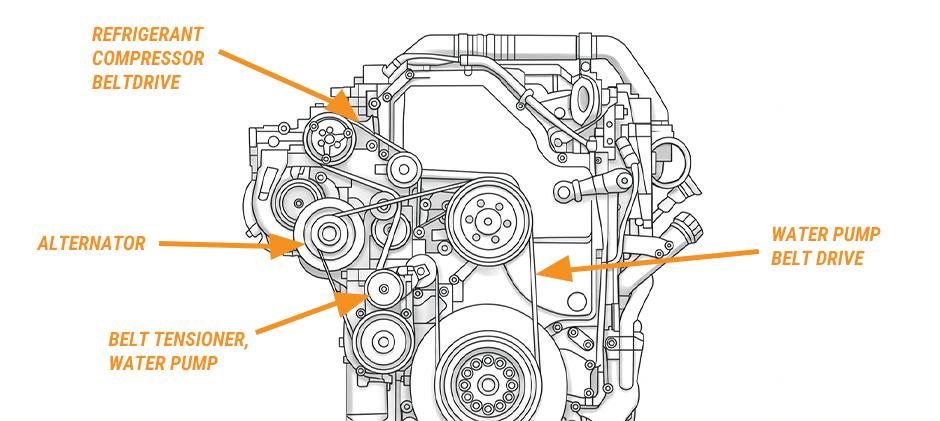
Cummins ISX belt diagrams often show a two-belt setup for most ISX and ISX15 engines, especially trucks with AC. If you look at the front of the engine, you’ll normally see two separate belt drives.
- The main drive belt runs the water pump and alternator. This one does most of the work. It goes around the big lower crankshaft pulley, also called the vibration damper. Starting at the crankshaft, it runs up over the water pump pulley, then to the alternator. The main belt tensioner keeps it tight.
- The second accessory belt is for the AC compressor. This belt sits in front of the main belt. It comes off a separate groove on the crankshaft or water pump, wraps around an idler pulley, then goes around the AC compressor. It has its own tensioner too.
Belt routing changes a lot depending on what accessories your truck has. Always use your Engine Serial Number (ESN) to get the correct belt path for your truck. If there’s no belt routing sticker under your hood, look up your ESN in the service manual.
Here’s an easy way to route the belt: start at the crankshaft pulley. Run the belt around the air compressor if your model uses a belt-driven air compressor, then to the alternator. Run it down under the water pump, then slide it over the tensioner pulley.
Cummins ISX15 Serpentine Belt Part Numbers and Types
The Cummins ISX15 uses a heavy-duty V-ribbed serpentine belt. The V-ribbed design provides maximum surface area contact with the pulleys, which prevents slipping under heavy loads.
A very common part number for EPA07 15L ISX engines is 5413204. However, because accessory brackets change depending on the truck brand (like Peterbilt, Kenworth, or International), the belt length changes too. Here is a quick checklist of what to look for when buying a new belt:
- Rib Count: Count the grooves on your pulleys. Most ISX main belts are 8-rib or 10-rib.
- Length: Check the old belt if it is still intact, or use your ESN to find the exact millimeter length.
- Material: Look for EPDM rubber belts. They handle high engine bay heat much better than older neoprene belts and resist cracking.
If you are building an emergency roadside kit, we highly recommend keeping one main drive belt, one AC belt, and a spare tensioner in your side box.
How to Install a Cummins ISX Serpentine Belt?
Putting a new belt on an ISX engine can be tricky. The radiator fan and shroud get in your way a lot. But you can fix it roadside if you know what to do.
- Clear the Path: First, work the new belt past the fan. Feed it over one fan blade at a time until the whole belt sits behind the fan near the engine pulleys.
- Route the Hard Pulleys First: Get the belt locked into the pulleys that are hardest to reach first. That’s usually the lower crankshaft pulley and water pump. Line up the belt’s ribs fully inside the pulley grooves.
- Route the Idlers and Accessories: Run the belt up around the alternator and AC compressor. For flat idler pulleys, use the smooth back of the belt against the pulley. For grooved pulleys, the ribbed side faces in.
- Release the Tensioner: Grab a long breaker bar or ratchet. Most ISX tensioners take a 15mm socket or 1/2-inch drive. Hook your tool onto the tensioner arm and pull to release the spring tension.
- Slip the Belt On: Keep holding the tensioner back, then slide the belt onto the last pulley. Watch your fingers — don’t get pinched between the belt and pulley.
- Inspect the Fit: Before starting the engine, run your hand along every pulley. Make sure the belt isn’t crooked and no ribs are hanging off the pulley edge.
Always spin the belt by hand a little after you finish. Double-check every rib seats correctly before turning the engine on.
Common Cummins ISX Belt Problems and Causes
If you’re swapping out your serpentine belt over and over every year, the belt itself isn’t the issue. Some other part in the drive system is wrecking it. ISX engines make lots of power, and even a tiny mechanical problem can tear up a belt quickly.
Pulley Misalignment
Pulley misalignment is the top reason ISX engines strip the ribs right off belts. If the fan pulley or alternator bracket tilts even just a little, it pushes the belt toward the pulley edge. That slices the belt edge apart.
Worn Belt Tensioners
Tensioners don’t last forever. They have a strong spring and dampener inside. Dirt and rust build up behind the tensioner arm over time and make it stick. A stuck tensioner lets the belt slip and flap around. If you see the tensioner arm shaking hard when the engine idles, its internal spring is worn out. You need to replace the full tensioner assembly.
Harmonic Balancer and Thrust Bearings
If you’ve already changed the tensioner and all idler pulleys, but the belt still jumps off, check the crankshaft. The big bottom harmonic balancer can come loose from its rubber cushion, which makes it wobble. In worse cases, worn crank thrust bearings let the whole crankshaft slide back and forth. That movement knocks the pulleys out of alignment and throws the belt off.
Take the belt off, then check every pulley for sharp edges. Listen for grinding noises from bearings, and make sure everything spins freely. Fix the real root problem. It saves cash and stops unexpected breakdowns.
Wrapping Up
Having the correct Cummins ISX belt diagram is the fastest way to fix a broken serpentine belt and get your truck moving again. By matching your ESN to the correct replacement parts, following the proper routing steps, and checking your pulleys for wear, you can help prevent future breakdowns. When it’s time for a replacement, FridayParts offers a wide selection of aftermarket parts to help keep your Cummins-powered machine running smoothly.
