

Is your Briggs and Stratton engine running at an unstable speed like a roller coaster? Or do you have no idea where to connect the springs and rods after cleaning your carburetor? A wrong connection can cause your engine to fail, run at a crazy speed, or not start. In fact, you only need to understand three key components for the adjustment. Keep reading to view our interactive Briggs and Stratton governor spring linkage diagram and learn the exact steps to hook up your governor springs.
Understanding Key Components of Briggs and Stratton Governor Spring Linkage
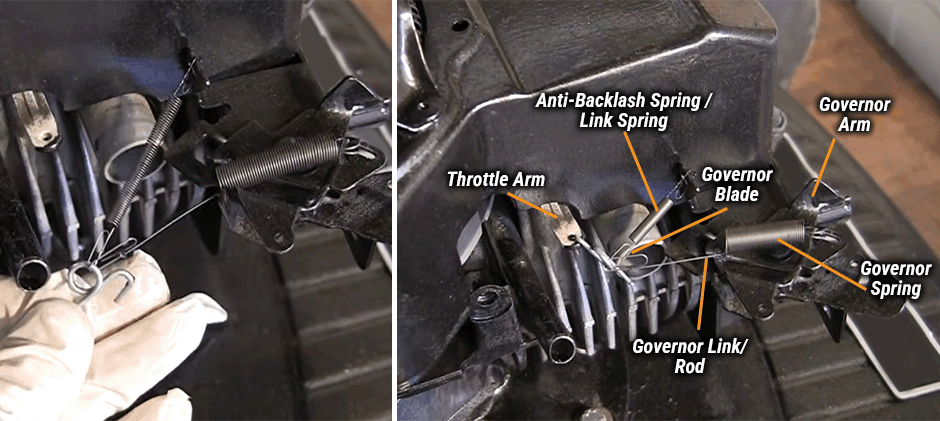
For proper adjustment of your Briggs and Stratton governor linkage, it’s essential to understand the diagram above. The quick reference table below can help
you understand the key components of a normal Briggs and Stratton governor spring linkage diagram.
| Key Components | Functions |
|---|---|
| Throttle Lever / Arm | Controls fuel/air intake into the engine |
| Governor Blade / Air Vane | Senses engine speed via flywheel airflow. |
| Governor Link / Rod | The metal rod connecting the throttle to the governor arm. |
| Speed Control Bracket / Tab | Adjusts tension on the main governor spring. |
| Link Spring (Anti-Backlash) | Eliminates play/wiggle to prevent engine “hunting” |
| Governor Linkage Arm | The junction where the rod and springs meet. |
| Governor Spring | The heavy spring that determines maximum engine RPM. |
| Governor Control Plate | The main metal bracket mounted on the engine block. |
Three Key Components
In a normal Briggs and Stratton governor spring linkage diagram, there are three key components that most readers can mix up.
- Governor Link: Governor link, aka governor rod, is a stiff metal wire that connects the throttle lever to the governor linkage arm.
- Link Spring: Link Spring, aka anti-backlash spring, is a thin spring wrapped around the metal rod. It must hook into the exact same holes as the metal rod to eliminate physical play.
- Governor Spring: It is a thick spring that connects the linkage arm to the speed control tab. It works to resist the governor’s force to control RPM.
Governor Spring Linkage Diagram for Briggs and Stratton Engine
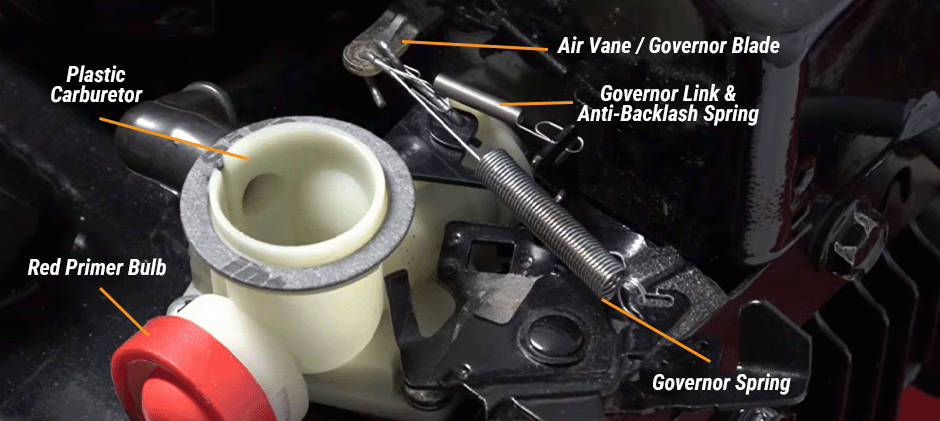
Here is another Briggs and Stratton governor spring linkage diagram to help you understand how these springs and rods are connected on a Briggs and Stratton small engine.
See Related:
- Briggs and Stratton Governor Linkage Diagram
- Briggs and Stratton Throttle Linkage Diagram
- Briggs and Stratton Carburetor Diagram
How to Reassemble the Briggs and Stratton Governor Spring Linkage?
Now that you’ve understood the key components of a Briggs and Stratton governor linkage diagram, let’s get started with the adjustment. Below are critical steps for your reference:
- Inspect the springs and rods: Check if your springs and rods are stretched or bent and replace them when necessary.
- Install the Governor Link & Link Spring: Put the small, thin anti-backlash spring (link spring) onto the rod as a whole and hook it into the hole of the throttle arm and governor arm.
- Connect the Governor Spring. Hook up one end of the thick, large spring to the governor arm and the other end to the speed control bracket (or speed control tab).
- Manual Test: Pull the throttle by hand to ensure all the links and springs can move smoothly without binding.
When Should You Adjust the Governor?
In some cases, you may have to adjust the governor, and there are simply two major reasons behind it. The first is if your engine is consistently running too fast or too slow. The second is if your engine surges or slows dramatically for no apparent reason. The main reason a governor could require adjustment is simply through use over time.
Here are 2 YouTube Video clips to help you better understand the configuration of the choke, throttle and governor linkage setup on a Briggs and Stratton engine for your mower.
- Video 1: How to Fit Lawnmower Governor Springs (Briggs And Stratton)
- Video 2: Choke, Throttle & Governor Linkage Configuration on Briggs & Stratton 4-5Hp Engines
FAQs
Where does the governor spring go on a Briggs and Stratton motor?
There should be a loop in the governor throttle linkage arm. This is where both of the springs, primary and secondary, stay clipped. Right in front of the carburetor, you should be able to locate the throttle lever control bracket. And this basically has the throttle lever. You can use your hand to unclip the secondary governor spring end from this loop.
What effect does the tightened governor spring have on engine speed?
The throttle needs to be pulled toward an open position. This is where both springs of the pneumatic governor help. Without proper tightening, it can affect the smooth operation of your engine. More importantly, the engine won’t be able to increase the speed under a heavy load.
How do you install a Briggs and Stratton governor spring?
The Briggs and Stratton governor spring installation involves putting the long lead and short end in the proper way, replacing the air filter, reconnecting the spark plug, and warming the engine for a test. You should look for a detailed guide on the entire installation or check the manual for instructions.
Conclusion
A proper connection of your Briggs and Stratton governor spring and linkage is the key to eliminating engine “hunting” and maintaining a smooth, stable RPM. By understanding how the governor link, link spring and main governor spring work together, you can easily restore your mower’s engine performance after a carburetor cleaning or rebuild. However, even the most precise installation won’t help if your springs are stretched, bent, or worn out over time. If your engine needs fresh hardware to run smoothly again, FridayParts has you covered! Explore our wide selection of high-quality, reliable aftermarket Briggs & Stratton parts today. From governor springs and linkage rods to complete carburetor rebuild kits, we have the exact replacement parts you need to keep your equipment running like new.
