

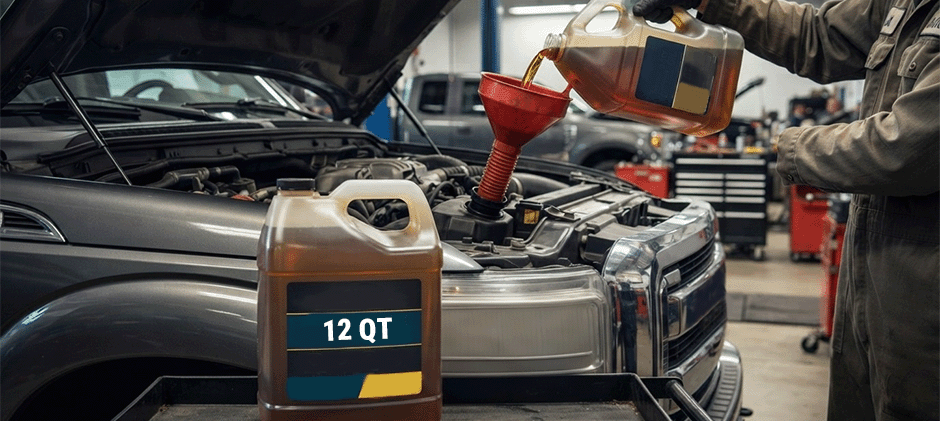
6.7 Cummins oil capacity is 12 quarts with filter—but that’s not the whole story for every 6.7 Cummins owner. Depending on the year, oil grade, service conditions, and whether you’re dealing with a Ram pickup or a commercial B6.7 application, the right fill and maintenance approach can look very different. If you’d rather avoid overfilling, DPF trouble, and bad oil advice, the details below matter.
6.7 Cummins Oil Capacity by Model Year
Every generation of the 6.7 Cummins holds 12 quarts with a filter change on a stock pan. If you drain without pulling the filter, expect about 11 quarts. Roughly a quart stays behind in the filter and upper galleries. With an aftermarket high-capacity pan, go by the pan maker’s spec instead.
| Model Year | Fill With Filter | Drain Only (No Filter) |
|---|---|---|
| 2007.5 – 2012 | 12 qt (11.4 L) | ~11 qt |
| 2013 – 2018 | 12 qt (11.4 L) | ~11 qt |
| 2019 – 2024 | 12 qt (11.4 L) | ~11 qt |
| 2025 – Present (HO redesign) | 12 qt (11.4 L) | ~11 qt |
| Aftermarket high-capacity pan | 14 – 15 qt | Varies |
Pre-filling the filter with fresh oil cuts down the dry-crank window on start-up. When you do that, the crankcase pour ends up slightly under 12 quarts since the filter already holds some oil. Check the final level with the dipstick.
One important distinction: the commercial B6.7 engine used in medium-duty box trucks and chassis-cab applications has a different pan and holds 16 quarts (standard pan) or 19.5 quarts (high-capacity pan). Don’t confuse those numbers with the Ram pickup fill.
Choosing the Right Oil Type and Viscosity
Getting the fill volume right matters, but the wrong viscosity or the wrong specification will damage the engine faster than being a quart low. The 6.7 Cummins runs behind a diesel particulate filter and an SCR module, so the oil chemistry has to match the emissions hardware, not just the moving parts.
Viscosity for 2007.5–2018 Trucks
For trucks in this range, Ram calls for either 15W-40 or 5W-40 depending on your climate:
- 15W-40 works well anywhere ambient temperatures stay above 0°F. This is the traditional heavy-duty diesel grade and holds a strong film under high loads and towing duty.
- 5W-40 full synthetic covers cold-climate operation. Below 0°F, it flows fast enough on first crank to reach the top end before metal grinds against metal.
Both grades need to meet API CK-4 (or the older CJ-4, which is still accepted on many pre-2016 trucks) and Cummins CES 20081. Any jug missing those markings should stay on the shelf.
Viscosity for 2019 and Newer Trucks
The 2019 redesign introduced hydraulic lifters and removed 15W-40 from the approved list. Current guidance:
- 10W-30 is the standard grade above 0°F.
- 5W-40 full synthetic covers work below 0°F or year-round if you prefer a single oil across seasons.
Do not put 10W-30 in a 2015 truck, and do not put 15W-40 in a 2022. The engine internals were tuned for the newer grade, and older engines were tuned for the older grade. Swapping across generations raises wear rates and, on the newer trucks, can trigger low-pressure faults on cold starts. If you’re unsure which grade the truck was built for, check the oil fill cap. Ram prints the approved viscosities directly on the cap for 2019 and newer builds.
Why Low-Ash Oil Is Required?
Every gallon of oil in your crankcase burns a tiny amount during normal operation. The metallic additives in that oil don’t fully combust; they turn to ash and collect in the DPF. Standard heavy-duty oil designed for pre-emissions engines carries high ash content, which clogs the filter faster than active regens can clean it. That leads to forced regens, then service regens, then a filter replacement bill that runs into the thousands.
Two specifications keep this from happening:
- API CK-4 covers wear protection, oxidation resistance, and shear stability for modern diesels.
- Cummins CES 20081 limits ash chemistry to protect the DPF and SCR catalyst.
Both markings should appear on the back of any jug you pour into a Ram 2500 or 3500. If the label only mentions “CI-4 Plus” or reads “for older diesels,” put it down. Cheap oil is the most expensive part of any diesel maintenance schedule.
Step-by-Step Fill Method That Prevents Overfilling
The MIN-to-MAX range on the dipstick is roughly one quart. That’s a tight window, and it is exactly where most 6.7 Cummins oil capacity mistakes happen—pouring three gallons in one shot lands you on the wrong side of it more often than most drivers realize. A slow-fill method takes five extra minutes and eliminates the guesswork.
-
- Drain hot, then let the truck sit. Warm oil drains faster. Ten minutes on a level surface after the last drip catches the residual pan volume.
- Swap the filter every time. Skipping this rolls contaminated oil into your fresh fill.
- Torque the drain plug to 37 ft-lbs. Fresh crush washer every service. Aluminum pan threads strip if you eyeball it.
- Pour 10 quarts to start. Stop short of the full 12 on purpose. This gives you a safe baseline before verifying with the dipstick.
- Run the engine for 30 seconds. This fills the filter cavity and primes the galleries.
- Shut down and wait 10 minutes. Let everything drain back to the pan.
- Check the dipstick. Wipe, reinsert, pull, read. Add the rest of the way until you reach the MAX line.
That final top-off is where most driveway mistakes happen. Pouring the last bottle blind almost guarantees you’ll pass MAX. A funnel with a slow pour and a paper towel to catch drips is worth having in the toolbox.
While you’re under the hood, this is also a smart moment to inspect the intake side and swap in fresh 6.7 Cummins fuel filters if you’re near the 15,000-mile mark. Clean fuel handling protects the HPCR pump and injectors from the kind of wear that ends in a five-figure repair bill.
Oil Change Intervals
Factory intervals are generous on paper, but they assume normal-duty use. Heavy towing, extended idling, and short winter trips all pull the number down.
| Model Year | Normal Duty | Severe Duty |
|---|---|---|
| 2007.5 – 2012 | 7,500 mi / 6 months | 5,000 mi / 6 months |
| 2013 – 2018 | 15,000 mi / 500 hrs / 6 months | 7,500 – 10,000 mi |
| 2019 – Present | 15,000 mi / 500 hrs / 6 months | 7,500 – 10,000 mi |
Severe duty covers most working trucks. If any of these describe your routine, treat the shorter interval as your real target:
- Regular towing above 10,000 pounds
- Extended idling in traffic or on job sites
- Short trips that never reach full operating temperature
- Dusty or dirty operating environments
- Frequent cold starts below freezing
If you’re not sure which category applies, pull an oil analysis after a typical interval. A twenty-dollar lab report tells you exactly how much life your oil has left, and it beats guessing on a $15,000 short block. For high-mileage engines that have already seen years of severe duty, a 6.7 Cummins overhaul kit can restore compression, oil control, and reliable performance.
Common Mistakes to Avoid
Two categories cause almost every avoidable failure after an oil service: pouring the wrong amount and pouring without verifying. Both come down to how you handle 6.7 Cummins oil capacity in practice, not just what number you read online.
Overfilling. Push the level past MAX and the crank whips oil into foam. Aerated oil cannot lubricate or carry heat. Bearings starve, pressure drops, and seals push out. Fill in stages and finish on the dipstick—never pour the full 12 quarts in one shot.
Skipping the filter. Draining without swapping the filter leaves roughly a quart of contaminated oil in the system. That old oil mixes into the fresh fill on the first crank, cutting the new oil’s useful life by ten to fifteen percent.
Wrong specification. A jug marked CI-4 or CJ-4 alone will still lubricate, but the ash content shortens DPF life. Over three or four services, you can knock 30,000 to 50,000 miles off the filter’s usable life.
Ignoring the dipstick. Bottle counting is a starting point. On a slightly warm pan, three gallons often reads slightly over MAX. On a cold pan with a pre-filled filter, it might read just under. The dipstick is the only source of truth.
Cheap filters. Quality media traps particles down to about 25 microns and holds up against cold-start pressure spikes. Bargain filters often bypass under cold-flow pressure, meaning unfiltered oil hits the bearings first thing in the morning. Sourcing quality 6.7 Cummins oil filters from a reliable supplier of Cummins aftermarket parts is one of the cheapest forms of engine insurance available.
Final Words
A 6.7 Cummins will run past 400,000 miles on four habits: 12 quarts with a filter, the right viscosity by year and climate, a CK-4 low-ash oil meeting CES 20081, and a fill that ends with the dipstick. Miss any of those, and you’re gambling with bearings. For aftermarket filters, gaskets, and diesel service parts, FridayParts stocks a broad range for Ram and heavy equipment applications.
Also Read:
5.9 vs 6.7 Cummins: Reliability, Repair Costs, and G56 Pairing
