

Are you proud to be a John Deere owner? The iconic yellow and green are like heroes in agricultural communities worldwide. Owning and operating a vintage John Deere tractor connects you to a rich history of American agriculture and engineering, with many models from the mid-20th century still working hard on farms or being lovingly restored by enthusiasts. However, keeping these older tractors running often means finding the right replacement parts. Finding John Deere parts for a machine that might be several decades old can seem difficult, but there are actually many options available if you know where to look and what to look for.
This guide will walk you through the different types of parts available for your classic John Deere, helping you source what you need to maintain, repair, or restore your machine.
You may also be interested in: How To Replace Injector Nozzles For John Deere Tractor?
How To Replace Led Lamp For John Deere 4055 And 4250 (Step By Step)
How To Use The John Deere Parts Catalog For Your John Deere Lawn & Garden Tractor
Are there any special warranties for John Deere Parts?
Why Keep Vintage John Deere Tractors Running?
Before diving into parts, it’s worth noting why these machines command such loyalty. Models like the John Deere 4020, the two-cylinder tractors, or the “New Generation” tractors were groundbreaking for their time. They offer:
- Reliability: Built with heavy-duty components, many still perform essential tasks.
- Simplicity: Their mechanical systems are often easier to understand and repair than modern, computer-controlled tractors.
- Historical Value: They represent important eras in farming technology.
- Community: A large network of owners and enthusiasts shares knowledge and passion.
Identify Your Tractor Model and Serial Number
The single most important step before searching for John Deere tractor parts is accurately identifying your tractor. You need two key pieces of information:
- Model Number: (e.g., 4020, Model B, L100) This tells you the specific type of tractor.
- Serial Number: This unique number identifies your specific machine and is crucial for determining the exact parts needed, as changes were often made during a model’s production run.
The John Deere serial number plate is usually located on the frame or transmission housing. Online resources and collector forums can help you decode the serial number to find the model year. Knowing this information is essential for ensuring part compatibility. There is also a little tip, always have your model and serial number ready when searching for or ordering parts. This avoids costly mistakes and delays.
Types of Vintage John Deere Parts Available
Once you know your tractor’s identity, you can start searching for parts. Here are the main categories you’ll encounter:
1. OEM Parts:
OEM stands for Original Equipment Manufacturer. These are the authentic components made directly by or specifically for John Deere. Choosing OEM parts guarantees a perfect fit and the quality standard set by the original manufacturer, which is ideal if maintaining the tractor’s originality is a high priority. However, this authenticity often comes at a higher price point. Furthermore, for truly antique models, the availability of John Deere OEM parts can be quite limited, as many may have been discontinued over the years, although dealerships might still stock some, particularly for later “vintage” tractors.
2. Aftermarket Parts:
Unlike those authentic ones, aftermarket components are produced by independent companies. They are designed to function as compatible replacements for the original parts. As you can imagine, the price of aftermarket parts is usually low, They are also often widely available, especially for popular vintage models, and sometimes these parts even incorporate design improvements over the original. On the downside, the quality of aftermarket parts can vary significantly between different manufacturers, so it requires careful selection from reputable suppliers to ensure you get a reliable part that fits correctly and lasts.
3. Used Parts:
Another common option is Used Parts. These are original components that have been salvaged from tractors being dismantled, often found at salvage yards or through private sellers online. Opting for used John Deere parts can be the most budget-friendly route, and sometimes it’s the only practical way to locate extremely rare or obsolete components needed for an antique John Deere parts restoration. The main challenge with used parts lies in their condition, which can vary dramatically. They are typically sold “as-is” without any warranty, meaning careful inspection before purchase is crucial, and finding the specific used John Deere parts online might take some patience and searching.
4. Remanufactured (Rebuilt) Parts:
If you are a heavy equipment owner and you value sustainability very much, the rebuilt parts are your go-to option. This category typically includes major components like engines, alternators, or water pumps that were originally OEM parts. These used parts undergo a professional process where they are completely disassembled, thoroughly cleaned and inspected, rebuilt with new internal wear components, and then tested to ensure proper function. Remanufactured parts offer a good balance, being more affordable than brand-new OEM parts while often coming with a warranty, which provides some peace of mind. They are also an environmentally conscious choice.
5. NOS (New Old Stock) Parts:
OS (New Old Stock) Parts. These are original, genuine OEM parts that were manufactured years ago but never sold or installed on a tractor. They’ve essentially been sitting on a shelf in inventory, sometimes for decades. For restorers seeking absolute authenticity, NOS parts are highly desirable because they offer genuine OEM quality. Finding them can be difficult, though, as they are often quite rare and consequently can be very expensive. It’s also worth considering that materials like rubber or plastic on NOS parts might have degraded somewhat over their long time in storage. Here’s a quick comparison:
Common Categories of Vintage Parts You Might Need
Whether you’re doing routine maintenance or a full restoration, here are some common John Deere agriculture parts categories you’ll likely encounter:
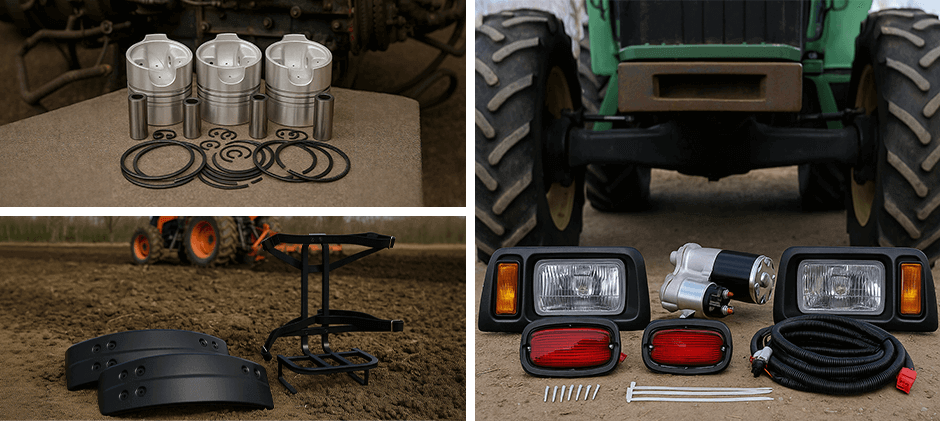
- Engine Components: Pistons, rings, gaskets, bearings, valves, and engine overhaul kits.
- Fuel System: Carburetor kits, fuel pumps, injectors, fuel lines, sediment bowls.
- Cooling System: Radiator, water pump, hoses, thermostat.
- Electrical System: Starter, alternator/generator, wiring harnesses, switches, lights.
- Body & Appearance: Fender, hood, grille, seat, decals, emblems, paint.
- Steering & Drivetrain: Steering wheel, tie rods, gears, clutch parts, bearings, seals.
- Hydraulics: Pumps, cylinders, hoses, valves.
- Maintenance Kits: Filters (oil, fuel, air, hydraulic), belts, spark plugs.
- Attachments: Parts for loaders, mowers, and plows specific to vintage models.
Many owners of models like the John Deere 4450 tractor or even smaller John Deere compact/utility tractors from past decades rely on a mix of these part types to keep their machines operational.
Where to Find Vintage John Deere Tractor Parts

Finding the parts involves looking in several places:
- John Deere Dealerships: Still a source for some OEM parts, especially for less ancient models. They also have access to the John Deere parts catalog.
- Online Aftermarket Parts Suppliers: Companies specializing in John Deere aftermarket parts often have extensive inventories, easy parts lookup tools (sometimes by serial number), and competitive prices.
- Online Marketplaces: Websites like eBay can be good for used John Deere parts online, NOS parts, and sometimes aftermarket options.
- Tractor Salvage Yards: Physical locations where you can often find specific used components.
- Specialty Vintage/Antique Tractor Parts Suppliers: Businesses focusing specifically on vintage John Deere tractor parts for restoration.
- Online Forums and Social Media Groups: Communities dedicated to specific models or John Deere tractors in general can be great resources for sourcing parts and advice.
- Collector Shows and Swap Meets: Opportunities to find parts and connect with other enthusiasts.
Conclusion
Keeping a vintage John Deere tractor in working order is achievable thanks to the variety of parts available. Whether you need authentic OEM parts for a perfect restoration, affordable and reliable aftermarket parts for everyday use, or hard-to-find used components, options exist. The key is to accurately identify your tractor using the model and serial number, understand the differences between part types (OEM, aftermarket, used, remanufactured, NOS), and know where to search.
If you’re looking for high-quality John Deere aftermarket parts at great prices, we can help at FridayParts. We pride ourselves on our vast inventory covering many heavy equipment brands, including a wide range of compatible parts for numerous John Deere models, both vintage and modern. Our goal is to provide reliable parts that keep your machinery running smoothly without breaking the bank. Browse our selection today to source the John Deere tractor parts you need for your next repair, maintenance, or restoration project!
