

The P0300 on off-road machinery always means that your Engine Control Module (ECM) has detected random or multiple cylinder misfires. But don’t worry, it’s easy to fix as long as you follow this guide. You’ll learn how to diagnose the problem, find the root cause, and restore your machine to its peak performance.
What Is The P0300 Code On Off-Road Machinery?
P0300 is a generic diagnostic trouble code defined as a “Random/Multiple Cylinder Misfire Detected.” A misfire occurs when the combustion process in a cylinder is incomplete or fails to ignite entirely, sending unburned hydrocarbons into the exhaust system. The ECM monitors these events using the camshaft and crankshaft position sensors to track rotational speed.
The ECM monitors misfire rates over specific windows of 200 and 1,000 engine revolutions. The camshaft sensor identifies which cylinder is at the firing position, while the crankshaft sensor measures variations in rotational speed. When a cylinder fails to fire, the crankshaft momentarily slows down. If these speed fluctuations exceed programmed thresholds within the 200 or 1,000-revolution intervals, the ECM increments a counter and triggers the P0300 code.
6 Common Symptoms Of A Random Engine Misfire
 When an off-road engine suffers from a P0300 condition, it will exhibit several distinct performance indicators:
- Illuminated or Flashing Check Engine Light: A solid light typically indicates a steady emissions problem, while a flashing light warns of a misfire rate severe enough to cause immediate thermal damage to the catalyst.
- Reduced Engine Power: The machine will feel sluggish or struggle to maintain its cycle times when operating under heavy load.
- Rough Idling: You will notice jittery or unstable behavior and excessive vibration when the machine is stationary.
- Poor Fuel Economy: Incomplete combustion leaves unburned fuel in the exhaust, significantly increasing hourly fuel consumption.
- Hard Starting: The engine may require multiple attempts or longer cranking periods to turn over.
- Unusual Engine Noises: Improper combustion often results in audible knocking or pinging sounds from the engine block.
Why Does My Machine Trigger A P0300 Code?
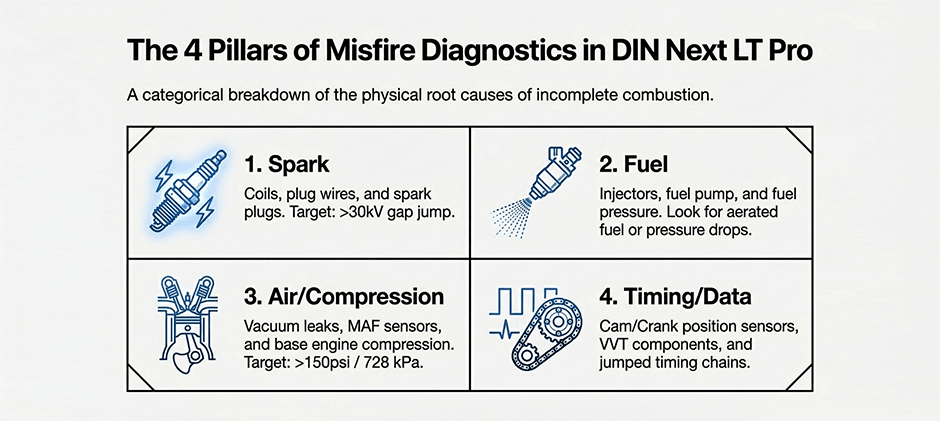
Misfires in heavy equipment generally originate from ignition failure, fuel delivery issues, or mechanical timing discrepancies.
What Ignition Issues Cause Misfires?
Ignition system wear is the most common culprit in high-hour machinery. Faulty spark plugs, worn ignition coils, and damaged plug wires can prevent the air-fuel mixture from igniting. If the secondary ignition system cannot produce enough voltage to jump the gap—typically requiring a 30kV threshold—the cylinder will misfire.
How Do Fuel System Failures Affect Performance?
The engine requires precise fuel pressure and volume to maintain combustion under load. Common causes of failure include clogged injectors, a failing fuel pump, or a dirty fuel filter. In off-road environments, aerated fuel (fuel containing air bubbles) is a major concern; it can simulate correct pressure on a gauge while failing to deliver the actual fuel mass needed, resulting in a lean-condition misfire.
What Air And Sensor Problems Should I Check?
Unmetered air entering the system through vacuum leaks or a faulty Mass Air Flow (MAF) sensor will disrupt the air-fuel ratio. Malfunctioning Variable Valve Timing (VVT) components or Oxygen (O2) sensors also provide incorrect data to the ECM. On rough terrain, extreme vibrations can sometimes interfere with the crankshaft sensor’s ability to measure speed variations accurately, leading to “rough road” false detections.
Can Electrical Health Cause False Misfires?
Low battery voltage or a failing starter can trigger a false P0300 or P0339 code during the cranking phase. If the engine turns over too slowly, the ECM may misinterpret the irregular crankshaft speed as a misfire. In harsh environments where batteries degrade quickly, you must verify electrical health before diagnosing mechanical engine issues.
How To Diagnose P0300 Step-By-Step
Follow this systematic workflow to isolate the failure and avoid unnecessary parts replacement.
- Step 1: Scan for specific cylinder codes to narrow the search. Use a diagnostic scanner to check for companion codes like P0301 through P0312. These indicate exactly which cylinders are failing, allowing you to move from a “random” diagnosis to a targeted repair of a specific bank or cylinder.
- Step 2: Analyze freeze frame data to understand failure conditions. Check the engine load, temperature, and RPM at the exact moment the code was triggered. This data reveals if the misfire is intermittent, occurring only during cold starts, or appearing under peak load in the field.
- Step 3: Perform a “swap test” by moving a coil or plug from a misfiring cylinder to a known good one to see if the fault follows the part. Additionally, use a multimeter to measure the resistance (Ω) between coil terminals; any reading of zero or one outside manufacturer specifications confirms the component is dead. (Learn how to test a spark plug or how to test an ignition coil here).
- Step 4: Verify fuel delivery and injector performance. Use a fuel pressure gauge to ensure the system reaches base pressure, then perform a pressure drop test. Activate individual injectors with a pulse tester or scan tool—each should cause an equal pressure drop on the gauge. A low drop indicates a clog, while an excessive drop suggests an injector that is stuck open.
- Step 5: Perform a compression test to check mechanical sealing. Measure the pressure in each cylinder to rule out internal mechanical failure. Significant variations in pressure indicate issues like worn rings, bent valves, or a blown head gasket, which require internal engine repair.
5 Ways To Fix Your Misfiring Engine
Once your diagnosis identifies the root cause, use these repairs to restore your machine:
- Replace Worn Spark Plugs and Coils: Swap out any components that fail resistance tests or the swap test, ensuring new parts meet OEM specifications.
- Clean or Replace Fuel Injectors: Address injectors that are clogged, leaking, or exhibit uneven flow during the pressure drop test.
- Repair Vacuum Leaks: Inspect the intake manifold and hoses for cracks. Use a smoke machine or carb cleaner to find leaks that are leaning out the air-fuel mixture.
- Update Software or Perform Relearns: Perform a “crank relearn” procedure if the ECM is seeing false misfires due to mechanical wear or if you have recently performed a PCM software reflash.
- Address Mechanical Timing: Repair timing chain slack, jumped teeth, or failed tensioners if the crankshaft and camshaft signals are no longer synchronized.
Conclusion
Follow these steps, and you can easily turn a catastrophic engine failure into a controllable issue. During this process, FridayParts offers cost-effective solutions to any problems you’ve found. There is a wide selection of high-quality replacement engine components and ignition parts for you to select. Visit FridayParts.com right now
