

If you operate modern off‑road diesel equipment — excavators, tractors, loaders, or trucks — you’ve noticed the blue‑capped tank beside your fuel tank. That’s for Diesel Exhaust Fluid. But what is DEF really? Is it an additive? A scam? Or a necessary evil? Let’s clear things up once and for all.
The Short Answer
It is not a fuel additive. It’s a precisely engineered solution made from just two ingredients:
- 32.5% ultra‑pure synthetic urea
- 67.5% deionized water
These strict proportions are set by ISO 22241, the worldwide standard that ensures DEF works exactly as intended in your engine’s Selective Catalytic Reduction (SCR) system.
Why Your Machine Needs DEF
Modern diesel engines produce nitrogen oxides (NOx) — harmful gases that create smog and acid rain. The SCR system’s job is to break those gases down into harmless nitrogen (N₂) and water vapor (H₂O).
Here’s how DEF makes that happen:
- The Problem: As your engine runs hot, it naturally creates NOx.
- Injection: The SCR system injects DEF into the hot exhaust.
- Reaction: The heat converts DEF into ammonia (NH₃).
- Clean‑Up: Inside the catalyst, ammonia reacts with NOx — transforming it into nitrogen and water.
Result: Up to 90% fewer emissions, a stronger engine tune, and compliance with EPA and Tier‑4 standards.
What’s in DEF and Why It Matters
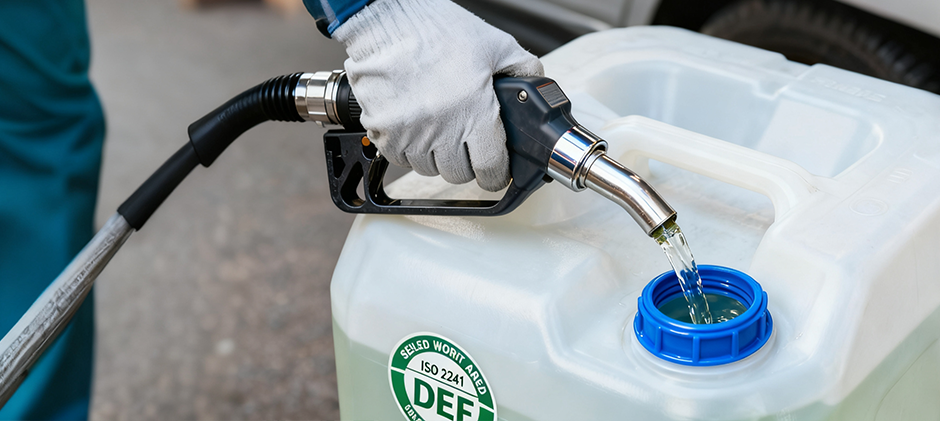
1. Urea (32.5%)
Not from animals, not from fertilizer pellets.
It’s synthetic, made from ammonia and carbon dioxide, and purified to avoid metals, salts, and aldehydes.
Low‑grade or homemade “urea” won’t work.
Even tiny contaminants can clog injectors, damage your SCR catalyst, and cost you $5,000–$20,000 in repairs.
2. Deionized Water (67.5%)
This is not tap water or filtered water. It’s been stripped of all minerals that would otherwise cause scale and corrosion in your exhaust system.
Tap water → mineral scale → blocked SCR passages → engine derate.
Deionized water → clean operation → long SCR life.
Common Misconceptions
| Myth | Reality |
|---|---|
| “DEF is an additive that mixes with diesel.” | Never mix DEF with fuel. It only goes into its own blue‑capped tank. |
| “I can make my own from fertilizer, urea, and water.” | ISO‑grade DEF uses lab‑grade purity – DIY batches will ruin injectors and invalidate warranties. |
| “If I run out, the machine will keep going.” | No. It’ll first enter ‘limp mode’, then may shut down until refilled. To avoid this, you should know How to Check DEF Fluid Level regularly. |
| “It’s only for emissions, doesn’t affect performance.” | Because SCR handles emissions externally, the engine can run more efficiently and powerfully than old EGR‑only setups. |
Storage & Handling Tips
1. Keep It Cool and Clean
- Store at 12°F to 86°F (-11°C to 30°C).
- Avoid sunlight — heat shortens its 12–18‑month shelf life.
2. Freezing Is Normal
- DEF freezes at 12°F (-11°C).
- Your machine’s DEF tank heater will thaw it automatically.
3. Use the Right Equipment
- Only use DEF‑approved containers and pumps (HDPE or stainless steel).
- Never reuse fuel or oil cans.
4. Keep It Pure
- Check that the fill nozzles are clean.
- Even small dirt or oil contamination can destroy a full SCR system.
The Hidden Advantage: More Power, Less Stress
The big secret?
Diesel Exhaust Fluid doesn’t just clean up emissions — it actually makes your engine perform better.
Because SCR handles NOx externally, the engine can run:
- Hotter and more efficiently
- With less exhaust gas recirculation (EGR)
- At higher power and lower fuel consumption
In short: More torque, better mileage, cleaner exhaust.
Quick Takeaways
- Diesel Exhaust Fluid = 32.5% urea + 67.5% deionised water.
- Never mix it with fuel.
- Only use certified ISO 22241 DEF.
- Freezing is normal; heat or sunlight isn’t.
- Dirty or homemade DEF will cost you thousands.
- A healthy SCR + DEF system = more efficient, longer‑lasting equipment.
Bottom Line
DEF isn’t a gimmick or an additive — it’s a critical part of how modern diesel engines stay powerful, efficient, and emissions‑compliant.
Handle it with care, buy from trusted sources like FridayParts, and your machines will reward you with longer life, fewer breakdowns, and cleaner performance on every job site.
