

You’re running your machine when a “Check Gauges” light suddenly turns on. You look at the fuel level — it’s fine. So what’s wrong? This light sometimes confuses operators. It doesn’t point to one problem; it simply tells you to check all your gauges. It’s your machine’s way of saying: “Something’s not right — look at my dashboard now.”
This guide shows what the light means, which gauges to check first, and how to find and fix the issue before it causes real damage.
What Is the Check Gauges Light?
The “Check Gauges” light is a general warning, not a direct fault message. It’s similar in purpose to a Master Warning Light, which also signals a general issue.
It turns on when any of your machine’s main systems shows a reading that’s too high or too low.
It’s a reminder to do a quick scan of your entire instrument panel.
Think of it as your machine talking:
“Hey, something in my system doesn’t look normal — take a quick look!”
What 4 Key Gauges Should You Check Immediately?
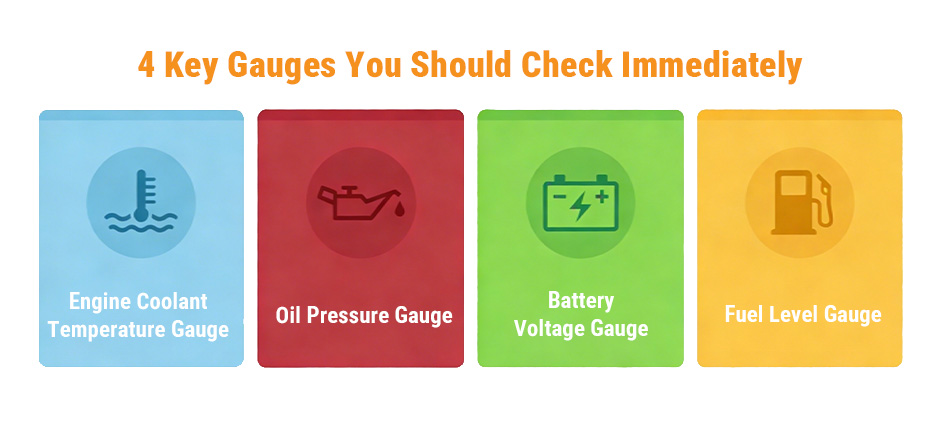
When this light shows up, check these four important gauges right away. Problems in any of them can stop your machine or cause expensive damage if ignored. For a good overview, you can start by understanding the general meaning of each gauge.
1. Engine Coolant Temperature Gauge
This gauge shows your engine’s running temperature.
When everything is normal, the pointer stays near the middle.
- If it moves toward “H” (Hot), the engine is overheating — stop and let it cool.
- If it stays cold even after running for a while, the thermostat might be stuck open, which wastes fuel and wears the engine out faster.
2. Oil Pressure Gauge
This is the most important gauge on your panel.
It measures how well the oil is moving through the engine to protect its moving parts.
If the needle drops to Low or the red zone, turn off the engine right away.
Low oil pressure can destroy an engine within minutes.
Common causes include: low oil level, a bad oil pump, or a faulty pressure sensor.
3. Battery Voltage Gauge (Voltmeter)
This gauge checks your machine’s electrical system.
When the engine runs, the normal voltage is usually between 13.5 and 14.5 volts. ( For a typical 12-volt system)
That means your alternator is charging the battery correctly.
- Too low = alternator or battery problem.
- Too high = voltage regulator problem, which can hurt the machine’s electronics.
4. Fuel Level Gauge
This gauge simply shows how much fuel you have.
If your “Check Gauges” light appears even with a full tank, the fuel level sender (inside the tank) may be reading past its limit or starting to fail.
Though not as critical as oil pressure or temperature, it’s worth checking.
How to Diagnose the Problem in 3 Steps
Follow these steps to quickly find why the Check Gauges light came on.
Step 1: Perform an Immediate Visual Sweep
As soon as the light appears, scan all four gauges.
Whichever one shows high or low is your first clue about what’s wrong.
Step 2: Look for Patterns
Notice when the warning appears.
- Does it only happen when the engine is cold?
- When lifting heavy loads or climbing steep ground?
- Or only when the machine shakes on rough terrain?
Patterns can help you guess the cause — for example:
- Cold-start problems might mean a thermostat issue.
- Flickering on bumps may mean a loose wire or sensor.
Step 3: Read the Diagnostic Codes (DTCs)
If the gauges look normal but the light stays on, use a diagnostic scanner.
Modern off-road equipment stores fault codes when sensors detect trouble.
A code like “P0128 – Coolant Thermostat Below Threshold” tells you exactly where to look.
Reading these codes saves time and avoids guesswork.
Why You Should Never Ignore a Check Gauge Warning
Ignoring the Check Gauges light is risky.
A simple issue, like low coolant, can quickly cause engine overheating and expensive damage.
Running with low oil pressure can ruin the engine in minutes.
Fixing a small issue early prevents downtime, saves money, and keeps your machine working safely.
In Summary
The “Check Gauges” light isn’t something to panic over—but don’t ignore it. By paying attention to your temperature, oil pressure, voltage, and fuel readings, you can spot problems before they become serious.
If you do need to replace a sensor, water pump, alternator, or other parts, choose FridayParts durable components built for off-road work. Keeping your machine in good condition ensures it runs strong, day after day, with less stress and fewer surprises in the field.
