

When you’re behind the wheel of a heavy truck, truck dashboard symbols can mean the difference between a smooth haul and a costly breakdown. Yet many operators — even experienced ones — admit they don’t fully understand what every light means. This guide breaks down truck dashboard symbols and their meanings, helping off-road and long-haul drivers recognize crucial alerts before trouble arises.
The Color of the Truck Dashboard Meaning
Your truck dashboard uses color-coded alerts to communicate urgency. Here’s how to interpret them:
| Color | Meaning | Immediate Action |
|---|---|---|
| Red | Critical system failure or immediate safety risk. | Stop the truck as soon as safely possible. Shut off the engine or address the immediate issue before continuing. |
| Amber / Yellow | Non‑critical faults that need attention soon. | Schedule maintenance or diagnostic service. Ignoring it can lead to major repairs later. |
| Green | Active system or confirmation (e.g., lights, cruise control). | Information only — no corrective action required. |
| Blue | Active condition notifications, like high beams or coolant temperature indicators. | Informational — used to confirm a system is engaged. |
Truck Dashboard Symbols and Meanings (Universal)
Below is a structured list of the most common truck dashboard symbols used across heavy-duty and off-road trucks, arranged by operational category and your provided sequence.
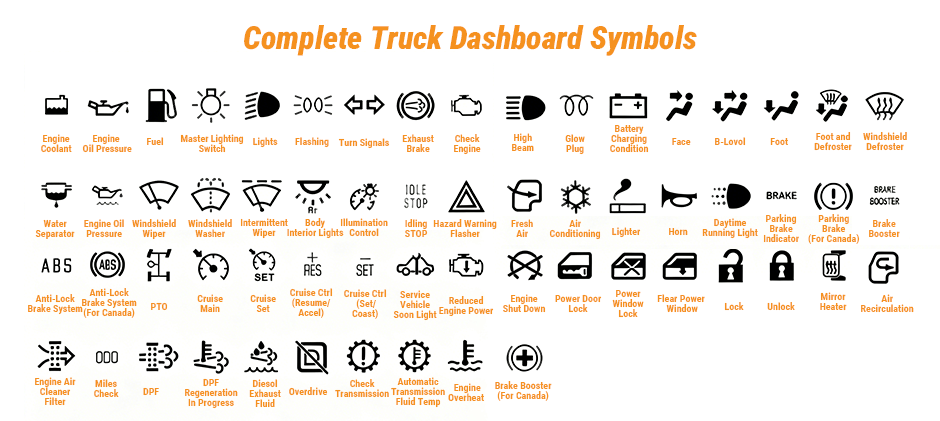
Engine and Powertrain Indicators
- Engine Coolant – Warns when the coolant temperature is too high or too low. Stop, allow cooling, and check coolant level.
- Engine Oil Pressure – Signals low oil pressure; stop immediately to prevent engine damage.
- Fuel – Low fuel level or a fault in the fuel gauge or supply system.
Lighting and Visibility
- Master Lighting Switch – Main headlights or work lights are active.
- Lights – Confirms that light circuits or running lamps are turned on.
- Flashing – Indicates flashing hazard or turn signal operation.
- Turn Signal – Shows directional turning lights are engaged.
Engine Braking and Diagnostics
- Exhaust Brake – Exhaust or engine retarder engaged to control speed on slopes.
- Check Engine – General system fault involving sensors or emissions; scan diagnostic codes.
Driver Visibility and Beam Indicators
- High Beam – Blue indicator confirming headlights set to high beam.
- Glow Plug – Diesel engine preheat indicator; wait for it to turn off before starting.
- Battery Charging Condition – Alternator or battery not charging properly.
Airflow and Ventilation Modes
- Face Mode – Directs cabin airflow to the driver and passenger face vents.
- B‑Lovol (Bi‑Level) – Splits air between upper (face) and lower (foot) vents.
- Foot Mode – Air output directed toward the footwell.
- Foot and Defroster – Airflow is distributed to the windshield and floor area.
- Windshield Defroster – Air directed to the windshield for defogging and defrosting.
Fuel & Filtration
- Water Separator – Fuel filter water level is high; drain water to prevent injector damage.
Engine Oil and Monitoring
- Engine Oil Pressure – Confirms a drop in oil pressure or sensor fault.
Wipers and Washers
- Windshield Wiper – Indicates wipers are operating.
- Windshield Washer – Low washer fluid or spray system active.
- Intermittent Wiper – Wipers in interval mode, adjustable speed.
Interior Lighting and Illumination
- Body Interior Lights – Cabin or dome light indicator.
- Illumination Control – Adjusts dashboard brightness or panel backlighting.
Idle and Safety
- Idling STOP (Auto Stop) – Engine start/stop system engaged.
- Hazard Warning Flasher – All turn signals are activated for hazard or emergency stopping.
Ventilation & Comfort
- Fresh Air – Draws in outside air for cabin ventilation.
- Air Conditioning (A/C) – Cooling compressor active; cabin temperature control.
- Lighter – 12V accessory socket or lighter powered.
- Horn – Horn circuit active or operational alert.
- Daytime Running Light – Running lights on during daylight for visibility.
Brake and Stability Indicators
- Parking Brake Indicator – Parking brake engaged or brake fluid low.
- Parking Brake (For Canada) – Canadian version of the parking brake indicator.
- Brake Booster – Brake assist malfunction or vacuum loss.
- Anti‑Lock Brake System (ABS) – ABS failure; standard braking is still available.
- Anti‑Lock Brake System (For Canada) – Canada‑specific ABS alert for trailers or secondary systems.
Cruise and PTO Controls
- PTO (Power Take‑Off) – PTO engaged; confirm safety before operating attached equipment.
- Cruise Main – Cruise control main switch turned on.
- Cruise Set – Cruise speed set and active.
- Cruise Ctrl (Resume/Accel) – Resume or accelerate cruise speed.
- Cruise Ctrl (Set/Coast) – Decrease speed or coast mode.
Vehicle Service and Engine Warnings
- Service Vehicle Soon Light – Maintenance or diagnostic reminder; schedule inspection.
- Reduced Engine Power – Limp mode active due to a major fault (e.g., DPF or throttle issue).
- Engine Shut Down – Automatic system preparing to shut down engine due to severe malfunction.
Door and Window Controls
- Power Door Lock – Doors locked via switch or key fob.
- Power Window Lock – Disables passenger window control.
- Rear Power Window – Rear window system active.
- Lock – Indicates locking of doors or window mechanisms.
- Unlock – Indicates unlocked status.
- Mirror Heater – Mirror defroster is active to clear fog or ice.
Air Circulation and Filtration
- Air Recirculation – Cabin air recirculated for faster cooling or heating.
- Engine Air Cleaner Filter – Air filter clogged; service or replace to ensure airflow.
- Miles Check – Maintenance interval reminder based on mileage.
Emission and Exhaust Systems
- DPF (Diesel Particulate Filter) – Soot buildup detected; regeneration required soon.
- DPF Regeneration in Progress – Automatic cleaning cycle active; allow completion.
- Diesel Exhaust Fluid (DEF) – Low DEF level or contamination detected.
- Overdrive – Transmission in overdrive mode for improved fuel economy.
Transmission and Temperature Indicators
- Check Transmission – Transmission fault or fluid issue; inspect immediately.
- Automatic Transmission Fluid Temp – Transmission fluid overheating; reduce load.
- Engine Overheat – Engine temperature excessively high; shut down immediately.
Brake Booster (Regional)
- Brake Booster (For Canada) – Canadian-specific warning for vacuum or assist system failure.
Additional Safety Dashboard Tips
- Reset lights only after actual repair. Clearing warnings without fixing the root issue hides the damage temporarily.
- Learn your specific model’s cluster layout. Some off‑road machinery may combine multiple alerts into one icon.
- Plan preventive maintenance. Regularly replacing filters, injectors, and electrical sensors cuts down the frequency of false alerts.
- Keep spare components from trusted suppliers. You can find reliable truck parts, including sensors, filters, and switches, suitable for major heavy‑duty brands.
Conclusion
Every light on the truck dashboard speaks a language of safety and performance. By taking the time to decode each truck dashboard symbol, you protect your equipment, reduce downtime, and improve operational efficiency. When a replacement is due, trust FridayParts, your aftermarket partner providing high‑quality truck parts at affordable prices — compatible, durable, and ready for any heavy‑duty challenge.
