

All vehicles have extensive internal parts for proper function and safety on roads. A transfer case is a key component in an FWD vehicle that helps to split power from the transmission to the front and rear propeller shafts, while a differential splits power from the propeller shafts to two axles of wheels and helps drive both wheels at different speeds. In this guide, we’ll walk you through the transfer case vs differential regarding key differences and their simple maintenance.
What Is A Transfer Case?
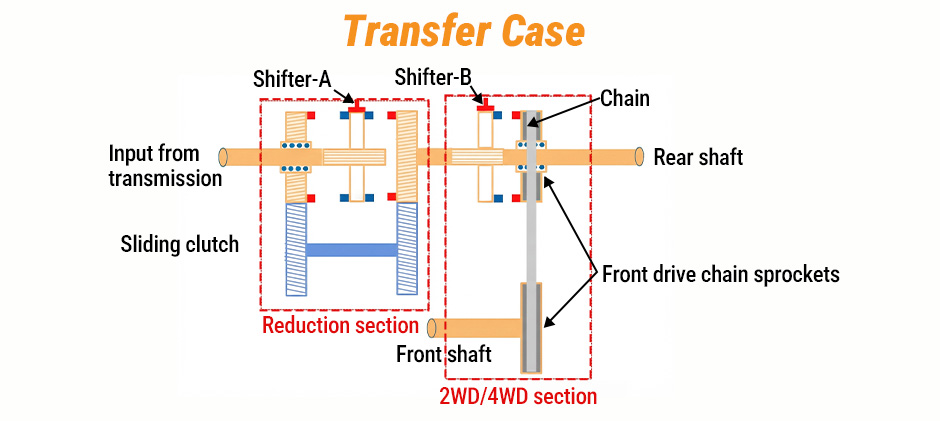
A transfer case is an important mechanical part of four-wheel-drive vehicles that receives power from the vehicle’s transmission and sends it to the front and rear axles. The input shaft of the transfer case is connected to the output shaft of the transmission, while in some vehicles it is mounted directly onto the transmission unit. These two critical components work in unison to control the power sent to the differentials, which in turn manage the power sent out to each of the drive wheels. If the transfer case or either differential isn’t working properly, you won’t get proper performance out of your 4WD system.
Some of the transfer cases also have provisions to change the drive mode from 4-wheel drive to 2-wheel drive and vice versa. The transfer cases also have a speed reduction unit that provides two different speed ratios. It can indirectly help to increase traction while moving on slippery roads, such as muddy or icy roads. All transfer cases have the same goal, but variants are ideal for heavy-duty and off-road use. Common types of transfer cases are chain-driven, gear-driven, married, and divorced units.
What Is A Differential?
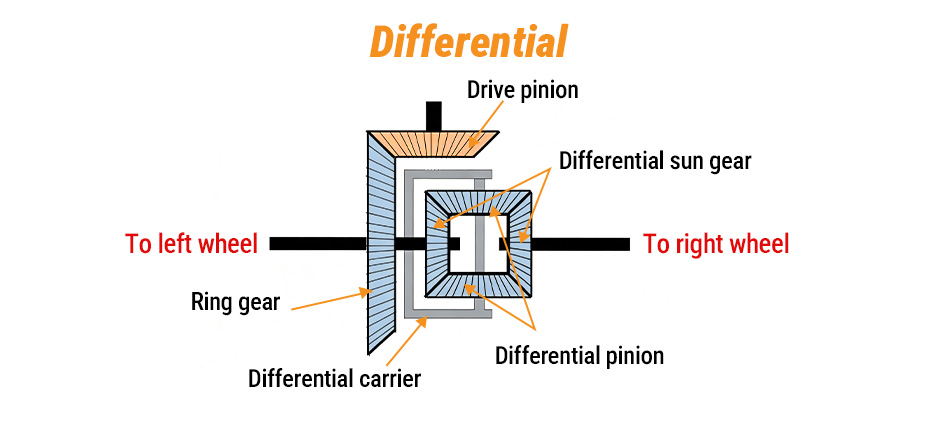
The differential is another complex and vital component in the drivetrain of modern vehicles. It is a case of gears that sit between the front or rear axles of the vehicle. The major function of this case is to precisely control the power from the engine and transmission out to each of the drive wheels. When you drive, the differential provides constant adjustments to manage the speed of each wheel. This is even more important while cornering because one wheel must rotate faster than the other to maintain a consistent velocity.
Generally, you’ll have one or two differentials depending on the drive set-up of your vehicle. A front-wheel-drive vehicle will have a front differential and vice versa. For all-wheel-drive or 4×4 vehicles, you’ll have both front and rear differentials. These components are critical for safety and your vehicle’s longevity.
Key Differences Between Transfer Case vs. Differential?
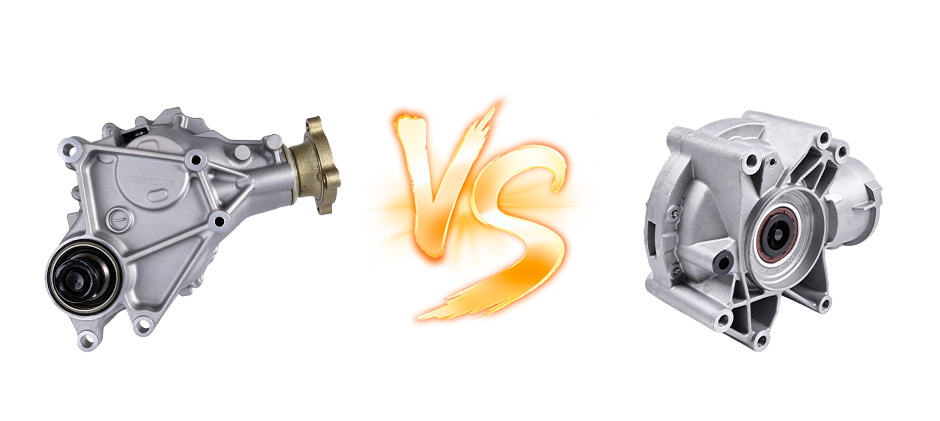
The transfer case and differential are both critical parts in your vehicle. The table below helps you understand the differences and functions of the transfer case and differential.
| No. | Transfer Case | Differential |
|---|---|---|
| 1 | Splits the power from the transmission shaft to the front and rear propeller shaft | Splits the power from the propeller shaft and helps to drive the left and right side wheels at different speeds |
| 2 | Necessary to drive all 4 wheels to increase traction while moving on slippery roads | Allows the left and right wheels to rotate at different speeds while taking a turn or while moving on a bumpy road |
| 3 | Used in only four-wheel-drive/All-wheel drive vehicles | Used in both two-wheel drive and four-wheel drive vehicles |
| 4 | Spur or helical gears | Bevel gears |
| 5 | Connected after the transmission | Connected after the final drive |
| 6 | In the transfer case, the input and output shafts are parallel | In a differential, the input shaft is perpendicular to the output shafts |
| 7 | Some of the transfer cases also have an inbuilt internal differential that helps to drive the front and rear wheels at different speeds | It helps to drive the right and left wheels at different speeds |
| 8 | Requires an oil pump for cooling and lubrication | Doesn’t require an oil pump |
| 9 | Requires manual and automatic control to shift the drive mode from 2WD to 4WD and vice versa | Doesn’t require any manual or automatic control |
Transfer Case and Differential Repair and Maintenance
Like any vehicle parts, the transfer case and differential require regular maintenance. You may find the gear oil gets dirty or corroded, making it necessary to replace the components when necessary. Besides, seals and other key components should be checked periodically and need cleaning or replacing as needed. For major problems with the transfer case or differential, you may need to replace the whole component. It’s wise to turn to a repair store to replace the faulty parts or get your still-working parts cleaned and reinstalled.
FAQs about Transfer Case and Differential
Is it safe to continue driving without a transfer case or a differential?
If you have a 2-wheel drive vehicle, you can drive it without a transfer case. If you don’t have a differential, you can’t drive any vehicle.
What connects the transfer case to the differential?
Generally, the transfer case is connected to the differential unit with a propeller shaft.
Conclusion
Both the transfer case and differential are essential parts to ensure the proper function of your vehicle and your safety on the roads. Over time, your transfer case or differential may develop problems. At FridayParts, you can source a vast lineup of quality transfer cases, differentials and other related replacement parts. Explore now and enjoy your new drive.
See Related
What Is A Differential? Front vs Rear Diff Explained
Is Transfer Case The Same As Transmission? Ultimate Guide 2026
