

When tightening nuts and bolts, using the right tool makes a big difference. The two most common tools are a torque wrench vs ratchet wrench. A ratchet wrench is mainly for speed and convenience. A torque wrench is used when you need accurate tightening.
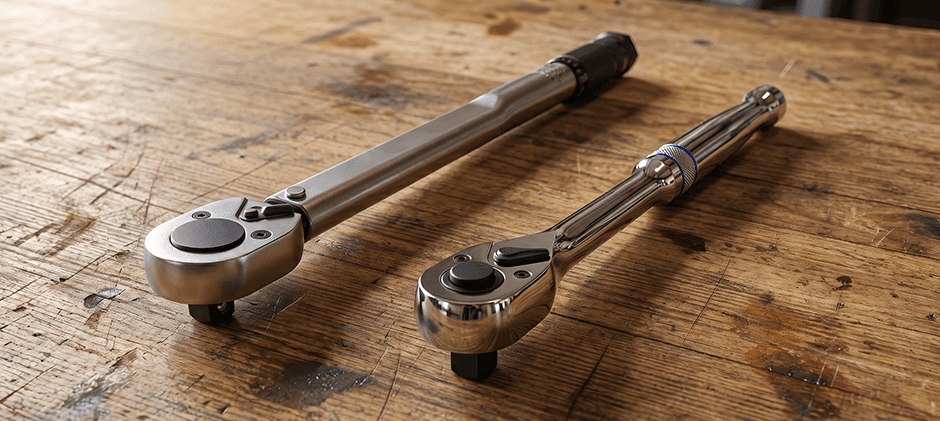
What Is a Torque Wrench?
A torque wrench isn’t just a regular wrench for tightening bolts — it’s a precision tool that’s calibrated accurately. Its main job is to tighten nuts and bolts with a specific, exact amount of twisting force, which we call torque. It’s made to fasten parts to a perfect tightness, no more, no less. You’ll also hear people call it a torque spanner in repair guides.
When you tighten and hit the torque number you set, the tool will let you know right away. There are different types: beam, dial, digital, and the super common click-style wrench. It can alert you with a loud click, a beep, a slight vibration, or just show the number on a screen.
Key Features:
- Lets you easily set exact torque, measured in ft-lb or Nm.
- Gives a clear alert — click, beep or digital readout — once you hit the right torque.
- Built to meet standard accuracy rules like ISO 6789. Most stay accurate within about ±4-6% error.
Why Is this Important for Off-Road Machinery?
Using a torque wrench is a must to avoid over-tightening bolts. If you crank them too hard, you can stretch or snap the bolts, ruin the threads, or damage delicate parts like gaskets and bearings.
More importantly, it helps you get the right clamping force and proper bolt preload. For dozers, excavators and haul trucks, this matters a lot — think engine head bolts, hydraulic pump mounts, final drive parts and track hardware. When you use the correct torque, parts stay secured and work exactly as they should, even under heavy working loads.
What Is a Ratchet Wrench?
A ratchet wrench — most people just call it a ratchet — is made for one thing: working faster and easier.
Inside it has a gear and pawl mechanism. That lets you spin nuts and bolts nonstop in one direction, no need to lift the wrench off the bolt at all. You just rock the handle back and forth, and the socket only catches and turns when you’re tightening or loosening.
The biggest difference from a torque wrench: a ratchet doesn’t measure or limit how hard you crank. It’s only for turning parts quickly.
Key Features:
- A reverse switch lets you instantly flip between tightening and loosening.
- Comes in common drive sizes: ¼″, ⅜″, ½″, and bigger sizes for heavy-duty jobs.
- Fine-tooth ratchets need less room to swing the handle. Perfect for tight, cramped spaces like engine bays and hydraulic compartments on off-road machinery.
When Do We Use a Ratchet?
A ratchet is the tool you’ll use for most everyday work. It’s ideal for quickly taking bolts off and putting them on when you don’t need a precise final torque setting.
You can use it to remove access panels, hand-thread bolts into place before torquing them down, and for regular assembly work. It saves you a ton of time and effort on repetitive bolt jobs.
Torque Wrench vs Regular Ratchet
So these two tools look almost the same and both work with sockets, but they’re totally different in how you use them. Simply put: one is for accuracy, the other for speed.
A standard ratchet can’t measure torque at all. You just tighten bolts until they feel snug by hand — and that feeling’s different for everyone, even depending on how tired you are. For non-important parts like toolbox lids or cab light covers, hand-tight is totally okay.
But if your wheel loader’s service manual says to torque lug nuts to 450 ft-lbs, there’s a serious reason for that. Only a torque wrench can hit that exact tightness. Using a regular ratchet here will only cause trouble.
If the lug nuts are too loose, the wheel will wobble. That wears parts out fast, and in the worst case, the wheel could even come off.
If you tighten them too hard, it puts uneven pressure on the brake parts. Brake rotors can bend, and your brakes will start pulsing. Even worse, you can stretch the wheel studs past their limit, permanently damaging them — and they could break down the line.
This is why pros follow the two-step process:
- Use a ratchet to fasten the lug nuts and get them snug.
- Then switch to a calibrated torque wrench for the final tighten, hitting every nut to the exact torque spec.
Know what a torque wrench shouldn’t be used for.
- Never use a torque wrench to loosen bolts. Breaking loose a stuck bolt takes sudden, sharp force. That can damage the wrench’s internal parts and mess up its calibration. Use a breaker bar or standard ratchet to loosen bolts instead.
- Down to the lowest torque setting before storing (For set click-style models, to keep your torque wrench accurate ). If you leave it on a high setting, the inner spring stays squeezed tight. Over time, the spring weakens and no longer gives correct torque readings.
If a Torque Wrench Is Just an Improved Ratchet, Why Not Use It Always?
It’s a reasonable question. If a torque wrench can tighten bolts and is way more accurate, why not use it for every job? Because torque wrench is first a measuring tool, and only second a regular wrench.
You’d never use a sensitive caliper to hammer a nail, even though both are metal hand tools. You always pick the right tool for the job to keep it working properly. The same rule applies to a torque wrench.
If you use it for everyday loosening and tightening — jobs meant for a ratchet or breaker bar — you’ll wear it out for no reason. Every twist, every click, and especially the sudden force of breaking loose a stuck bolt, slowly ruins its precision internal parts. Pretty soon, it loses its accurate calibration. It makes you think you’ve tightened the bolt to the right torque, but you actually haven’t.
Beyond just calibration, there are also practical reasons to use the right tool:
- Durability: Ratchets are made really tough. You can drop them, toss them in your toolbox, or even use them for light hammering — though it’s not advised. Torque wrenches are much more delicate. You have to handle them carefully to keep them accurate.
- Efficiency: Torque wrenches are usually longer, heavier, and bulkier than regular ratchets. Trying to spin on dozens of bolts quickly in tight spaces with one is slow and awkward. A small, fine‑tooth ratchet works way better and faster for that kind of work.
- Cost: Good quality torque wrenches don’t come cheap. It’s just not smart to wear them out with rough daily use like you would a normal ratchet. Save your precision torque wrench for only what it’s made for: final, exact tightening.
Pros work this way to get the job done fast and make their tools last longer.Use a breaker bar for tough loosening, a ratchet for speed, and a torque wrench for precise tightening — each tool does its own job.
Conclusion
Proper maintenance is super important to make heavy machinery last longer. Choosing and using the right tools is just as critical as picking the right replacement parts.
FridayParts not only have compatible parts for all major brands, but also carry a full range of wrenches — including oil filter wrenches, torque wrenches, spanner wrenches and many more.
