

Transmission internals have many different parts. We’ll explain the parts of a transmission in a simple and general way. With the diagram, you may need to imagine how everything works together.
What Is a Transmission?
The transmission is a crucial link between the engine and the wheels or tracks. It converts the high-speed, low-torque engine output into low-speed, high-torque power. This achieves the action of pushing, lifting or digging.
Without a transmission, the engine cannot drive the machine or adapt to changing loads. The transmission controls the gear ratio to maximize the engine’s power output. It is the part that converts power into actual performance.
Transmission Parts Diagram
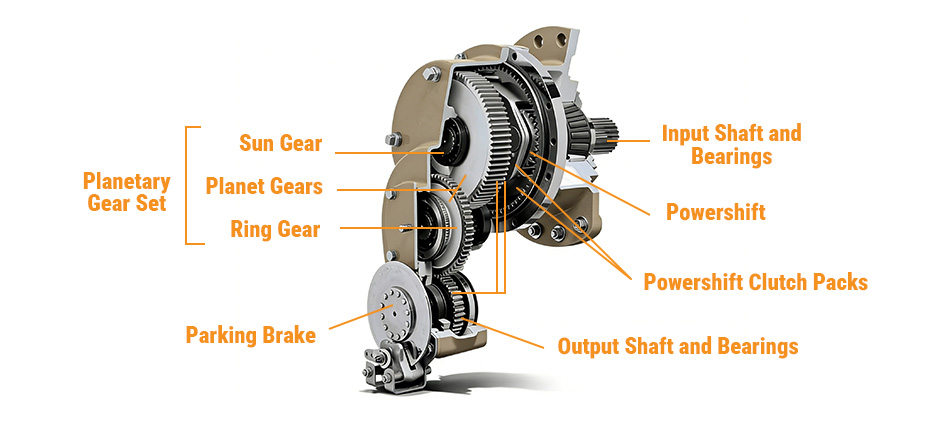
The heavy equipment relies on the powershift transmission. This design handles massive torque and allows for shifting gears under full load, something that would destroy a standard car transmission.
Let’s move past the casing and explore the core transmission internals. A powershift transmission isn’t just one part; it’s a team of components working under immense pressure.
Input Shaft
Power enters the transmission here. The input shaft is the first mechanical component that receives power inside the transmission. It is directly connected to the turbine in the torque converter, so they rotate together. Its job is simple: it takes power from the engine and passes it to the gear sets, where the transmission increases and distributes the power. Because the input shaft carries the engine’s direct power, it is usually made from strong, hardened steel for durability.
Clutch Packs (Friction & Steel Plates)
This is a key part of a powershift transmission and the reason it can shift gears under load. A clutch pack is not a single part. It is a stack of friction plates and steel plates arranged alternately inside a clutch drum.
- Friction Plates: These plates have inner splines that connect to the hub or shaft. Their surfaces are covered with special friction material that can keep good grip even under pressure and high temperatures.
- Steel Plates: The steel plate is a flat steel disc with splines on the outside that connects to the inner wall of the clutch drum.
When the clutch pack is not engaged, the plates can rotate independently. So different parts can spin at different speeds.
When applying hydraulic pressure, the plates are pressed tightly together. The hub and the clutch drum lock so they rotate as one unit.
In a powershift transmission, each gear is controlled by a specific clutch pack. If you change the gear, the transmission just engages the corresponding clutch pack.
Clutch Piston & Housing
So, where does the pressure on the clutch plate pack come from? This is what the clutch piston and housing do. Each clutch pack sits inside a drum-shaped housing. Inside, has a large ring-shaped piston.
When changing the gear, hydraulic oil flows into the clutch housing through oil passages in the shaft. The oil is in the space behind the piston. High-pressure hydraulic oil pushes the piston forward and squeezes the friction plates and steel plates together.
Good hydraulic control makes shifts smooth and quick. Piston seals wear out, oil can leak, and pressure drops. The clutch slips and may lead to clutch failure.
Planetary Gear Sets
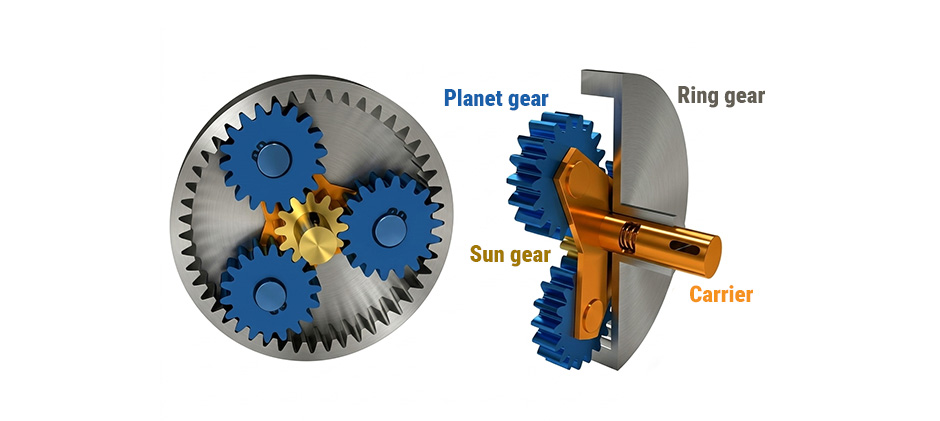
A transmission can give you different gear ratios in a small space mainly thanks to the planetary gear set. It’s a clever little setup that helps multiply power. It has three main parts:
- Sun Gear – the gear in the middle.
- Planet Gears & Carrier – small gears that spin around the sun gear, held by a carrier.
- Ring Gear – a big outer gear with teeth on the inside that connect to the planet gears.
The cool thing about a planetary gear set is how flexible it is. By using clutch packs to lock one part and power another, you can get different gear ratios or even reverse.
- Lock the ring gear and turn the sun gear, and the carrier spins slower – this gives you a lower gear.
- Lock two parts together, and everything spins as one – that’s a 1:1 direct drive.
This trick lets powershift transmissions be strong but still compact.
Output Shaft
After the gear sets multiply the power, it needs to go out to the rest of the drivetrain. The output shaft is the last part in the power flow inside the transmission. It takes the final rotational force from the gear set that’s engaged and sends it out the back of the transmission housing, where it connects to the driveshaft, differential, or final drives that ultimately turn the wheels or tracks.
Bearings & Bushings
The unsung heroes of any transmission are the bearings and bushings. These important parts are everywhere—supporting every shaft, gear, and carrier. In a heavy equipment transmission, they aren’t just simple ball bearings. They are often heavy-duty tapered roller bearings or needle bearings, built to handle huge radial (up-and-down) and axial (thrust) loads.
They keep all transmission parts running smoothly with very little friction and stay properly aligned. If one bearing fails, the shaft will wobble and the gears won’t mesh correctly.
Countershafts & Gears (in Countershaft-type Transmissions)
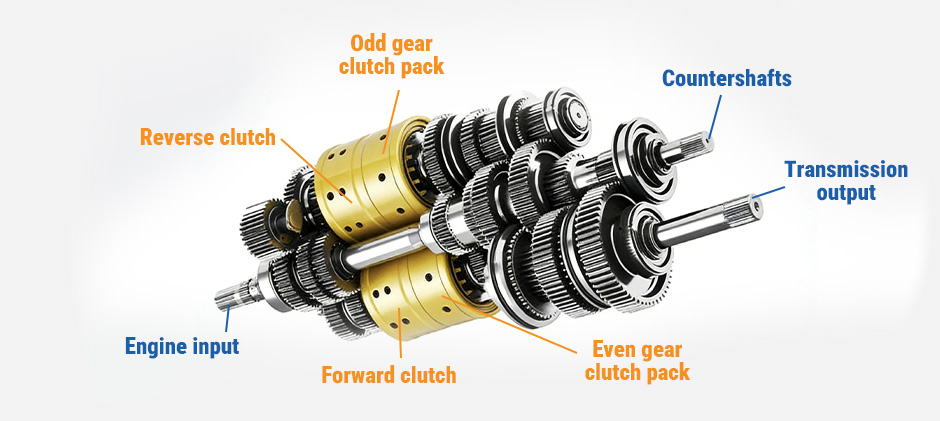
While planetary gear sets are common, there’s another strong design called the countershaft powershift transmission. If you looked at a parts diagram of this type, it would kind of look like a heavy-duty manual gearbox.
It has a main shaft and one or more parallel countershafts. All the gears are always meshed—they’re always touching and spinning. The gears spin freely on the shafts until a clutch pack is used. When a clutch pack is engaged, it locks a gear to the shaft, making that gear transmit power. This setup is very durable and is used in many dozers, loaders, and haul trucks.
Signs of Transmission Problems
What are some common transmission problems? What symptoms might they cause? Knowing the specific components will help you better understand the reasons behind these symptoms.
- Delayed or rough shifting: If the machine hesitates or jerks when shifting between forward, reverse or gears, you may have low hydraulic pressure, worn clutch plates, or a faulty control valve.
- Slipping transmission: The engine revs up, but the machine doesn’t speed up or have normal power. This usually means worn clutch plates.
- Overheating: If the transmission temperature stays in the red, it’s a serious warning. Causes include low fluid, a clogged cooler, or internal slipping. These damage seals and clutches quickly.
- Unusual noises: Grinding, whining or loud banging when operating or shifting usually means bad bearings, damaged gear teeth, or other serious internal problems.
- Leaks: Red or amber fluid under the machine means a leaking seal or gasket. Low fluid causes overheating and internal damage fast.
- Lack of power: If the machine feels weak and struggles with work it used to do easily, and the engine is fine, the problem is probably the transmission or torque converter not transferring power properly.
Transmission Maintenance Tips
Such a complex internal structure indicates that repairing a damaged transmission is not easy. we can do is keep up with regular maintenance and prevent problems before they happen.
- Follow fluid and filter schedules: Clean fluid keeps parts lubricated, cools the system, and gives the hydraulic pressure needed for shifting. Old or dirty fluid can’t do this.
- Watch temperatures: Keep an eye on the transmission temperature gauge while using the machine. If it runs hot, find the cause before it causes damage.
- Check fluid levels often: A quick check can stop a big failure. Make sure the fluid is at the right level and doesn’t look or smell burnt.
- Fix leaks right away: A small leak is cheap to fix. Low fluid causing a transmission failure is expensive.
- Operate properly: Abruptly shifting from forward to reverse at high speed puts huge stress on the transmission. Proper training can help parts last much longer.
