

If your Kubota zero-turn mower won’t drive or isn’t pulling as it should, the drive btelt could be the problem. A worn or broken belt can keep your mower from moving. This guide offers the specific Kubota drive belt diagram for popular models, and easy step-by-step instructions to replace the belt yourself.
Kubota Z421 Drive Belt Diagram (Z400 Series)
The drive belt (also known as the hydrostatic or HST belt). This belt’s sole job is to transfer power from the engine’s clutch pulley to the two hydrostatic transmission pulleys, which drive the rear wheels and allow the mower to move.
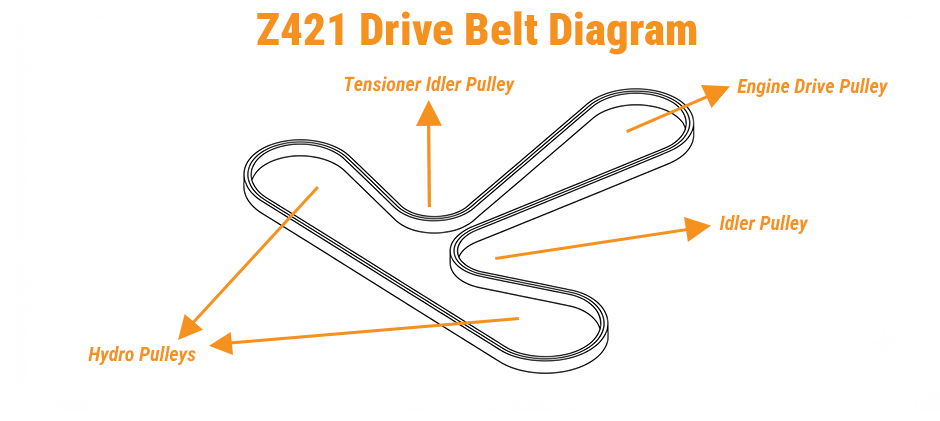
- Engine Clutch Pulley: This pulley connects to the engine’s output shaft and clutch assembly. When the clutch is engaged, this pulley turns the drive belt, providing power to the entire drive system.
- Hydrostatic Transmission Pulleys: The diagram shows two of these pulleys. Each one is connected to an independent hydrostatic transmission that powers a rear wheel. The belt must wrap correctly around both pulleys to drive the mower forward, in reverse, and to execute zero-turns.
- Tensioner Idler Pulley: This pulley is mounted on a pivoting, spring-loaded arm. The spring pulls on the arm, applying constant tension to the belt. This prevents slippage during operation and ensures efficient power transfer.
- Idler Pulley: This pulley does not pivot; its only purpose is to guide the belt along the correct path for smooth operation and to maintain proper alignment between the other pulleys.
The drive system on the Z421 works in conjunction with an electric clutch and a heavy-duty tensioner to provide reliable power to the wheels. When the drive belt on this machine fails, it’s typically due to age, wear, or a problem with one of the pulleys in the system (such as a failed bearing). Proper maintenance of this system is critical for the mower’s mobility.
Kubota Z121s, Z122r, Z125s, Z231 Drive Belt Diagram (Z100 & Z200 Series)
The Kubota Z100 and Z200 series mowers, such as the Z121s, Z122r, Z125s, and Z231, feature a more straightforward drive belt system. While simpler, the components serve the same crucial function.
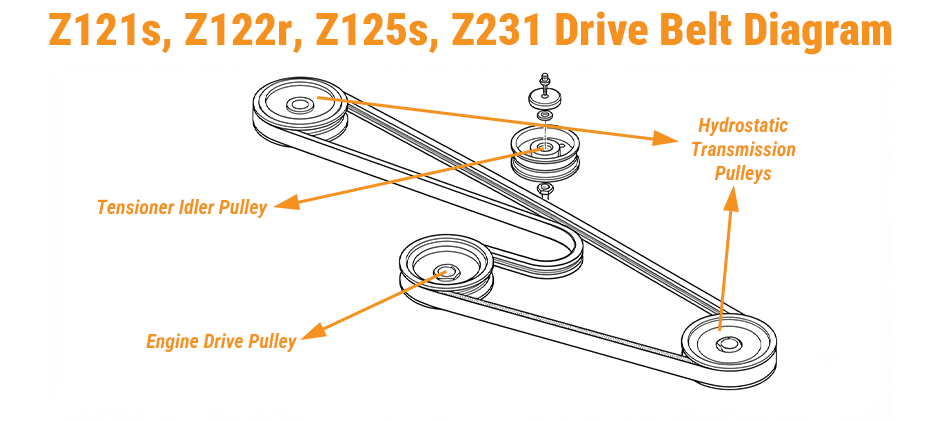
This diagram shows a cleaner, more direct belt path. The principles, however, remain the same.
- Engine Drive Pulley (Top): This pulley is connected to the engine’s crankshaft and is the source of power for the drive system.
- Hydrostatic Transmission Pulleys (Bottom Left & Right): The belt drives these two pulleys, which in turn power the left and right wheels independently.
- Tensioner Idler Pulley: This pulley is mounted on a pivoting arm that is pulled by a spring. It applies constant pressure to the belt to keep it tight.
The clear difference between this system and the Z400 series is the tensioner design. Here, a single spring-loaded idler pulley provides tension, whereas the Z421 uses a more complex arm assembly. This difference is a primary reason why the drive belts are not interchangeable between series. Using the wrong belt will lead to poor performance and rapid failure.
How to Replace Your Kubota Drive Belt?
Changing the drive belt on your Kubota zero-turn mower isn’t hard — all you need are basic tools and a little patience. This job also lets you fully check over your whole drive system.
Safety First
Park the mower on flat ground. Shut off the engine, take out the key, and disconnect the negative battery cable to stop accidental startup.
If you lift the mower, use a proper jack and lock it with jack stands. Never get under the mower if it’s only held up by a jack.
Step 1: Make Room to Access the Belt
You’ll need to take off side panels or fenders to reach the drive belt. Most Kubota models use 10mm and 14mm bolts to hold these parts on. You might also remove the floor pan so you can work easily from above and under the frame.
Step 2: Release Belt Tension
You can’t take the belt off while it’s tight.
- Remove the deck belt from the electric PTO clutch. Find the tension spring for the deck belt and unhook it to loosen the belt.
- Remove the PTO clutch: unplug its wiring connector, then take out the main bolt securing the clutch to the engine crankshaft. Slide the clutch off carefully — it’s heavy.
- Find the drive belt tensioner. It’s an arm with a pulley pulled tight by a heavy spring. Use a long breaker bar or wrench on the tensioner arm to push against spring pressure. This loosens the drive belt.
Step 3: Take Off the Old Belt & Do Inspections
Once tension is loose, work the old belt off all pulleys. Don’t fit the new belt right away — use this chance to inspect parts. Wipe or brush rubber buildup and dirt out of every pulley groove.
Spin each idler and tensioner pulley by hand. They should turn smoothly with no noise. If you feel grinding, stiffness or wobble, the bearing is worn out and you need a new pulley. A stuck pulley will destroy your new belt quickly.
Step 4: Fit the New Belt
- Follow photos and Kubota’s drive belt routing diagram to install the new belt.
- Thread the belt up from below, and loop it around the two hydro transmission pulleys first.
- From above, route the belt around the idler pulleys and tensioner pulley following the correct path.
- Use your breaker bar to move the tensioner arm once more, then slide the belt onto the engine crank pulley.
- Let the tensioner back slowly, and confirm the belt sits fully inside every pulley groove.
Step 5: Put Everything Back & Test
Mount the PTO clutch back on and plug its wiring in. Refit the deck belt and reattach its tension spring. Install all floor pans and fenders, then reconnect the battery.
Double-check no tools are left inside the machine. Start the mower and listen for strange sounds. Test forward and reverse pedals to confirm the belt works properly.
Final Words
You can replace your Kubota drive belt yourself. Just follow the belt diagram and take it slow. The two most important things are using the correct belt for your exact mower model and making sure all your pulleys spin smoothly with no issues. You can easily find matching aftermarket parts for your Kubota mower at FridyParts.
FAQs about Kubota Drive Belts
My mower moves slowly, feels weak, or won’t move at all. Is the drive belt the problem?
More than likely yes. A slipping or worn drive belt is the most common reason for this issue. If you push the forward/reverse pedals and your engine revs up, but the mower barely moves or doesn’t move at all — check the drive belt first.
Low hydraulic fluid or a bad transmission can cause similar problems, but the belt is far more likely to fail and the easiest part to check.
How do I find the exact part number for my drive belt?
Use these 3 simple, reliable ways:
- Check your owner’s manual — it lists all common replacement part numbers.
- Look up official parts diagrams online — go to a Kubota parts site, enter your exact model (like Z421KW), and open the Transmission diagram. The belt’s part number will be shown there.
- Check your old belt — sometimes the part number is printed on it, though it’s often worn off and unreadable.
Are Z421 and Z125s drive belts interchangeable?
No, they are not interchangeable at all.
These two mowers have totally different drive systems. The belts have different lengths, widths, and tensioner setups. The Z421 uses an electric clutch system, while the Z125s has a simpler mechanical setup. Always use the belt made for your exact model — wrong belts won’t work right and will cause damage.
