

Looking at used backhoes, or trying to figure out what size machine your work actually needs? This John Deere backhoe size chart puts every model side by side — 1990s 310C through the new 710 P-Tier — with horsepower, operating weight, dig depth, and transport dimensions. You’ll also find the things spec sheets don’t bother with: why one machine shows two different weights online, what changed from the L-Series to the P-Tier, and how to plan your trailer and licensing without guessing.
How John Deere Classifies Its Backhoe Lineup
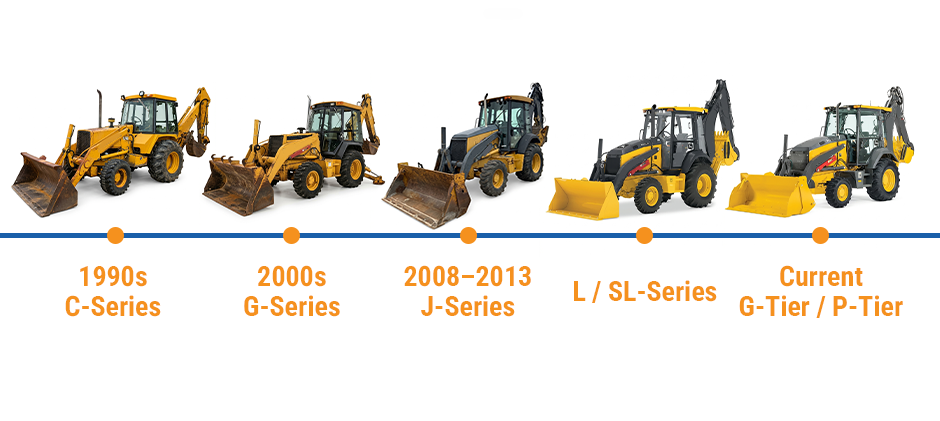
Deere divides its backhoe loaders into size classes by model number, and generations by series letter. The 310, 320, 410, and 710 are four separate size classes. The letters — C, G, J, L, SL, G-Tier, P-Tier — tell you which generation or configuration you’re looking at.
- 310: compact production class, roughly 14 ft dig depth
- 320: mid-size with upgraded hydraulics
- 410: full-size production machine
- 710: largest class, 17 ft class dig depth, used for pipeline and utility work
G-Tier is the current value line. P-Tier models add performance and operator features, but the engine, hydraulics, and telematics differ from model to model.
The 310 P-Tier runs an open-center hydraulic system, the simpler and less expensive setup. The 410 P-Tier uses a PowerTech EWL engine with a simplified emissions package that drops the diesel particulate filter (DPF) entirely. The 710 P-Tier runs a load-sensing axial piston pump. So don’t assume every P-Tier machine shares the same package. Check the individual spec sheet.
Why the Same Model Shows Different Weights
If you’ve compared listings online, you’ve probably noticed published weights for one model can swing by 500 to 1,500 lb. The reasons are usually mundane:
- Cab vs canopy adds roughly 300 lb
- Counterweight packages change based on loader setup
- An extendable dipperstick adds weight at the rear
- Tire choice swings the number, whether that’s R1 ag, R4 industrial, or foam-filled
- Spec sheets get revised as options change
Deere publishes machine weights in a few different places, and these don’t always agree, because each one weighs a different reference configuration. Before you spec a trailer or order matched replacement hydraulic components, confirm the number against your exact build sheet.
Current John Deere Backhoe Loaders Spec Chart
The current lineup has five core models: one G-Tier machine and four P-Tier models. The John Deere backhoe size chart below gives you the core numbers to check before buying, trading, or ordering fresh parts. The 320 P-Tier also comes in a Heavy-Lift (HL) configuration for jobs that need extra dig depth and loader performance.
The table below gives you the core numbers to check before buying, trading, or ordering fresh parts.
Table A: Core Specifications
| Model | Net HP | Op. Weight | Std. Dig Depth | E-Stick Depth | Loader Lift at Full Height | Bucket Breakout |
|---|---|---|---|---|---|---|
| 310 G-Tier | 69 hp | 13,907 lb | 13′ 8″ | 17′ 4″* | 6,610 lb | 9,564 lbf |
| 310 P-Tier | 100 hp | 16,217 lb | 13′ 8″ | 17′ 10″ | 6,602 lb | 9,512 lbf |
| 320 P-Tier | 113 hp | 17,081 lb | 14′ 3″ | 18′ 2″* | 7,390 lb | 10,541 lbf |
| 320 P-Tier HL | 113 hp | 17,383 lb | 15′ 1″ | 18′ 2″* | 7,244 lb | 10,598 lbf |
| 410 P-Tier | 116 hp | 18,651 lb | 15′ 11″ | 19′ 8″* | 6,967 lb | 10,361 lbf |
| 710 P-Tier | 148 hp | 26,422 lb | 17′ 3″ | 21′ 9″ | 9,866 lb | 16,539 lbf |
A few things worth knowing before you read too much into these numbers. The operating weights above reflect the Operating Weight value currently published on each model’s product page. Spec PDFs for individual configurations may list different numbers for the same machine.
*E-Stick dig depth varies with measurement reference. Confirm against the current spec PDF for your serial number before quoting a job.
Loader lift at full height. Bucket breakout force. Both are reference numbers. Both change with the bucket. The 410 P-Tier: roughly 6,144 to 7,211 lb, depending on bucket type and size. The 710 P-Tier: about 8,998 to 9,866 lb. When you’re matching a machine to a specific loading task, pull the loader section of the spec sheet.
Quick notes on who each one fits:
- 310 G-Tier: lowest buy-in, best for small contractors, farms, and municipalities running under 500 hours a year.
- 310 P-Tier: the daily driver for utility crews and site prep work in tight residential lots.
- 320 P-Tier: step up when you need faster cycles and heavier loader work.
- 320 P-Tier HL: the Heavy-Lift option, worth the extra cost if you load trucks all day.
- 410 P-Tier: full-size production machine for road, trenching, and pipeline crews.
- 710 P-Tier: the right call when a mid-size excavator plus wheel loader combo is too much.
Table B: Transport Dimensions
Most owners get burned by trailer rules, not by spec sheets. Here are the published dimensions from each model’s spec sheet. Use this section of the John Deere backhoe size chart to plan your trailer and transport.
One caution on the height column: it’s the height to the top of the ROPS (the rollover protection structure over the seat) or cab, not an all-in transport height.
| Model | Length | Width | Height to Top of ROPS/Cab | Wheelbase |
|---|---|---|---|---|
| 310 G-Tier | 23′ 9″ | 7′ 3″ | 9′ 3″ | 7′ 1″ |
| 310 P-Tier | 23′ 10″ | 7′ 3″ | 9′ 4″ | 7′ 2″ |
| 410 P-Tier | 24′ 5″ | 7′ 8″ | 9′ 5″ | 7′ 2″ |
| 710 P-Tier | 27′ 0″ | 7′ 9″ | 9′ 9″ | 8′ 4″ |
The 320 P-Tier and 320 P-Tier HL aren’t listed because their published dimensions depend on tire size, dipperstick choice, and cab option. Pull the current spec sheet for those two.
Real transport height gets measured on the loaded truck, in transport position with extensions and tie-downs in place, from the ground to the highest point of the combination. Measure it before you plan routes around bridges, overpasses, overhead lines, and loading docks.
Weight ratings matter just as much. The paperwork side of hauling starts with three figures. GCWR on the tow vehicle—gross combination weight rating, the ceiling on truck, trailer, and load together. GVWR on the trailer, or gross vehicle weight rating. And the weight of the whole combination as it will actually sit on the road. All three need to be known, not estimated.
On licensing, the federal FMCSA threshold has two parts: a Class A CDL (commercial driver’s license) is generally required once the combination’s GCWR is 26,001 lb or more and the towed vehicle’s GVWR is above 10,000 lb. That is the federal baseline only; state rules and exemptions can change the answer, so check them before you haul.
Legacy L-Series, SL-Series, and Earlier Models
Used Deere backhoes still make up most of the fleet on small job sites. These are the retired production models you’ll run into on auction sites and dealer lots. The John Deere backhoe size chart below covers these legacy models as well.
Table C: Legacy Backhoe Specs
| Model | Net HP | Std. Dig Depth | Op. Weight | Bucket Width |
|---|---|---|---|---|
| 310L EP | 69 hp | 13′ 8″ | 13,822 lb | 12 to 30 in |
| 310L | 100 hp | 14′ 1″ | 14,669 lb | 12 to 30 in |
| 310SL | 103 hp | 14′ 3″ | 15,872 lb | 12 to 30 in |
| 310SL HL | 113 hp | 15′ 1″ | 16,571 lb | 12 to 24 in |
| 315SL | 103 hp | 13′ 5″ | 17,554 lb | 12 to 30 in |
| 410L | 116 hp | 15′ 11″ | 17,786 lb | 12 to 30 in |
| 710L | 148 hp | 17′ 3″ | 25,588 lb | 24 to 36 in |
Source: Reference figures from published Deere specifications. Actual weights vary with cab, counterweight, dipperstick, tire, and attachment configurations.
For anything older than the L-Series, don’t get hung up on exact numbers — think in rough classes instead:
- C-Series, 1990s: around 13,000 to 16,500 lb, 14 ft class dig depth, mechanical controls.
- G-Series, 2000s: 14,000 to 17,500 lb, early electronic controls, Tier 2 engines.
- J-Series, 2008 to 2013: 14,500 to 17,500 lb, Tier 3, improved cab.
- 710D, 710G, 710J: 23,000 to 25,000 lb, 16 ft to 17 ft class dig depth.
If you’re ordering parts for a used machine, the PIN is where you start. The Product Identification Number does what a VIN does for a car, and the plate’s location changes depending on model and year. On Deere’s 17-character PINs, the first characters identify the manufacturer and machine model. The rest cover production year, engine emissions configuration, and serial sequence. Use the whole PIN when you’re checking parts compatibility — not just part of it.
One more thing: don’t assume parts carry over between generations. L-Series and P-Tier compatibility depends on the exact component, model, and serial number in question. Some buckets, pins, bushings, and service parts share designs. Hydraulic, electrical, and emissions parts can be completely different. Before you order injectors, fuel pumps, or sensor assemblies, verify the full part number against the PIN.
Backhoe Attachments for Compact Tractors
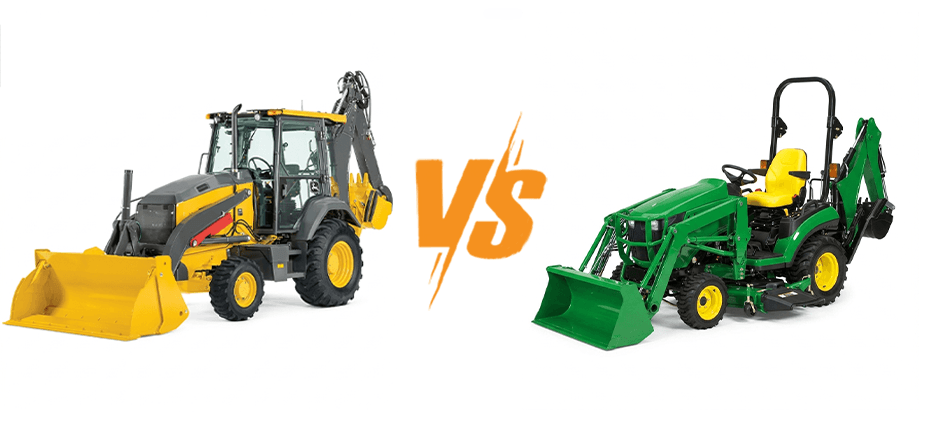
A compact tractor backhoe is not a backhoe loader — full stop. It bolts to the back of a utility tractor, shares the tractor’s hydraulics, and unbolts again when you need your three-point hitch back.
So the weights, dig forces, and lift numbers don’t match up with the 310 through 710 lineup. Don’t mix the two categories on your spec sheet.
Table D: John Deere Tractor Backhoe Attachments
| Attachment | Dig Depth | Bucket Widths |
|---|---|---|
| BH160 | 6′ 2″ | 8, 12, 16 in |
| BH270 | 6′ 10″ | 9, 12, 16, 18 in |
| 270B | 7′ 0″ | 8, 12, 16 in |
| 375A | 7′ 10″ | 9, 12, 16, 18, 20, 24 in |
| 385A | 8′ 7″ | 9, 12, 16, 18, 20, 24 in |
| 485A | 8′ 6″ | 9, 12, 16, 18, 20, 24 in |
These model numbers span multiple product generations, and availability varies — confirm current status with your Deere dealer before ordering.
With attachments, fit matters more than dig depth. Verify before buying used. The specific tractor model. Model year. Required subframe or mounting kit. Hydraulic coupler setup. Do not assume an attachment fits every tractor in a Family.
Pin diameters. Bushings. Bucket interfaces. These can differ between attachment generations. Check each wear part by its own number.
How to Choose the Right Size?
Rule of thumb: the smallest machine that still clears your deepest trench and heaviest lift. Oversizing costs fuel. Tires. Transport. Undersizing kills cycle time. It beats up the hydraulics.
Start with dig depth, matched to the job:
- Water and gas service lines: 4 to 6 ft — within a 310-class machine’s working range
- Sewer tie-ins and footings: 10 to 14 ft — a 310 or 320 class works
- Deep utility and storm drain: 15 to 18 ft — compare the 410 P-Tier with extendable-dipperstick options on smaller models
- Beyond 18 ft of reach: a 410 or 710 with an E-Stick, depending on required digging force, machine stability, and jobsite conditions
Then sort out trailer and licensing. Check the tow vehicle’s GCWR, the trailer’s GVWR and payload, axle and tire ratings, and full combination weight with attachments. Remember: the 26,001 lb federal threshold applies to the whole combination, not just the backhoe.
Loader lift at full height is only part of the picture. A full pallet of sod runs close to 3,000 lb. A cubic yard of wet gravel might weigh around 2,800 lb depending on moisture and material. Before handling material at full height, check rated capacity for your attachment, load center, and lift position. Material density and machine stability can shift the safe working load.
Tires deserve a thought too. R4 industrial tires are common on construction machines; R1 agricultural tires suit softer ground and farm work. Check tire size and machine configuration before swapping types.
While you’re at it, inspect hydraulic hoses, quick couplers, and fittings regularly for leaks and abrasion. When downtime costs you money, keep compatible spares on the shelf.
Bucket width quick guide:
- 12 in: irrigation, electrical, narrow trench
- 16 to 18 in: water service, drain tile
- 24 in: general dig, footings
- 30 in: backfill, loose material
- 36 in: cleanup and loading, commonly used on larger backhoes such as the 710
One last comparison: used L-Series vs. new P-Tier. An L-Series with clean hydraulics can still pay its way on lighter work. Moving up to a new P-Tier buys you current emissions compliance, updated hydraulic architecture on select models, and factory telematics. The gap really only bites when your contracts carry emissions requirements, or when you need uptime guarantees that call for current parts and service support. Either way, fresh engine filters, cooling parts, and DEF system components are what keep the aftertreatment clean and the machine on the job.
Whichever way you go, use this John Deere backhoe size chart as a starting point — then pull the exact spec PDF for the serial number you’re quoting.
Final Words
Smaller than needed costs cycle time. Buying bigger than you need costs you fuel, tires, and transport headaches. Lock your specs to the real workload, double-check trailer ratings against the full combination weight, and order parts by PIN instead of guessing from the model badge. For replacement filters, hydraulic parts, undercarriage wear items, and emissions components across the 310, 320, 410, and 710 families, FridayParts has aftermarket fitment at prices that keep older L-Series machines — and current P-Tier ones — earning on the job.
