

A loader hydraulic pump replacement should match more than the bolt pattern. To keep lift speed, bucket response, and system force close to normal, compare flow, displacement, pressure rating, operating RPM, pump type, control style, rotation, shaft, mount, and port details before buying. Skip that check, and a pump can fit the machine but still run slow, hot, noisy, or weak. The key difference is simple: physical fit gets the pump on the loader, but hydraulic fit keeps the loader working. A short spec check before installation can prevent most fit and performance problems.
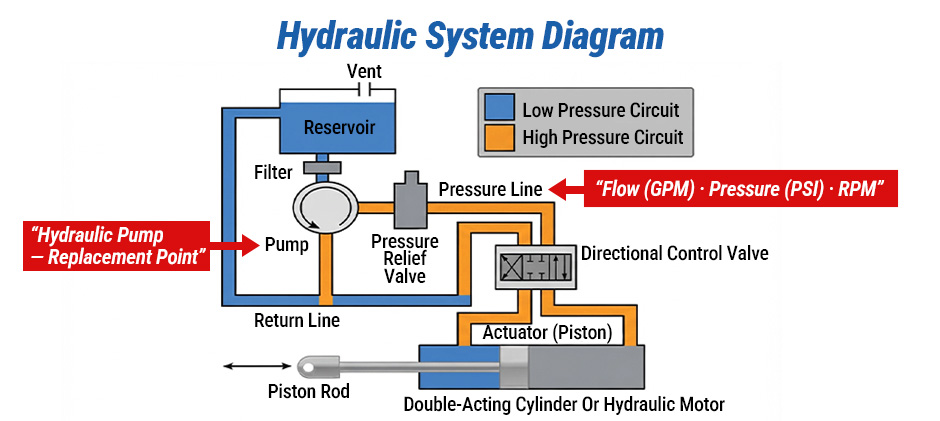
What Specs Should You Compare?
For loader work, the first question is not “Will it bolt on?” It is “Will it deliver the same oil flow and survive the same load?” That is the center of a smart hydraulic pump replacement.
The most important point is this:
- Flow controls speed
- Pressure supports force
If flow is too low, the boom lift and bucket curl slow down. If pressure capacity is too low, the loader may lose lifting force, or the pump may wear out early under normal work.
Start by comparing these six specs:
| Specification | What To Compare | Why It Matters On A Loader |
|---|---|---|
| Flow rate | GPM or LPM at a stated RPM | Sets lift and tilt speed |
| Displacement | cc/rev or in³/rev | Sets oil volume moved per shaft turn |
| Continuous pressure | Normal duty PSI rating | Supports regular digging and lifting |
| Maximum pressure | Peak pressure rating | Handles relief events and short spikes |
| Operating RPM | Real pump input speed | Changes the actual flow output |
| Pump type | Gear, vane, piston, fixed or variable | Must suit the circuit design |
This is why hydraulic pump replacement should never be based on outside dimensions alone. A pump can look right and still send the wrong flow through the loader valve.
That also affects related loader parts such as hydraulic hoses, quick couplers, pressure gauges, and hydraulic filters. If the pump output does not match the circuit, those parts will see the results right away.
How Do Flow and RPM Affect Performance?
Many pump mistakes happen because one number is matched while the others are ignored. On loader systems, flow, displacement, and RPM work as a set.
Flow Rate
Flow is usually listed in GPM. It tells you how much oil reaches the cylinders over time.
- Low flow makes lift and curl functions slow
- High flow can increase system heat and load on valves, hoses, and the engine
- Compare flow at the same RPM and pressure conditions, not just the largest advertised number
For example, 12 GPM at 2,000 RPM is not the same thing as 12 GPM at 2,500 RPM if the machine normally drives the pump slower.
Displacement
Displacement is the oil moved per revolution.
- Common units are cc/rev and cubic inches per revolution
- More displacement usually means more flow at the same speed
- The same displacement at a different RPM will produce a different flow
A simple working relationship is:
Flow = displacement × RPM × volumetric efficiency
That is why pump size cannot be judged by appearance. Technical matching matters more than casting shape. This point comes up often in heavy equipment replacement work, whether the search starts with Northern Hydraulics, Panagon Systems, Hydraulic Supply Company, or a brand cross-reference involving Danfoss or Parker.
Operating RPM
Pump catalogs often list output at a certain RPM. The loader does not care what the catalog says at some other speed. It only responds to the speed the machine actually gives the pump.
Check:
- Pump rated RPM
- Maximum allowed RPM
- Actual speed from the engine, PTO, or drive coupling
- Rated flow at that same speed
If this part is ignored, a replacement may look correct on paper but still feel lazy in the field.
A good time to inspect pump couplings, drive shafts, and mounting brackets is during this step, since wear there can change pump speed or create alignment trouble.
What About Pressure and Pump Type?
Once the flow is closed, the next question is pressure and circuit behavior. That is where many general guides stay too shallow. Loader systems need a pump that matches both the pressure demand and the way the hydraulic circuit controls oil.
Pressure Rating
Check two pressure values:
- Continuous pressure
- Maximum or peak pressure
The replacement should safely handle the loader’s main relief setting and normal working load. Many mobile gear and two-stage pumps are commonly seen in the 2,500 to 3,000 PSI range, but the actual target depends on the machine. If the service manual or pump tag says otherwise, that machine-specific figure wins.
A higher pressure rating does not automatically improve performance. The loader’s relief valve and circuit set the actual operating pressure. A pump that advertises a high-pressure number is not an excuse to run the machine above its intended setting.
Pump Type
The replacement also needs to match how the hydraulic system is designed to work. The existing system may use:
- Fixed displacement gear pump
- Variable displacement piston pump
- Vane pump
- Pressure-compensated pump
- Load sensing pump
A fixed gear pump is common on many loaders because it is simple and direct. More advanced systems may use piston pumps with different control methods. Panagon Systems stresses that the replacement must match the existing control strategy, and that is especially true on loaders with higher-performance hydraulic circuits.
Circuit Style
You also need to know whether the machine uses:
- Open center
- Closed center
- Load sensing
- Pressure compensated
This is one of the most overlooked parts of hydraulic pump replacement. If the control style is wrong, the loader may act slowly, be unstable, or be hotter than normal, while also wasting power.
This is also where loader valve assemblies, hydraulic reservoir tanks, and return filters should be checked. A pump does not work alone. The rest of the circuit has to suit it.
Will the Pump Fit?
Hydraulic fit comes first, but physical fit still matters. A loader pump must be installed correctly and sealed correctly.
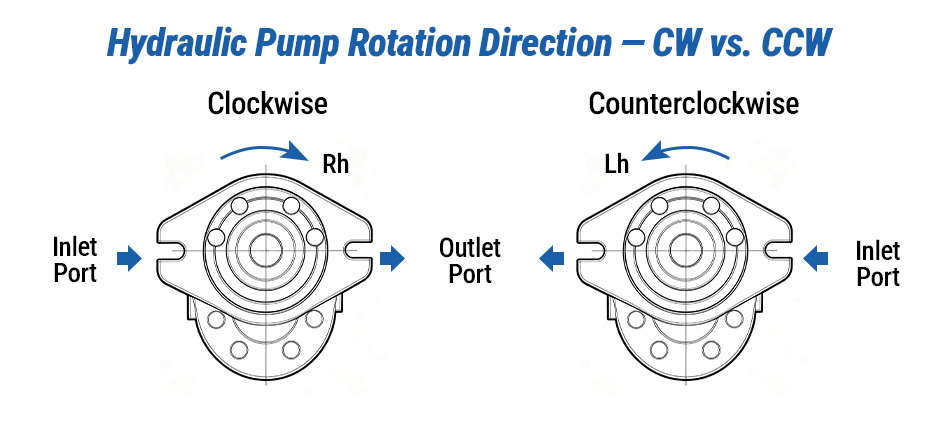
Use this comparison guide:
| Fit Item | What To Check | Why It Matters |
|---|---|---|
| Rotation | CW or CCW from the correct shaft end | Wrong rotation can stop the flow and damage the pump |
| Shaft | Diameter, length, spline, or key | Must match the coupling exactly |
| Mount | Flange style, bolt pattern, pilot diameter | Keeps alignment correct |
| Ports | Inlet and outlet size, type, location | Must match hose routing and sealing style |
| Control housing | Position and clearance | Prevents interference during installation |
Wrong rotation is a major risk. A pump installed with the wrong direction may fail to prime or may be damaged quickly. That warning shows up again and again in replacement guidance across pump suppliers and technical sources.
Port details matter too:
- NPT
- SAE O-ring
- BSP
- ORFS
- Split flange
A pump that bolts on but forces awkward hose routing is not really a match. This is why Parker Hannifin Corporation, Parker Discover, and older Parker replacement searches often require close checking of both hydraulic and physical details. Some heavy equipment pumps also need case-drain attention, which should never be guessed.
What Else Should You Check?
This is where a practical loader guide can do more than generic advice. The pump may be the failed part, but not always the only problem.
Before finishing a hydraulic pump replacement, check these items:
Suction Side
- Suction hose condition
- Clamp tightness
- Reservoir oil level
- Suction strainer cleanliness
- Air leaks at fittings
A weak suction side can cause cavitation, whine, foam, and low output.
Fluid And Filtration
- Correct hydraulic oil type
- Clean fluid
- Fresh hydraulic filters
- Clean reservoir interior
- Clean the filler and breather area
Contaminated oil is one of the most common pump killers. A new pump placed into dirty oil is at risk during the first startup.
Heat And Related Parts
- Oil cooler condition
- Relief valve setting
- Coupling wear
- Valve bypass
- Cylinder leakage
A loader that feels weak may not always have a bad pump. Worn cylinders or valve leakage can mimic pump trouble.
What Happens When A Key Spec Is Wrong?
| Spec Mismatch | Typical Result |
|---|---|
| Flow too low | Loader functions slow down |
| Flow too high | Extra heat and excess load on valves and hoses |
| Pressure rating too low | Early wear or failure under load |
| Wrong control type | Unstable or inefficient hydraulic behavior |
| Wrong rotation | No proper flow or immediate damage risk |
| Wrong shaft or mount | Installation trouble or alignment wear |
| Wrong ports | Hose fit issues and sealing problems |
Final Words
A loader hydraulic pump replacement should match hydraulic performance first and physical fit second. Compare flow, displacement, RPM, pressure, pump type, control style, rotation, shaft, mount, and ports before buying. That approach gives the best chance of keeping lift speed, bucket response, and service life where they should be. When it is time to source dependable replacement loader parts, FridayParts offers affordable aftermarket options, broad compatibility, and a large inventory for many heavy equipment brands.
