

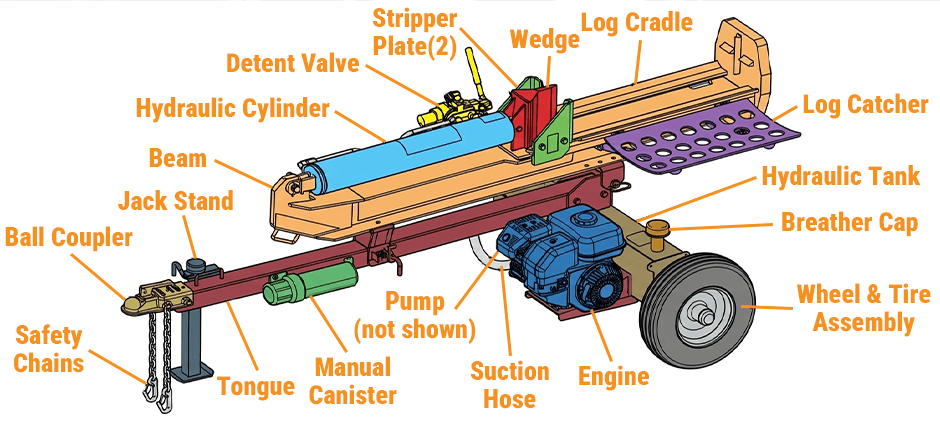
Most log splitters run on AW32, an anti-wear hydraulic fluid for log splitters with a viscosity grade of ISO VG 32. Some makers also approve Dexron III or Mercon ATF. A splitter that runs off a tractor or skid steer uses that machine’s oil instead. Whatever goes in the tank has to protect the pump at pressure and keep the seals tight. Below, we cover which fluids work, how to pick a grade for your climate, how much to buy, and what your oil can tell you about a problem.
Which Fluid Does Your Log Splitter Need?
Start with the manual, or the label on the reservoir. Most brands list one main hydraulic fluid for log splitters and one backup.
AW32 is the standard choice
Most towable splitters run between 2,500 and 3,900 PSI, which puts a heavy load on the gear pump. AW oils carry additives that coat metal parts, and that coating is what protects the pump at those pressures.
AW32 suits most splitters. It flows on cool mornings and still holds up on warm days, and it resists foaming, so the ram moves smoothly. Water that finds its way into the system drops to the bottom of the tank, where you can drain it off. The grade is also easy to buy in 1-gallon jugs and 5-gallon pails.
Some manuals also allow AW46 or AW22. The number is the viscosity: a thicker grade holds up better in heat, and a thinner one flows better in cold.
When ATF Is the Right Choice
Automatic transmission fluid is a common backup. Some brands allow Dexron III or Mercon only below 32°F, because ATF stays thin in the cold. Others list it as a full alternative to AW32 for year-round use.
The difference comes down to the pumps and seals each maker uses, so follow the guidance for your machine. If you don’t know what is in the tank, drain a little into a clear cup. Red fluid is usually ATF; amber or clear gold fluid is usually AW hydraulic oil. Top up with the type that is already in there rather than mixing the two.
Why Motor Oil and Jack Oil Fall Short
Motor oil has detergents that keep water mixed into the oil. Over time, you end up with a milky sludge that wears out the pump. Hydraulic oil works the other way and lets water separate out.
Jack oil is light and only sold in small bottles. It doesn’t have the anti-wear protection a splitter pump needs, and you’d need dozens of bottles to fill one tank.
| Fluid | Good Fit? | Pros | Watch Out For |
|---|---|---|---|
| AW32 | Yes, most models | Strong wear protection, all-season | Can thicken in deep cold |
| AW46 | Yes, if listed | Holds up in heat and heavy use | Slow in cold weather |
| ATF, Dexron III/Mercon | If the manual allows | Flows well in cold | Don’t mix with AW oil |
| Universal tractor fluid | Tractor-driven units | Matches the tractor’s system | Needs the right spec |
| Motor oil | No | Easy to find | Holds water, makes sludge |
| Jack oil | No | Good for small jacks | Too light, too little |
AW32 vs AW46 for Your Climate
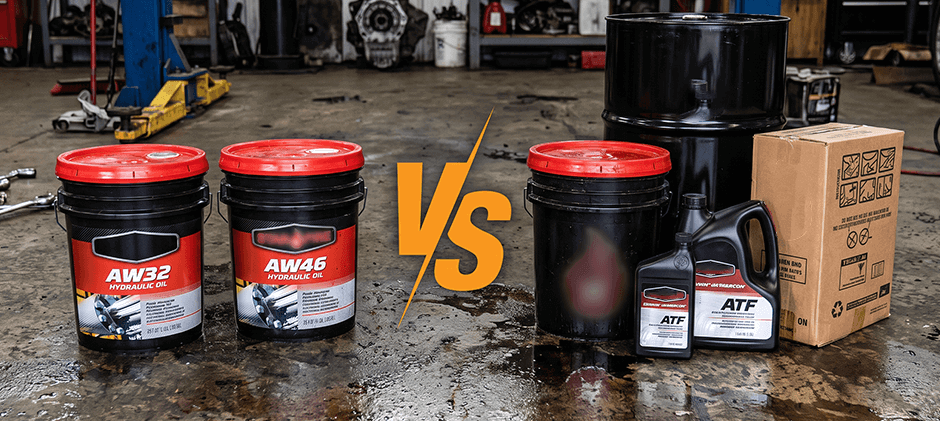
Once you know you need AW oil, the next choice is the grade. The number tells you how thick the oil is, and the right thickness depends on your weather and workload.
What the ISO Number Means
The ISO VG number measures how thick the oil is at 104°F, or 40°C. A higher number means thicker oil.
- ISO 22 is thin and flows fast in cold weather
- ISO 32 is the middle ground for most climates
- ISO 46 is thicker and holds its film in heat
- ISO 68 is mostly for large industrial systems and is rarely needed on a splitter
Matching Grade to Conditions
| Your Conditions | Suggested Grade |
|---|---|
| Winter splitting below freezing | ISO 22, ISO 32, or ATF if approved |
| Mixed seasons, weekend use | ISO 32 |
| Hot summers, long workdays | ISO 46 |
| Commercial firewood production | ISO 46, if the manual allows it |
If you’re stuck between AW32 and AW46, choose AW32 unless you split in steady heat for hours at a time. A thicker oil isn’t automatically better. Thick oil makes the pump work harder at startup.
Cold-Weather Splitting Tips
Cold oil is the most common cause of winter trouble. When thick oil can’t reach the pump fast enough, you may hear whining, see foam, or get weak splits.
- Let the engine idle for 5 to 10 minutes before you split.
- Cycle the ram a few times with no load on the beam.
- Store the splitter in a shed or garage between jobs when you can.
- Consider an HV, or high-viscosity-index, hydraulic oil. It stays more stable across temperature swings.
Tractor and Skid Steer Splitter Fluid
Not every splitter has its own tank and engine. Three-point splitters and skid steer attachment splitters run on the host machine’s hydraulics. For these, the right hydraulic fluid for log splitters is whatever the tractor or loader calls for.
Three-Point Splitters and Tractor Fluid
Most tractors share one oil among the transmission, the rear axle, and the hydraulics. This is usually a universal tractor transmission fluid, often called UTF or UTTO.
Keep these points in mind:
- Never add AW32 to a tractor system that calls for tractor fluid
- If your tractor calls for John Deere Hy-Gard, look for a fluid that lists JDM J20C on the label
- Avoid jugs that only say “303.” That’s an old spec that went out of use decades ago, and nothing certifies against it today
- Check the tractor’s level after you hook up the splitter, because the hoses and hydraulic cylinder take oil away from the tank
Matching Flow and Pressure
An attachment splitter is rated for a range of flow, measured in GPM, and a top pressure, measured in PSI. Your machine has to stay inside both.
- Too much flow heats the oil and strains the control valve
- Too little flow gives you slow cycle times
- Too much pressure can damage the cylinder or blow out the seals
Compare the attachment’s rating to your machine’s auxiliary output before you buy.
Keeping Couplers Clean
The oil from a shared system flows through the splitter and back into the machine. That means dirt picked up on the splitter ends up in your loader’s pump.
- Wipe off both coupler halves before connecting
- Cap the couplers every time you disconnect
- Replace worn hydraulic quick couplers if they drip or won’t lock
Capacity, Change Intervals, and Warning Signs
Now that you know which oil to buy, the next questions are how much you need and how often to change it. Good oil care also helps you catch problems early.
Typical Tank Capacity
Capacity varies a lot, even between models with the same tonnage.
| Splitter Type | Common Range |
|---|---|
| Small electric, 5 to 7 ton | About 1 gallon or less |
| Towable gas, 20 to 25 ton | About 2 to 5 gallons |
| Large towable, 30 ton and up | About 5 to 7 gallons or more |
| Three-point or attachment | Uses the host machine’s oil |
Buy a little more than the listed capacity. You’ll need extra to top up after bleeding the air out.
Change Intervals for Oil and Filter
Many manuals call for a filter change after the first 50 hours, when bits from the break-in period get caught. After that, a common schedule looks like this:
- Filter: every 100 hours or once a season
- Oil: every 100 to 150 hours or once a year
- Right away: after a seal or pump repair, or if the oil looks bad
Most towable splitters use a spin-on return filter, often rated at 10 microns. Fresh oil filters cost little compared to a new pump.
Step-by-Step Fluid Change
- Retract the cylinder fully and shut off the engine.
- Place a drain pan under the tank and remove the drain plug or suction hose.
- Let the tank empty completely.
- Replace the filter. Put a light coat of fresh oil on the new gasket.
- Check the suction hoses for cracks or soft spots, and swap in a new hose if they’re worn.
- Refill with clean oil through a clean funnel.
- Start the engine and cycle the ram fully out and back about 10 to 12 times to push the air out.
- Recheck the level with the ram retracted, then top up.
Switching Fluid Types Safely
Don’t mix ATF and AW oil. If you’re switching, drain as much old fluid as you can. The cylinder and hoses still hold some, so a second change after a few hours of use clears out most of what’s left.
Reading Your Oil for Trouble Signs
Your hydraulic fluid for log splitters can warn you about a problem before a part fails. Check the color and smell each time you check the level.
| Symptom | Likely Cause | What to Do |
|---|---|---|
| Slow or weak ram | Low oil, air leak, worn pump | Top up, check fittings, inspect the pump |
| Foamy oil | Air entering the suction side | Tighten clamps, replace the hose |
| Milky oil | Water in the tank | Drain and refill fully |
| Dark oil, burnt smell | Overheating or old oil | Change oil and filter |
| Oil on the cylinder rod | Worn rod seal | Rebuild the cylinder |
| No pressure in cold | Oil too thick | Warm up or use a lighter grade |
If the ram stays slow after fresh oil and a new filter, the pump may be worn. Quality hydraulic pumps bring back cycle speed on high-hour machines. For leaks at the rod or gland, cylinder seal kits sized to your bore and rod diameter fix the problem for good.
Stop-leak additives can slow a small seep for a short time, but they don’t fix a worn seal. Use them only to finish a job, and plan a proper repair afterward.
Final Words
The right hydraulic fluid for log splitters comes down to three checks: what your manual lists, what your weather is like, and whether your splitter has its own tank or runs off a tractor or skid steer. Clean oil and a fresh filter take care of the rest. When it’s time for repairs, FridayParts carries aftermarket filters, pumps, seal kits, and couplers. We offer high-quality parts at affordable prices, a large inventory, and wide compatibility with many heavy equipment brands.