

To find the right loader parts, use the model number and serial number to search the manufacturer’s electronic parts catalog. The model identifies the machine, while the serial number helps narrow down the correct parts for its production range. This is important when looking for filters, belts, and other maintenance items, as part numbers can change between production years. In this guide, you’ll learn how to look up the correct part numbers, cross-reference aftermarket replacements, and avoid ordering parts that don’t fit your loader.
Why Is Your Serial Number Important?
You might ask, “I already know it’s a Cat 938M or Bobcat T650. Why isn’t that enough?”
Here’s why. Manufacturers swap out machine parts mid-production sometimes, even if the model name stays the same. They could use a different hydraulic pump, upgrade the cooling system, or switch engine suppliers. These updates change which parts work on your loader, and we call these serial number breaks.
If your machine was made before a serial number break, it takes Filter A. If it came after, you need Filter B. Skip the serial number, and you’re very likely to get the wrong part. Your serial number lets the manufacturer’s parts lookup pull up your machine’s exact production batch and build details.
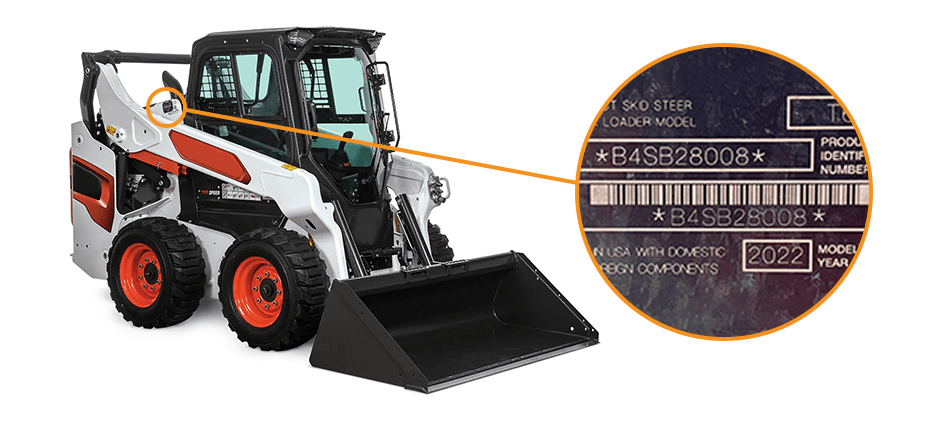
Step-by-Step Loader Parts Lookup Guide
Ready to find your parts? Follow these steps.
Step 1: Find your Machine Data Plate and Engine Tag
Get the right numbers before you start searching online.
- Machine Serial Number (PIN): It’s on a metal plate riveted to the machine frame. You’ll usually see it near the operator cab, steering pivot point, or loader arm mounts.
- Engine Serial Number: Important note! This number is often not the same as your machine serial number. Many loaders run engines made by outside suppliers. For example, Bobcat may use Kubota engines, and Komatsu may use Cummins engines. Look on the valve cover or the side of the engine block for the engine tag. You need this number to order engine oil filters, fuel filters and fan belts.
Step 2: Open the manufacturer’s online parts catalog
Most big equipment brands let anyone access their electronic parts catalog for free.
- Caterpillar: Head to Cat Parts Store (SIS). Just paste your serial number right into the search box.
- John Deere: The John Deere Parts Catalog supports PIN search and shows exploded parts diagrams.
- Bobcat: Enter your serial number in their online catalog, and it will hide parts that won’t fit your particular skid steer or track loader.
Step 3: Go to the Maintenance or Service section
After you enter your serial number, no need to dig through all those hydraulic schematics. Look for sections named Maintenance Parts, Service Items, or Filters and Belts. Brands bundle these commonly replaced wear parts together so you can find them fast.
OEM vs. Aftermarket Parts: Making the Right Choice
Once you have the exact OEM (Original Equipment Manufacturer) part numbers, you have a choice to make. Do you buy the parts directly from the dealer, or do you cross-reference them to aftermarket brands like Donaldson, Fleetguard, or Baldwin? Here is a quick breakdown to help you decide:
| Feature | OEM Parts (Dealer) | Premium Aftermarket (e.g., Fleetguard, Wix) |
|---|---|---|
| Fitment | Guaranteed 100% exact fit. | Excellent, usually meets or exceeds OEM specs. |
| Price | Highest cost. | Usually 20% to 40% cheaper than OEM. |
| Availability | Depends on local dealer stock. | Widely available at local auto/truck parts stores and online. |
| Warranty Risk | Zero risk to machine warranty. | Safe, as long as the filter meets OEM micron ratings (Magnuson-Moss Warranty Act protects you). |
| Best For | Machines under factory warranty, specialized hydraulic filters. | Older machines, mixed fleets, routine engine oil/fuel filters. |
Pro Tip: If you are crossing an OEM number to an aftermarket brand, always use the aftermarket manufacturer’s official cross-reference tool on their website. Never trust a random forum post.
Common Mistakes When Ordering Loader Parts
Even seasoned operators make mistakes when ordering parts. Avoid these common traps:
- Ignoring Superseded Parts: You might type in your old filter number, and the system spits out a completely different number. Don’t panic. This is called a “supersession.” It means the manufacturer updated the part, and the new number is the direct, upgraded replacement.
- Mixing Up Inner and Outer Air Filters: Loaders work in dusty environments and use a dual-element air filter system. The large outer filter is the primary, and the smaller inner filter is the secondary (safety) filter. Always replace the primary, but only replace the secondary according to the manual (usually every 3rd primary change). Make sure you order both if a major service is due.
- Forgetting the O-Rings: Many cartridge-style hydraulic and fuel filters require new O-rings. OEM filters usually include them in the box, but some cheaper aftermarket options do not. Always check.
Build Your Own Quick-Reference Maintenance Sheet
Do yourself a big favor: run this parts lookup just once. Grab a sheet of paper or open a spreadsheet, and write down the OEM part numbers and your preferred aftermarket cross-references for these items.
- Engine Oil Filter
- Primary & Secondary Fuel Filters / Water Separator
- Primary & Secondary Air Filters
- Hydraulic Return Filter
- Hydrostatic/Transmission Filter
- Fan/Alternator Belt
- Cab Air Filter (HVAC)
Print out this list, laminate it, then zip-tie it inside your loader’s battery box, or keep it in the cab. The next time you hit the 500-hour service mark, you won’t need to look up any parts at all.
FAQs
What if the serial number plate on my loader is gone or worn so bad I can’t read it?
If the data plate is unreadable, check for the serial number stamped straight into the machine’s steel frame. Manufacturers stamp the PIN in an easy-to-spot spot, like the front frame rail or near tie-down points, just for cases when the plate gets ruined.
Can I use automotive filters on my heavy equipment if they screw on?
Nope. Even if a car filter threads onto your loader engine, its internal bypass valve pressure, flow rate and micron rating are probably totally different. Slapping a car filter on a diesel loader can starve the engine of oil and cause total engine breakdown.
Why does my loader have two separate fuel filters?
Most newer diesel loaders run a two-filter setup. The primary filter, which often doubles as a water separator, traps big debris and removes water from fuel. The secondary filter has a much finer micron rating to catch tiny dirt particles before they hit the delicate high-pressure fuel injectors.
How often do I need to replace belts on my loader?
You should check belts every 250 hours for cracks, fraying or shiny glazed surfaces. As a general guideline, swap drive belts every 1,000 to 2,000 hours, or about every two years, depending on your working conditions. Stash an extra undamaged belt behind the seat for emergencies.
Conclusion
Finding the right loader parts doesn’t have to be complicated. Use your machine and engine serial numbers to look up the correct part numbers instead of relying on the model name alone. This helps you avoid ordering mistakes and reduce downtime. Once you have the correct part numbers, you can also compare aftermarket replacements to find options that fit your needs and budget. FridayParts offers a wide range of aftermarket parts for loaders, including filters, belts, and other service items. Browse our catalog to find the parts you need without overspending.