

If your throttle cable is too loose, too tight, or out of adjustment, your engine won’t respond right. You may notice weak power, odd RPMs or slow throttle reaction. How to adjust your throttle cable? Follow this simple guide to get it adjusted properly. We’ll also cover key checks and tips for testing it out.
What Does a Throttle Cable Do?
On most diesel equipment, the throttle cable connects your controls straight to the engine. The throttle manages how much fuel goes into the engine.
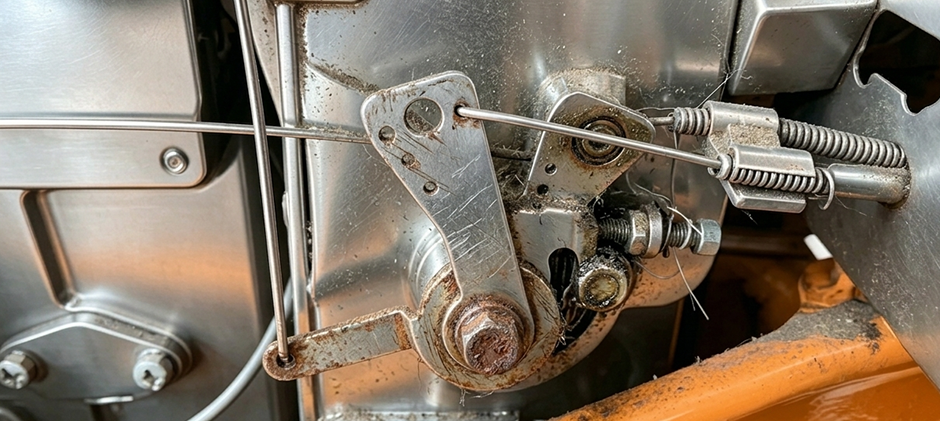
When you move the throttle lever or step on the pedal, the cable pulls a lever on the fuel injection pump governor. This part controls fuel delivery to the cylinder. Pull the cable further, and more fuel flows — the engine revs up and makes more power. Let off, and fuel gets cut back so the engine idles or runs at a lower speed.
Types of Throttle Systems
Understanding your system is key. Off-road machinery primarily uses one of two types.
Mechanical Throttle Cable System
This is the system this guide focuses on and is the most common type found on a vast range of equipment. It relies on the physical throttle cable we’ve been discussing. Its simplicity and reliability make it ideal for tough working conditions. The adjustment process is entirely mechanical.
Electronic Throttle Control System (ETC)
Newer or more advanced machines may use an electronic “drive-by-wire” system. Here, a sensor at the operator’s control sends an electrical signal to the Engine Control Unit (ECU). The ECU then commands an electronic actuator to manage the fuel system. These systems have no physical cable to adjust. Troubleshooting involves checking sensors, wiring, and the ECU, which is a different process.
Signs Your Throttle Cable Needs Adjustment
Here are the common signs that your throttle cable needs adjusting:
- Slow throttle response: When you move the throttle, the engine RPM takes time to change. This lag means the cable has too much slack.
- Can’t hit full engine speed: You push the throttle all the way forward, but the engine still won’t rev up fully. The cable is too loose and can’t pull the governor lever far enough.
- Too fast idle: Even with the throttle at the lowest setting, the engine idles too high. This happens when the cable is too tight and stops the governor from dropping back to normal idle.
- Wobbly or loose throttle lever/pedal: The first part of the movement feels slack and does nothing. That’s extra free play in the throttle cable.
Check the Condition of the Throttle Cable
Before you proceed, take a few minutes to examine the entire length of the cable, from the operator’s controls to the engine.
- Fraying: Check the inner wire for any broken or unraveled strands, especially near the connection points. A frayed cable is significantly weakened and will eventually snap.
- Kinks and Sharp Bends: Any sharp bends will cause the inner wire to bind inside the sheath, leading to stiff or jerky operation.
- Corrosion or Rust: Rust can cause the cable to stick and will weaken it over time.
- Damaged Outer Sheath: The black protective housing is crucial for keeping dirt and moisture out. If it’s cracked, split, or worn through, the inner cable is exposed to contamination that will cause it to bind.
Pro Tip: To check for binding, disconnect one end of the cable. Try to slide the inner wire back and forth by hand. It should move smoothly with minimal resistance. If it feels gritty, stiff, or gets stuck, the cable likely needs to be lubricated or, more often, replaced.
Check Throttle Cable Free Play
Once you’ve confirmed the cable is in good condition, the next step is to check the throttle cable free play, also known as slack. This is the amount the throttle control can move before it actually starts pulling the cable and affecting the engine. A small amount of free play is necessary to ensure the engine can return to a stable, low idle.
How to Measure Free Play?
Measuring free play is straightforward. With the engine turned off, you can check it at either end of the cable.
- At the Operator’s Control: Gently move the throttle lever from its idle position. Use a ruler or tape measure to see how far the lever moves before you feel resistance. This resistance is the point where the slack has been taken up and the cable is beginning to pull.
- At the Engine: Observe the point where the cable connects to the fuel pump’s governor lever. Have a helper slowly move the throttle control from idle. Watch the cable end. The amount the control lever moves before the governor lever begins to move is the free play.
While the exact specification can vary, a typical amount of free play is around 1/8 to 1/4 inch (3-6 mm) of travel at the hand lever. For the most accurate setting, always consult your machine’s service manual.
How to Adjust a Throttle Cable?
Make sure the engine is off and the machine is safely parked.
1. Locate the Adjustment Point
Most systems have at least one, and sometimes two, adjustment points.
- Engine-Side Adjuster: This is the primary point for making adjustments and is usually located on a bracket near the fuel injection pump where the cable sheath is held stationary.
- Control-Side Adjuster: Some machines have a secondary fine-tuner near the hand lever or foot pedal.
The adjuster itself typically consists of a threaded barrel with one or two lock nuts, just like the one circled in the image at the top of this article.
2. Loosen the Lock Nut
The lock nuts prevent the adjuster from changing its position due to vibration. You will need two wrenches—one to hold the adjuster barrel or the second nut steady, and one to loosen the primary lock nut. Turn the lock nut a few rotations to give yourself room to turn the adjuster barrel.
3. Adjust Cable Tension
This is where you will either remove or add slack. The principle is simple, but it can seem counter-intuitive at first.
The adjustment mechanism works by changing the effective length of the outer sheath, not the inner wire.
- To Tighten the Cable (Reduce Free Play): Turn the adjuster barrel so that it moves away from the cable end. This lengthens the path of the outer sheath, which pulls the inner wire tighter and removes slack.
- To Loosen the Cable (Increase Free Play): Turn the adjuster barrel so that it moves closer to the cable end. This shortens the path of the outer sheath, creating more slack in the inner wire.
Make small adjustments at a time—a half-turn or full turn can make a significant difference.
4. Check Idle and Full Throttle Operation
After each small adjustment, you must check the travel at both ends.
- Check Idle: Push the throttle lever to its low idle position. Go to the engine and confirm that the governor lever is resting firmly against its idle stop screw. If there is a gap, the cable is still too tight.
- Check Full Throttle: Push the throttle lever to its maximum/full power position. Go back to the engine and confirm the governor lever is now touching its high-speed stop screw. If it doesn’t reach the screw, the cable is too loose and has too much free play.
Continue this process of making small adjustments and checking both ends until the governor lever moves perfectly between both its idle and high-speed stops.
5. Tighten the Lock Nut
Once you have achieved the perfect adjustment, it’s time to lock it in place. Use one wrench to hold the adjuster barrel in its correct position, and use the second wrench to firmly tighten the lock nut against the bracket. Be careful not to move the adjuster barrel while tightening. Double-check the free play one last time to ensure nothing shifted.
Common Problems After Adjustment
If the machine isn’t behaving as expected after your adjustment, it’s likely one of two things:
- Idle is Too High: The cable is adjusted too tightly. Loosen it slightly by turning the adjuster barrel to create more free play.
- Engine Won’t Reach Full Power: The cable is too loose. Tighten it by turning the adjuster barrel to remove some free play.
Conclusion
Adjustment can only do so much. If your inspection revealed any damage, or if the cable action is still stiff or gritty after adjustment, it’s time for a replacement. A throttle cable is a wear item. Continuing to use a frayed or binding cable is risking a breakdown at a critical moment. FridayParts offers high-quality throttle cables for a wide range of heavy equipment brands, all at affordable prices.
