

A dry Ford 8N weighs 2,410 lbs. A fully serviced one weighs 2,717 lbs. Add ballast, and it hits 4,043 lbs. Most forum answers stop there — but that’s exactly why people show up at the scale house 800 lbs over what they planned for. “How much does a Ford 8N tractor weigh?” depends entirely on how yours is set up. Loaders, loaded rear tires, and attachments change the real number more than you’d think. This guide walks through every weight you will run into, plus the trailer and truck ratings you actually need to haul one home.
Ford 8N Weight Chart
The 8N has three official weight numbers, and each one describes a different condition. Confusing them is the reason you’ll see wildly different answers on forums.
| Configuration | Weight (lbs) | Weight (kg) |
|---|---|---|
| Shipping (Dry) | 2,410 | 1,093 |
| Operating (Wet) | 2,717 | 1,232 |
| Ballasted (Max) | 4,043 | 1,833 |
What Each Weight Number Means
- Shipping (Dry): Factory weight with no fuel, no coolant, no hydraulic fluid, and no attachments. This is what left the assembly line.
- Operating (Wet): The tractor fully serviced — coolant, engine oil, 10 gallons of gasoline, hydraulic fluid, and rear-axle oil all topped off. This is the number to use for daily hauling math.
- Ballasted: Every fluid loaded plus calcium chloride or beet juice in the rear tires and cast rear wheel weights bolted on. Common for plowing wet ground or pulling heavy loads.
The gap between shipping and ballasted weight is over 1,600 lbs. That’s the difference between a half-ton truck barely handling the trailer and needing a 3/4-ton pickup.
Weight Differences Between 8N Models and Variations
Do All Ford 8N Years Weigh the Same? (1947–1952)
The short answer is yes — the base spec never changed across production years. Ford built the 8N from July 1947 through 1952, and every unit shipped at 2,410 lbs dry.
That said, minor changes appear on later models:
- 1947–1949: Front-mounted distributor, original three-brush generator
- 1950–1952: Side-mount distributor, Proofmeter added, upgraded ignition coil, slightly heavier dash and wiring
The differences add only a few pounds — nothing that changes towing or lift calculations.
What About a “1960 Ford 8N”?
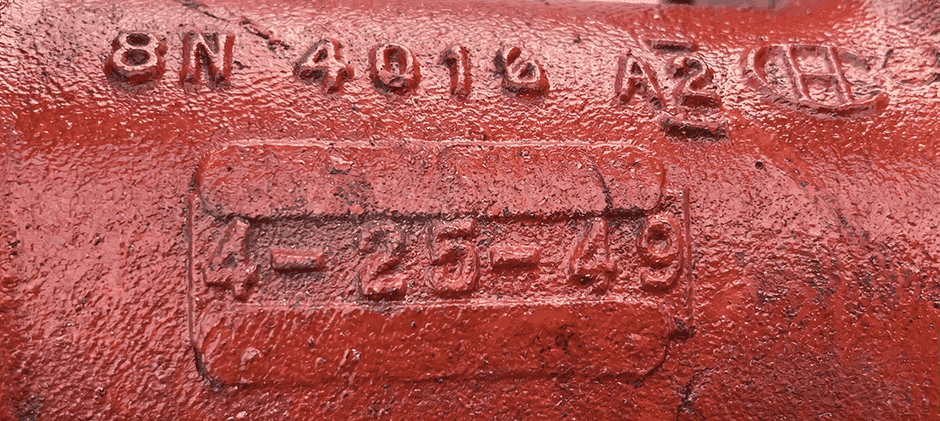
There isn’t one. Production ended in 1952, and the NAA “Golden Jubilee” took over in 1953—about 100 lbs heavier than the 8N. So if you see an ad for a 1960 8N, something’s off. Either the year’s off, or it’s really an NAA or something newer. The only way to settle it? Check the serial number stamped on the left side of the block, under the head and behind the oil filter housing. Every genuine 8N serial begins with “8N.”
How the 8N Compares to the 9N and 2N
| Model | Years | Shipping Weight |
|---|---|---|
| 9N | 1939–1942 | 2,340 lbs |
| 2N | 1942–1947 | 2,340 lbs |
| 8N | 1947–1952 | 2,410 lbs |
| NAA | 1953–1954 | 2,510 lbs |
The 8N is about 70 lbs heavier than the earlier N-series thanks to the four-speed transmission, running boards, and independent brake system.
How much does my Ford 8N tractor weigh? Almost no working 8N weighs exactly 2,717 lbs anymore. Decades of add-ons, tire changes, and ballast have shifted the number on nearly every machine still in the field. Three things are usually responsible.
Why Does the Actual Weight Vary So Much?
Almost no working 8N weighs exactly 2,717 lbs anymore. Decades of add-ons, tire changes, and ballast have shifted the number on nearly every machine still on the field. Three things are usually responsible.
3 Factors That Change Your 8N’s Actual Weight
- Liquid Ballast in the Rear Tires — Calcium chloride, beet juice, or windshield-washer fluid inside the tires adds 400 to 800 lbs total. This is the single biggest variable.
- Attachments and Implements — A front-end loader adds 400–600 lbs. A rear blade or box scraper adds 150–350 lbs. Cast front wheel weights add another 50 lbs each.
- Fluid Levels and Fuel — A 10-gallon tank of fuel adds about 60 lbs. Coolant in the radiator, oil in the oil filter housing, and hydraulic fluid running through the hydraulic pump push that total up by roughly 100 lbs compared to a completely dry machine.
How Much Does an 8N Weigh With a Front Loader?
Expect a total of 3,000–3,200 lbs operating weight. A period-correct or aftermarket loader with subframe brackets averages 500 lbs installed. Add another 200 lbs if a bucket-mounted attachment stays on.
How Much Does an 8N Weigh With Loaded Tires?
Rear tires filled with calcium chloride solution push the operating weight to roughly 3,200–3,500 lbs. That kind of ballast gives you a huge traction boost, but it also puts extra load on the front axle bearings and steering parts—so keep up with the grease.
Rule of thumb: a working 8N with a loader and filled tires is closer to 3,500 lbs than the 2,410 lbs on the factory sticker. So weigh it before you tow.
Towing Guide: What Truck and Trailer Do You Need to Haul a Ford 8N?
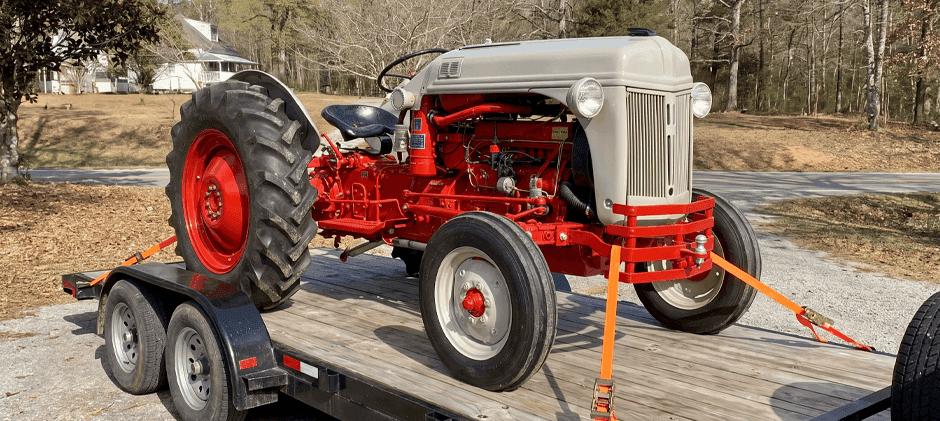
Once you know the real weight, matching a trailer and tow vehicle becomes simple. Here’s what fits an 8N safely.
Minimum Trailer and Truck Requirements
| Item | Minimum Rating | Recommended |
|---|---|---|
| Trailer GVWR | 5,000 lbs | 7,000 lbs |
| Truck tow capacity | 5,000 lbs | 7,500+ lbs |
| Trailer type | Utility flatbed | Equipment trailer with brakes |
| Ramp length | 5 ft | 6–8 ft (gentler angle) |
A half-ton pickup can pull a stock 8N on a light trailer, but once you add a loader, ballasted tires, and attachments, you’re at the edge of that rating. A 3/4-ton truck handles it comfortably.
4 Safety Tips for Loading and Tying Down an 8N
- Position for 60/40 weight distribution. Place roughly 60% of the tractor’s weight ahead of the trailer axle to keep tongue weight in spec.
- Use four separate tie-downs. Chains or Grade 70 straps at each corner, hooked to the frame — not the axles or hydraulic lift arms.
- Lock it down. Engage the parking brake, leave the transmission in low or reverse gear, and lower any implements to the deck.
- Check trailer tires and lights before rolling. A 3,000-lb load on underinflated trailer tires is a blowout waiting to happen.
Quick FAQs on Ford 8N Weight
How much does a Ford 8N tractor weigh? The short answer is 2,410 lbs dry, 2,717 lbs wet, and up to 4,043 lbs with full ballast. But your actual number depends on tires, attachments, and fluid levels. The only way to know for sure is to run it across a scale.
Is an 8N heavier than a 9N? Yes — about 70 lbs heavier due to the four-speed gearbox and running boards.
Can an 8N lift its own weight? No. The three-point hitch has an 800 lb rear lift capacity, well below the tractor’s 2,717 lb operating weight.
Does a front loader change the front-axle load rating? Yes. A loaded bucket can put 1,500+ lbs on the front axle. Inspect front axle spindles regularly if you run a loader daily.
Where can I confirm my specific unit’s weight? The serial number on the engine block gives you the exact production year. Combine that with a certified scale reading for haul planning.
After 70+ years of use, the most commonly replaced items are the water pump, carburetor kit, points and condenser, spark plug wires, and rear axle seals. Keeping these in stock saves downtime during a busy season.
Final Words
The Ford 8N is one of the most enduring utility tractors ever built, and knowing its true weight — dry, wet, or ballasted — keeps hauling, lifting, and implement matching safe. Any 8N you’ll meet today weighs somewhere between 2,410 and 4,043 lbs depending on its setup, so always verify before you tow. Keeping a 70-year-old tractor working takes reliable parts. At FridayParts, we stock aftermarket components for the Ford 8N and hundreds of other heavy equipment models — quality parts at fair prices, wide compatibility, and fast shipping so you get back to work sooner.
