

How much does a backhoe weigh? Most backhoes weigh between 12,000 and 30,000 lbs. What changes that range? Attachments, ballast, and machine size. A larger unit may finish faster, but it also brings hauling and surface problems. Before you move, buy, or size a backhoe, you need to know the real range and what affects it. We cover that next.
Backhoe Weight Range by Size
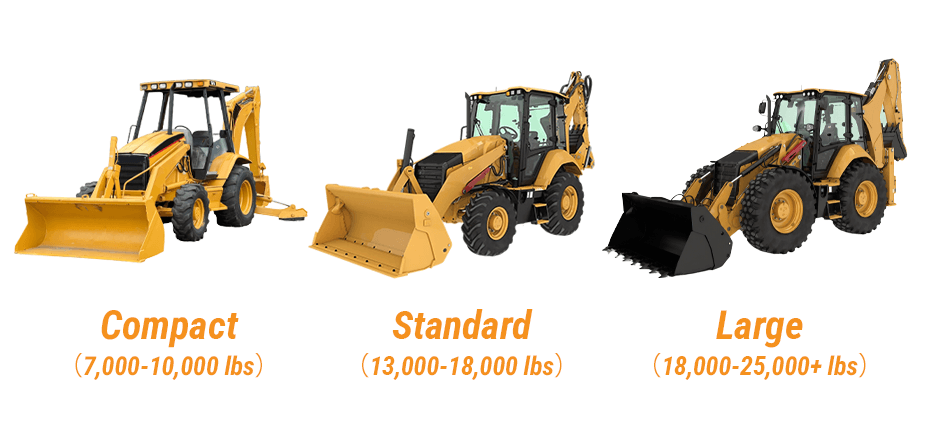
Most backhoes fall between 7,000 and 40,000 lbs. In daily work, the most common backhoe loader range is 13,000 to 18,000 lbs. Smaller compact units can sit below that, while larger commercial machines can go well above 20,000 lbs.
| Backhoe Type | Typical Weight Range | Typical Jobs |
|---|---|---|
| Compact or Mini Backhoe | 7,000 to 10,000 lbs | Landscaping, shallow trenching, yard work |
| Small Compact Range | 3,000 to 10,000 lbs | Utility repair, tight access jobs |
| Standard Backhoe Loader | 13,000 to 18,000 lbs | Trenching, loading, general construction |
| Large Backhoe Loader | 18,000 to 25,000+ lbs | Roadwork, commercial excavation |
| Heavy-Duty Range | 20,000 to 40,000 lbs | Deep digging, infrastructure work |
A few model examples show how wide the spread can be:
| Model | Operating Weight |
|---|---|
| Kubota B26TLB | 4,001 lbs |
| Kubota L47TLB | 7,205 lbs |
| JCB 1CXT | 9,572 lbs |
| CAT 415 | 16,279 lbs |
| CASE 580N EP | 15,810 lbs |
| CAT 420 | 17,271 lbs |
| John Deere 310SL | 17,196 lbs |
| CASE 580 Super N | 19,067 lbs |
| JCB 4CX-15 Super | 19,017 lbs |
| CASE 590 Super N | 20,532 lbs |
| CAT 450 | 24,039 lbs |
| John Deere 710 P-Tier | 25,790 lbs |
The question “How much does a backhoe weigh?” often sounds simple, but the published operating weight is only a starting point. Once the machine is fitted with a loader bucket, rear bucket, forks, couplers, or other job tools, the real number goes up.
What Makes a Backhoe Heavier
Two machines in the same class may not weigh the same. Weight changes with setup, options, and work tools.
The biggest factors are:
Machine Size and Frame
Larger frames, stronger axles, and heavier hydraulic systems add weight.
Engine Power
More horsepower often comes with more mass.
Bucket Size
A larger front bucket or rear bucket can shift both working weight and hauling weight.
Attachments
Common tools that add weight include:
- auger
- hammer
- thumb
- ripper
- coupler
- forks
Counterweights
These improve balance and lift feel, but they raise the total machine weight.
Cab and Protection Package
Enclosed cab units usually weigh more than open-station machines.
Fuel and Fluids
Operating weight often includes these, but not always in the same way from one source to another.
Some source data gives useful attachment examples. One source lists a backhoe bucket at 50 to 500 kg. Another source lists common add-on weights such as:
- Auger: about 250 lbs
- Hammer: about 300 lbs
- Thumb: about 150 lbs
- Ripper: about 350 lbs
- Rear bucket: about 400 lbs
- Cold planer: about 600 lbs
- Coupler: about 100 to 400 lbs
On the Cat 420, the stock 1.25-cubic-yard bucket is listed at 1,642 lbs, while a bucket with fold-over forks is 2,017 lbs. The extendable stick adds 595 lbs. Stackable counterweights add 529 lbs, with a maximum listed counterweight package of 1,014 lbs. Even comfort and protection features add up. Air conditioning adds 99 lbs, ride control 33 lbs, and ROPS plus FOPS 320 lbs.
That is why a single published figure rarely tells the full story. When people ask “how much does a backhoe weigh”, the real answer depends on what is actually mounted on the machine.
Why Does Backhoe Weight Matter on Real Jobs?
Weight affects every stage of machine use, from loading it on the trailer to getting traction in poor ground.
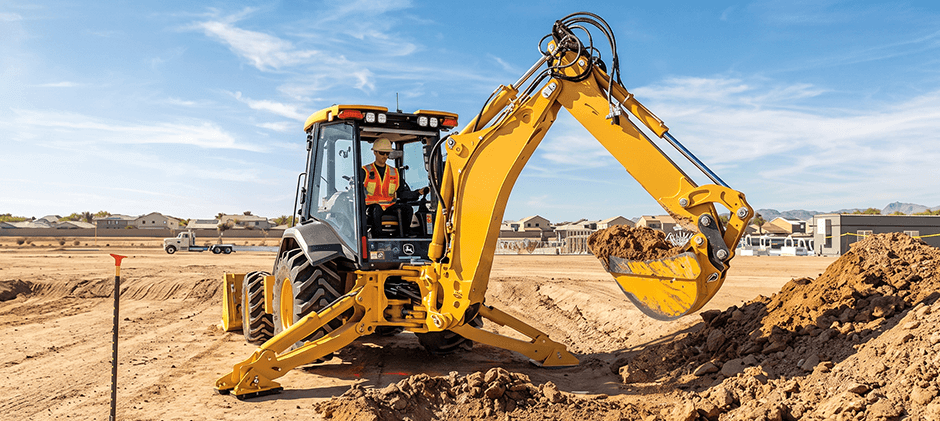
Transport and Trailer Planning
Before hauling, the full load should include:
- Machine operating weight
- Front bucket
- Rear bucket
- Mounted attachments
- Loose attachments on the trailer
- Fuel and fluids
- Chains and binders
- Trailer weight
This is where many hauling mistakes begin. A machine that looks fine on paper may overload the trailer once extra gear is added. It also affects axle balance, brake demand, and route planning.
Ground Pressure and Surface Damage
Heavier machines can:
- rut soft ground
- damage lawns
- mark paved surfaces
- stress septic fields
- sink in wet fill
If the machine will cross a finished area, details like outrigger pads, tire condition, and stabilizer foot contact matter almost as much as the machine class.
Stability and Digging Feel
More weight often gives a backhoe a steadier feel when digging hard material or lifting with the loader. That helps with trenching, truck loading, and rough grading. Still, good stability also depends on:
- slope
- outrigger setup
- bucket size
- load position
- operator control
A heavier backhoe can help, but it does not fix a poor setup.
Productivity and Machine Match
A lighter machine may be easier to move and may leave less damage behind. A heavier machine may dig faster and lift more. The better choice depends on the work, not just the spec sheet.
This is also where bucket teeth, boom pins, loader arm bushings, and hydraulic hose kits start to matter. Higher machine weight often means more strain on wear parts during repeated digging and loading cycles.
Backhoe Weight and Job Type
Matching the machine to the task saves time and prevents overkill.
Compact Backhoes
Typical range: 3,000 to 10,000 lbs
Best for:
- property maintenance
- drainage work
- small trench runs
- landscaping
- residential access
Main benefit: easier transport and tighter turning room.
Standard Backhoe Loaders
Typical range: 13,000 to 18,000 lbs
Best for:
- trenching
- loading spoil
- utility work
- farm work
- general site prep
This is the most common class for mixed-use work. It usually gives the best balance of reach, lift, and mobility.
Large Backhoe Loaders
Typical range: 18,000 to 25,000+ lbs
Best for:
- road construction
- deeper excavation
- heavier materials
- commercial site work
- longer duty cycles
These machines can improve output, but they need more planning for hauling and jobsite access.
How to Find the Exact Weight of Your Backhoe?
If the machine is already in the fleet, broad averages are only a rough guide. The exact number should come from the actual machine.
Use this checklist:
- Check the operator manual
The spec section often lists base and operating weight. - Check the manufacturer’s spec sheet
This can help confirm the exact configuration. - Look at the machine plate
Some machine data plates include weight information. - Add installed tools and options
Count buckets, forks, couplers, counterweights, and cab equipment. - Use a commercial scale
This is the most reliable method before hauling.
If the machine has older or mixed components and no complete spec sheet is available, the exact total is unknown until weighed. In cases like that, the question “how much does a backhoe weigh” cannot be answered accurately without a scale.
How to Choose the Right Weight for the Work?
The fastest way to choose a backhoe is to work backward from the job.
Choose a lighter machine if the priority is:
- easier hauling
- narrow access
- lower surface impact
- lighter residential work
- lower fuel use
Choose a heavier machine if the priority is:
- deeper digging
- higher lift capacity
- better planted feel
- rougher ground
- larger bucket use
A simple field check helps narrow it down:
| Question | Why It Matters |
|---|---|
| How deep do you need to dig? | Deeper work usually pushes machine size up |
| What material will you move? | Stone and wet spoil need more lift and stability |
| How soft is the ground? | Higher weight can create a rutting or sink risk |
| What will haul the machine? | Trailer and truck limits may determine the class |
| Which tools stay mounted? | Attachments can change both weight and balance |
These points also help when planning service stock. Machines that run heavier cycles often benefit from keeping seal kits, pins and bushings, cutting edges, and other fast-wearing parts ready before downtime starts.
Final Words
By the time you work through the details, “How much does a backhoe weigh?” is not just a simple spec question. It comes down to machine size, attachments, counterweights, and the actual setup used on the job. Checking those details before hauling or buying can prevent costly mistakes. And when replacement parts are needed, FridayParts is a practical source for aftermarket parts for many backhoe and heavy equipment models.
