

Finding the exact fuel lift pump comes down to your engine model and serial number, the old pump’s part number, and matching specifications such as voltage, port threads, and flow rate. If your tractor cranks but won’t start, or your excavator loses power halfway through a dig, a worn fuel lift pump could be the cause. Swapping it is simple once you have the right part. Finding that part is harder, because two machines of the same model can run different pumps. Here’s how to confirm the pump has failed, match the replacement to your engine, and get fuel flowing again after the swap.
What Does a Fuel Lift Pump Do?
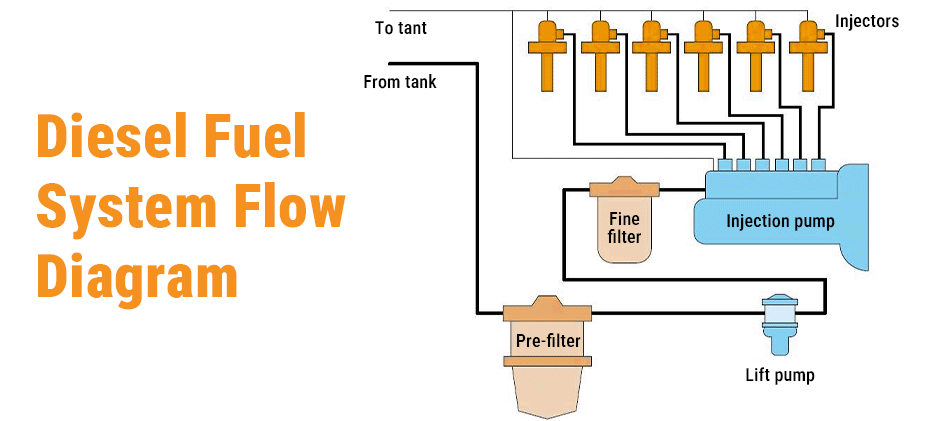
A diesel engine needs a steady supply of clean fuel with no air in it. The fuel lift pump moves fuel from the tank, through the filters, and on to the injection pump. You may also see it called a feed pump, transfer pump, or supply pump. It works at low pressure, and its only job is keeping the high-pressure side of the system fed.
On most machines, the fuel path looks like this:
Tank → Lift pump → Fuel filter and water separator → Injection pump → Injectors
Lift pump vs injection pump
The lift pump moves fuel at low pressure. It sits between the tank and the filter, or bolts to the side of the engine block. The injection pump does the heavier work: it raises fuel to very high pressure and sends it to each injector at the right moment.
When the lift pump can’t keep up, the injection pump runs short of fuel, and you lose power. A short supply also wears the injection pump faster, because diesel lubricates and cools its internal parts. A healthy feed pump helps protect your fuel injection pumps and injectors.
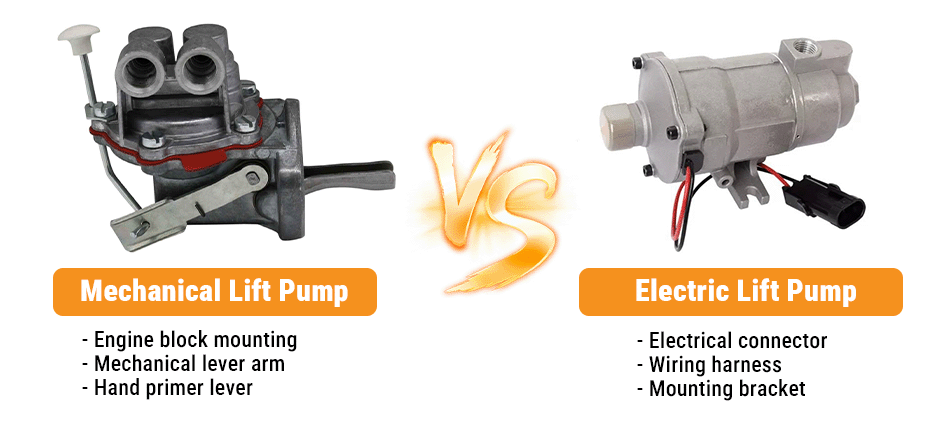
Mechanical vs electric lift pumps
Before you can match a pump, you need to know which type your engine uses.
| Feature | Mechanical pump | Electric pump |
|---|---|---|
| Power source | Cam lobe on the engine | 12V or 24V electrical system |
| Location | Bolted to the engine block | Frame rail, near the tank, or near the filter |
| Priming | Often has a hand primer lever | Runs when the key is turned on |
| Common machines | Older tractors, loaders, generators | Newer compact tractors, skid steers, mini excavators |
| Typical failure | Torn diaphragm, worn lever arm | Burned-out motor, bad wiring, clogged screen |
| Check before ordering | Gasket, arm style, bolt spacing | Voltage, connector, port threads |
Some engines can be converted from mechanical to electric, but a conversion needs extra wiring, a relay, a block-off plate, and the correct flow rate. In most cases, replace the pump with the same type the engine came with.
What’s the Sign Your Diesel Fuel Lift Pump is Failing?
Lift pump trouble can look like a lot of other fuel problems. Here are the common symptoms, with the other parts that can cause each one:
| Symptom | Possible lift pump cause | Other possible causes |
|---|---|---|
| Power loss under load | Low fuel volume | Clogged filter, blocked tank vent |
| Cranks but won’t start | No fuel delivery | Air in the lines, faulty fuel shutoff solenoid |
| Hard start after sitting | Weak check valve lets fuel drain back | Air leak at a hose or fitting |
| Rough or surging idle | Uneven fuel supply | Water in the fuel |
| Engine stalls at high RPM | Pump can’t keep up with demand | Collapsed suction hose |
| Fuel smell or wet spots | Leaking seal or diaphragm | Loose fitting, cracked line |
If your engine has a mechanical pump, pull the dipstick as well. A torn diaphragm lets diesel seep into the crankcase, so oil that smells of fuel, or a level that creeps up between changes, is a bad sign. Keep running it like that and the thinned oil will take the bearings with it.
How to Match the Right Fuel Lift Pump?
A pump can look identical to yours and still have the wrong thread, voltage, or flow rate. Getting it right the first time comes down to a few minutes of homework.
Start with the engine, not the machine
Plenty of equipment brands buy their engines from someone else. Your skid steer might run a Kubota. Your mini excavator might have a Yanmar in it. Fuel parts belong to the engine, so search by engine make and model, and treat the machine model as a cross-check.
Get the serial number
A model name narrows things down, but the serial number settles it. Manufacturers revise parts in the middle of a production run, and two engines wearing the same model name can take different pumps. You’ll usually find it in one of three places:
- A sticker or plate on the valve cover
- A number stamped into the side of the engine block
- The machine data plate near the operator station or on the frame
Wipe it clean and photograph it before you go any further.
Read what the old pump tells you
The pump itself often says what it is. Look for a part number cast into the body or printed on a label, then photograph the inlet and outlet ports, the electrical connector if there is one, and the mounting holes or bracket. A readable part number cross-references in seconds. If the label has worn away, those photos are what confirm the fit.
Step 4: Match the specs
Compare the new pump to the old one on each of these:
| Spec | What to check | Why it matters |
|---|---|---|
| Voltage | 12V or 24V | The wrong voltage can burn out the pump or make it run weakly |
| Drive type | Mechanical or electric | It has to fit your engine’s mount and drive |
| Ports | Size and thread type | Mismatched fittings leak or let air in |
| Flow rate | Volume per hour from your manual | Too little flow starves the engine |
| Mounting | Bolt pattern and bracket | The pump has to sit firmly in the correct position |
| Connector | Plug shape and pin count | A matching plug means no cutting or splicing wires |
| Screen or filter | Built-in strainer or not | This affects service intervals and your filter setup |
| Hand primer | Present or not | Some engines need a primer for bleeding |
A good aftermarket replacement lists the original part numbers it replaces, and its specs match every row above. If a listing says the pump fits your engine, but the voltage or ports differ, ask the seller before you buy. Good replacement fuel pumps should drop in place of the old pump with no modifications.
How to Install the Pump and Bleed the System?
A new pump only works well if you fit it correctly and get all the air out afterward.
Before you start
- Park on level ground and let the engine cool.
- Disconnect the battery.
- Close the fuel shutoff valve.
- Put a drain pan and rags under the work area.
- Cap any open lines so dirt can’t get in.
Fitting a mechanical or electric pump
Mechanical pump: Turn the engine over by hand until the cam lobe is at its low point. That makes the lever arm easier to seat and keeps it from bending. Use a new gasket, make sure the arm rides on the cam correctly, and tighten the bolts evenly.
Electric pump: Find the flow arrow on the pump body and point it toward the engine. Mount the pump in the same position as the old one, away from heat sources. Use clean connections, add a little dielectric grease to the plug, and secure the wiring so it can’t rub against anything. Quality engine wiring harness parts help prevent voltage drop.
Bleed Air From the Fuel System
Air left in the lines is the most common reason an engine won’t start after a pump swap. To bleed the system:
- Open the bleed screw on the filter head.
- Work the hand primer, or turn the key on to run the electric pump.
- Close the screw once the fuel flows with no bubbles.
- Repeat at the injection pump bleed point if your manual lists one.
- Start the engine and check every fitting for leaks.
Some newer engines bleed themselves if you turn the key on a few times. Check your manual for the steps for your engine. Avoid cranking for long periods, because it can overheat the starter.
Final Words
Replacing a bad lift pump is a straightforward job when you work in this order: rule out filters and air leaks, identify your engine, match the specs, and bleed the system. At FridayParts, we’re an aftermarket parts supplier with a large inventory of high-quality fuel system parts at affordable prices. Our parts fit many heavy equipment brands. Send us your engine details, and we’ll help you find the right pump.
