

Choosing the right battery for your electric forklift is very important for both safety and performance. Unlike normal vehicle batteries, a forklift battery is not only the power source—it also acts as a counterweight to keep the machine balanced. This guide will help you figure out how to find the correct forklift battery size and type using your own forklift’s “battery size chart”: its data plate and battery compartment.
Why Is Forklift Battery Size So Important?
The size and weight of a forklift battery are critical for safety. Every forklift is built to work with a battery of a specific weight. This helps the machine stay balanced when lifting heavy loads.
If the battery is too light, the forklift can become unstable and may tip over.
If the battery is too large or heavy, it may not fit correctly or could damage the compartment.
“Think of your forklift battery as both the heart and the backbone of your machine — it gives power and keeps everything steady.”
3 Steps to Determine Your Forklift Battery Size
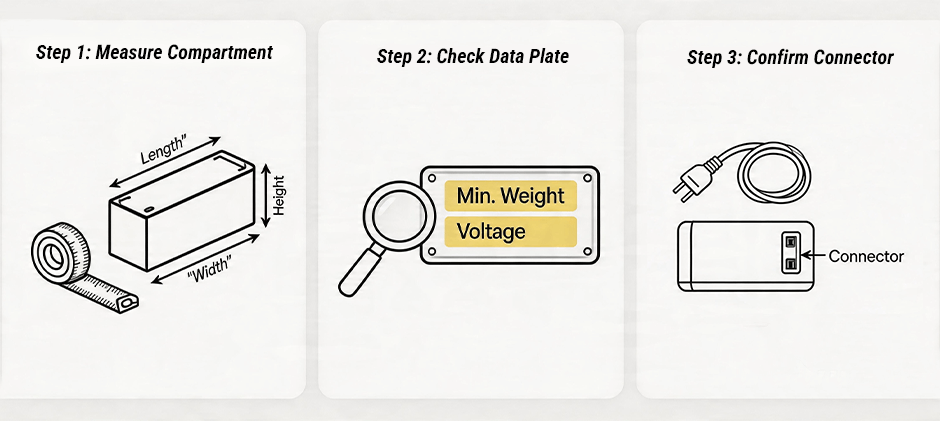
You don’t need a complicated chart to find your forklift’s right battery. Just follow these three easy steps.
Step 1: Measure the Battery Compartment
Use a tape measure to check the size of your forklift’s battery space. Measure the length, width, and height carefully. Write these numbers down. The new battery must fit within these dimensions so it sits securely inside the compartment.
Step 2: Check the Forklift’s Data Plate
Find the data plate—usually attached to the forklift’s frame or cab. It lists official details from the manufacturer, like the required voltage and minimum battery weight. Always follow these numbers, as they are part of the forklift’s safety design.
Step 3: Record Cable and Connector Details
Look at your current battery and note where the cables connect. Record the cable length and connector position (left, right, or center). The new battery needs to match these, so the cables can reach comfortably and fit safely.
What Do the Battery Specifications Mean?
Each forklift battery has numbers and letters that describe how it works. Here are the key ones to understand:
- Voltage (V): The voltage must match your forklift. Common types are 24V, 36V, or 48V. Using the wrong voltage can damage the forklift’s electrical system.
- Amp-Hours (Ah): This is like the battery’s “fuel tank.” A higher Ah means the forklift can run longer before recharging. It’s okay to choose a higher Ah—but it must still fit your compartment.
- Weight (lbs or kg): The battery weight helps balance the forklift. It must meet or exceed the minimum weight listed on the data plate to stay stable and safe.
How Are Forklift Batteries Different from Other Heavy Equipment Batteries?
A forklift battery works very differently from a dozer or excavator battery.
- A forklift battery is designed for deep-cycle use, meaning it provides steady power for many hours at a time.
- A dozer or loader battery is a starting battery, made to deliver one fast, powerful burst of energy to start the engine.
“A forklift battery is like a marathon runner — it provides steady power over time. A dozer battery is like a sprinter — strong but short bursts.”
Because of this difference, forklift batteries are rated by Amp-Hours (Ah) for endurance, while dozer batteries are rated by Cold Cranking Amps (CCA) for starting power.
Where Can I Find a Universal Forklift Battery Size Chart?
There isn’t one chart for all forklifts. Battery sizes and weights are different depending on the brand and model. Using the wrong size can make your forklift unsafe.
The best chart is your own machine:
- The data plate tells you the correct voltage and weight.
- The battery compartment gives you the physical size.
Together, these are your most accurate “forklift battery size chart.”
Conclusion
Finding the correct forklift battery starts with simply measuring and checking your data plate. Knowing your dimensions, voltage, and weight requirements keeps your machine balanced and safe.
Once you know your specs, maintaining your power system is the next step. For strong battery accessories and other essential electrical parts to complete your installation, FridayParts provides the durable components you need to keep your off-road equipment running safely and efficiently.
