

Tracking down the right parts for a Ford-powered off-road machine starts with one thing: knowing exactly what engine is in front of you. That is what Ford engine number identification is for. In this guide, we explain where to find the number, how to read it, and how to use it before you spend money on parts. When you get this step right, everything that follows—from dating the block to ordering replacement components—becomes much easier.
Engine Number vs. Casting Number
Before you start looking, you need to know that a Ford engine usually carries two very different markings. Mixing them up is one of the most common reasons equipment owners order the wrong parts.
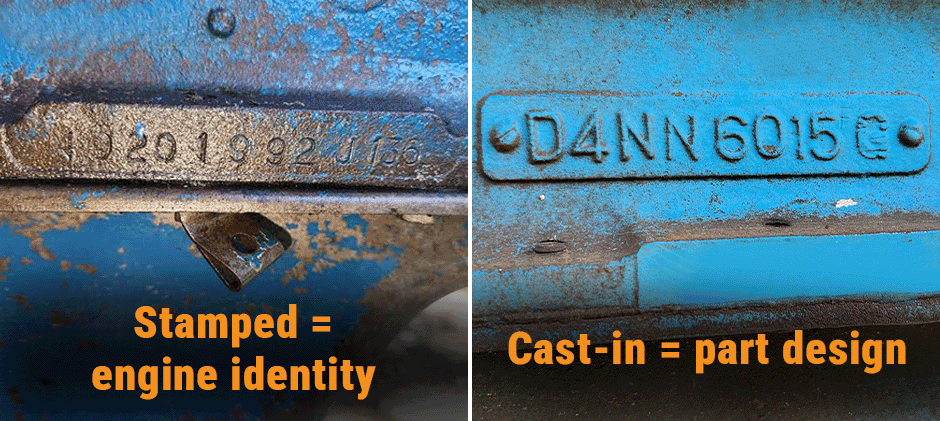
- Engine number — stamped into the metal. It identifies one specific engine and works much like a serial number.
- Casting number — cast into the metal during manufacturing. It shows what the part was designed for, not which exact engine is installed in your machine.
You should treat cast-in numbers as engineering or application references. They describe the casting design, not the true identity of the engine currently powering your equipment.
For accurate Ford engine number identification, you should always begin with the stamped number. The casting number is a useful backup clue, but on its own, it does not identify the engine with enough certainty for parts ordering.
Where to Find the Number?
You can usually find the stamped number in predictable places, but the exact location depends on which kind of Ford engine you have. Knowing the engine type makes Ford engine number identification much faster.
Modern Ford engines
You will often find the stamped number:
- Near the bellhousing, where the block meets the gearbox
- On the front left side of the engine, facing the radiator
Ford ID tag engines
From early 1964 onward, many Ford engines also used a separate ID tag. You should check:
- Under the coil attaching bolts
- Under the dipstick-tube bolt on larger blocks
- Near a carburetor stud on some builds
Classic British Ford engines
On older British-built Ford engines used in tractors, loaders, pumps, and industrial machines, you may find the number:
- On the left front side, just below the cylinder head
- On later 100E units, on the front right above the generator bracket
If you wipe the area with a rag or soft brush, you can often make a faded stamping readable again. Dirt, grease, paint, and surface rust frequently hide numbers on working machines.
Here is a quick guide to what you may find:
| What did you find? | What does it usually mean? |
|---|---|
| Stamped number | The engine’s true identity |
| Cast-in number | Part design/application code |
| 6015 | Engine block basic part number |
| ID tag | Displacement, build date, change level |
How to Read a Casting Number?
A Ford casting number may look complex at first, but it breaks into clear sections. Take D4NN-6015-G as an example:
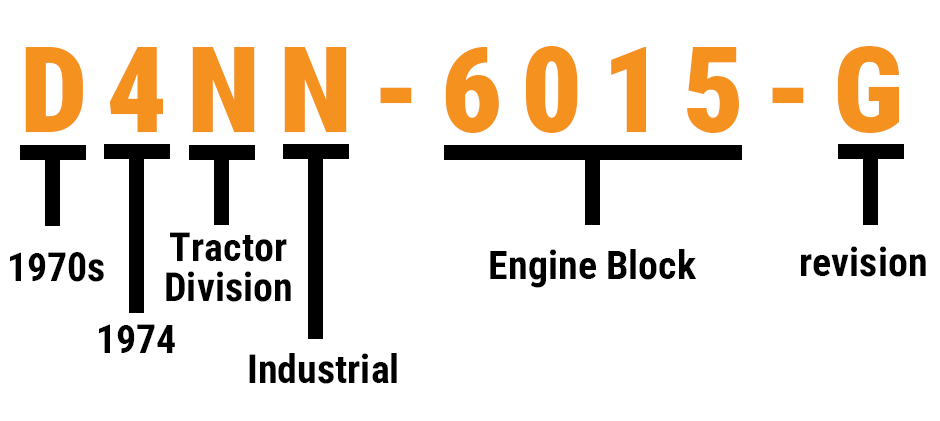
- The first four characters give application information
- The middle four are the basic part numbers
- The last letter or letters show the engineering revision
The first letter tells you the decade:
| Letter | Decade |
|---|---|
| A | 1940s |
| B | 1950s |
| C | 1960s |
| D | 1970s |
| E | 1980s |
| F | 1990s |
| Letter | Group |
|---|---|
| E | Engine |
| C | Body and electrical |
| P | Automatic transmission |
| R | Manual transmission |
The basic part number is especially useful when you are trying to understand what component you are looking at. A few common examples:
- 6015 = engine block
- 9510 = carburetor or related fuel-system component on older applications
- 9425 = intake manifold
When you see 6015, you know you are looking at the block itself.
Ford reused design codes across years and across many applications, including equipment and industrial power units. Because of that, one casting number alone does not always confirm the exact engine in an off-road machine.
If you rely only on a casting code, Ford engine number identification becomes less precise. You should always pair the casting number with the stamped number or ID tag before ordering parts.
Reading the ID Tag
In practical Ford engine number identification, the ID tag can give you details that the casting number cannot. Depending on the engine family, the tag may include:
- Cubic inch displacement (CID)
- Model year
- Production month and year
- Change the level number
This matters because many off-road machines stay in service for decades, and engines are often rebuilt, replaced, or swapped between units. A correct tag reading can save you from buying the wrong gasket set, fuel-system part, or cooling component.
One small detail also helps when reading these tags: the letter I is not used, so you do not need to guess whether a character is an I or a 1.
Classic British Ford Numbers
British Ford engines follow a separate coding system, and this is where many owners of older off-road equipment get stuck. You will often see these prefixes:
- Y = 8hp
- C = 10hp
- 100E = 100E / 300E family
- 105E = 107E family
- R prefix = replacement engine
These codes appear on many older machines, especially where agricultural and industrial equipment shared engine families with other Ford applications.
You should keep two cautions in mind here. First, on early British Ford-powered machines, the original records may have been linked to the engine first fitted at the factory, so a replacement engine can break that connection. Second, cast-in numbers still describe the casting, not the identity of the engine now in service. For reliable Ford engine number identification, you should stay focused on the stamped number and then use the tag and casting as supporting evidence.
Worked Examples
Worked examples make Ford engine number identification much easier because you can see how the code breaks down in real situations.
Example 1 — C2OE-6015-G
- C2 → 1962
- O → original Ford design family code
- E → engine
- 6015 → block
- G → revision level
This tells you that the casting is for a 1962 engine block from that Ford design family. On an off-road machine, however, you should still cross-check the stamped number and any tag before using that information to buy parts.
Example 2 — C9VE-A
Here, C9 reads as 1969, V points to a Ford design family code, and E confirms an engine part. This kind of marking can appear on larger Ford engine applications that later found their way into industrial or equipment use. As always, you should treat the casting number as the first clue and then confirm it with the stamped number or ID tag before you place an order.
The same step-by-step method works across Ford-powered loaders, tractors, industrial units, pumps, and other machines used in off-road service.
Cross-Check Before Ordering Parts
Once you confirm the engine, matching parts becomes much easier—and a correct read helps you avoid buying components that will not fit. This is especially important with older equipment, where engines may have been swapped long before you bought the machine.
Before you order, check these points:
- Clean the stamped pad fully
- Record the stamped number exactly as shown
- Photograph the casting number and ID tag
- Compare all markings together
- Check your equipment records if available
- Confirm the engine before ordering off-road heavy equipment parts
Once Ford engine number identification is confirmed, many common replacement items are much easier to match correctly:
- A coolant leak at the front of the block clears up with a new water pump.
- Low compression on one cylinder is often solved by fitting a fresh cylinder head gasket.
- A rough idle after long service usually points to a tired fuel injector, which a direct replacement fixes.
FAQ
Where is the engine number located on a Ford?
You will usually find it stamped on the block near the gearbox, on the front left side facing the radiator, or on an ID tag used on many engines from 1964 onward. On older British Ford units, it may appear below the head on the left front side.
What’s the difference between a casting number and an engine number?
The engine number is stamped and identifies one specific engine. The casting number is cast in and describes the part design or application, so you should never use it alone for Ford engine number identification.
How do I tell what year my Ford engine is?
You can usually start with the casting prefix. The first letter gives the decade, and the second digit gives the year within that decade. For example, C9 means 1969.
What does 6015 mean on a Ford engine block?
It is the basic part number for the engine block. If you see 6015, you know you are reading a block casting reference.
Does the engine number have to match the records?
Not always. Replacement engines are common on older off-road machines, tractors, and industrial units, so a mismatch does not always mean something is wrong. It does mean you should verify carefully before ordering parts.
Conclusion
Once you know how to separate a stamped number from a casting code and read the ID tag correctly, Ford engine number identification becomes much simpler. Start with the stamped number, confirm it with the casting and tag, and then buy with confidence. If you need replacement parts after confirming your engine, we recommend FridayParts for quality aftermarket products, affordable pricing, and broad compatibility across many types of off-road equipment.
