

When an off-road machine starts shaking, loses power under load, or idles roughly, the job often stops before the engine fully quits. In many cases, the root problem is an engine misfire—one cylinder (or more) isn’t making the power it should. We’ve seen this start as “a small stumble” and end as downtime, overheated parts, and expensive repairs. This guide explains what an engine misfire is on non-road equipment (tractors, skid steers, mowers, light towers, generators, utility machines), the most common causes, and a practical fix-and-prevent plan.
What Is an Engine Misfire?
An engine misfire means one or more cylinders fail to burn the air-fuel charge correctly (or fail to contribute power at the right time). The combustion event can be weak, late, or missing altogether—so the crankshaft doesn’t get smooth, and it even pushes.
On off-road equipment, misfire signs often show up during cold starts, heavy pulls, or sudden throttle changes.
Common misfire symptoms in off-road equipment
- Rough or “lumpy” idle (machine shakes more than normal)
- Hesitation, bogging, or surging when you add throttle
- Loss of power under load (mowing deck engaged, climbing, pushing, lifting)
- Hard starting, slow cranking, or repeated crank attempts
- Strong fuel smell, black smoke (rich), or popping/backfiring (gas engines)
- Higher-than-normal engine temperature (sometimes a cause, sometimes a result)
Quick clarity (gas vs diesel):
- Gas engines usually misfire from ignition (spark) or fuel/air issues.
- Diesel engines don’t use spark plugs, but they can still “misfire” in the everyday sense: a cylinder isn’t contributing because of injector problems, low compression, glow plug issues in cold weather, or timing/sensor faults on modern systems.
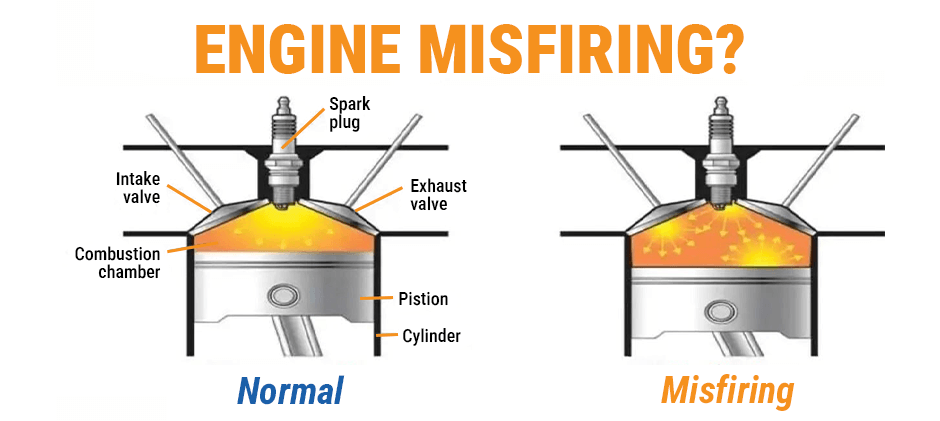
Common Causes of Engine Misfires
A simple way to diagnose is to remember what every cylinder needs:
- The right fuel delivery
- The right air amount
- Enough compression
- Correct ignition or heat source (spark on gas; heat/compression + correct injection on diesel)
- Correct timing of events
If anyone is missing, you get an engine misfire (or something that feels exactly like one).
Top Misfire Causes
Ignition / Cold‑Start Heating
- Gas engines: worn spark plugs, weak coils, damaged plug wires
- Diesel cold starts: weak glow plugs can cause rough running until warm
These are often engine auxiliary components that affect starting quality and stable combustion.
Fuel Delivery Issues
- Clogged/leaking injectors, weak fuel pump, restricted lines
- Plugged filters or water contamination
- Stop the solenoid from not opening/closing correctly
- Typical pattern: idles “okay,” then stumbles or loses power under load.
Air Intake Leaks or Restrictions
- Air leaks after the filter (lean misfire on gas)
- Dirty air filter, manifold gasket leaks affecting one cylinder
Low Compression / Mechanical Wear (Usually the expensive one)
- Ring/cylinder wear, valve sealing issues, head gasket leaks, timing slip
- Often worse at idle and during starting.
Overheating & Oil Control Problems (Indirect, but important)
- Overheating can increase the likelihood of misfires by impairing combustion stability and cylinder sealing. If you see high temps, oil/coolant mixing signs, or low oil pressure, check the cooling/lube system—including the engine oil cooler.
Potential Causes
If you need a quick “most likely” list before tearing in:
- Gas engines: spark plug → coil/wire → air leak → injector/fuel restriction → compression/timing
- Diesel engines: injector/fuel restriction → glow plug (cold) → air restriction → compression/valve lash → timing/sensors
Repairing the Root Cause
A misfire can come from one failing part—or two smaller issues stacking up (example: marginal injector + restricted filter). Swapping parts blindly often wastes money.
A practical approach:
- Confirm the symptom (idle only, under load only, hot only, cold only)
- Check basics (air filter, fuel quality, battery/starting speed)
- Inspect the most failure-prone parts first (plugs/glow plugs, coils, injectors)
- Only then chase mechanical causes (compression, valve lash, timing)

How to Fix Engine Misfiring?
Below is a step-by-step path that fits most off-road machines without assuming car-specific systems.
Step 1: Recreate the condition
Write down:
- When it misfires (cold start vs warmed up)
- RPM range
- Load condition (PTO engaged, hydraulic work, slope, heavy push)
This prevents “it’s fine in the shop” situations.
Step 2: Do fast, high-value checks (15–30 minutes)
- Air: inspect air filter, intake boots, clamps, and manifold area for leaks
- Fuel: check for stale fuel, water in fuel, restricted filter, weak supply
- Electrical (gas): inspect plug condition, gap, cracked porcelain; coil connections
- Starting health: slow cranking can mimic misfire; starter/charging issues matter
If you’re collecting replacement items during diagnosis (filters, injectors, ignition pieces, solenoids), it’s usually faster to source from a single catalog of engine parts so you can match by engine brand/model and reduce ordering delays.
Step 3: Cylinder-by-cylinder isolation
Depending on equipment and access:
- Gas engines: pull and inspect plug by cylinder; check coil output; inspect plug wire (if used)
- Diesel engines: look for injector imbalance (sound/temperature differences); check return flow (where applicable); verify connector health on electronically controlled injectors
Step 4: Confirm fuel delivery quality
Misfires under load commonly point to fuel supply limits.
- Replace/inspect the fuel filter
- Inspect fuel lines for collapse/cracks
- Verify pump output (as applicable)
- Check injector spray/flow pattern (bench test if needed)
Step 5: Check compression and valve train if the easy fixes don’t change anything
Compression and leak-down testing (or equivalent field checks) help catch:
- valve sealing issues
- ring wear
- head gasket leaks
- timing problems
This step is where you avoid repeating the same misfire forever.
How to Prevent Engine Misfires?
Preventing an engine misfire is mostly about keeping combustion stable and keeping heat under control—especially in dusty, high-vibration off-road work.
1) Follow a “combustion basics” maintenance routine
- Replace air and fuel filters on schedule (dusty work shortens intervals)
- Use clean, correct fuel (store fuel properly; manage water contamination)
- Service injectors when performance drops (don’t wait for total failure)
- For gas engines, replace spark plugs at recommended intervals
2) Keep starting and charging systems healthy
Hard starting and slow cranking increase incomplete burns and rough running—especially on diesels in cold weather.
- Check battery condition and cable connections
- Inspect starter performance
- Verify alternator output where applicable (charging issues can create odd misfire-like behavior in electronically controlled systems)
These are common “small parts, big impact” items—often found under engine auxiliary components.
3) Control heat and oil temperature
Overheating accelerates wear and can lead to sealing problems that eventually show up as misfires.
Watch for:
- rising temp gauge
- oil leaks near cooler assemblies
- milky/discolored oil (possible coolant mixing)
- low oil pressure indications
If those appear, inspect the cooling/lube system early—including the engine oil cooler—because keeping oil at the right viscosity supports lubrication and reduces the wear that can later cause compression-related misfires.
4) Don’t ignore “minor” symptoms
A light stumble under load is often the early stage of:
- A fuel restriction that will worsen
- An ignition part breaking down under heat
- An injector pattern drifting
Fixing it early is usually cheaper than repairing valves, heads, or pistons later.
Conclusion
An engine misfire on off-road equipment means one or more cylinders aren’t contributing power. The fastest fix comes from a structured approach: confirm when it happens, do basic air/fuel/electrical checks, isolate the weak cylinder, then test injectors and compression if needed. FridayParts is an aftermarket parts supplier dedicated to providing high-quality, cost-effective products. We maintain an extensive inventory, and our products are widely compatible with numerous heavy equipment brands. When inspecting or repairing an engine, you can utilize our engine parts catalog to precisely identify the components you need, thereby facilitating a more efficient and successful overhaul.
