

When servicing your John Deere tractor, the operator manual recommends Hy-Gard fluid. But what if the nearest dealer is far away, or you want a cheaper alternative that still delivers reliable performance? Lots of operators have the same question. This guide covers the common John Deere Hy-Gard equivalent. And what to look for when making your choice.
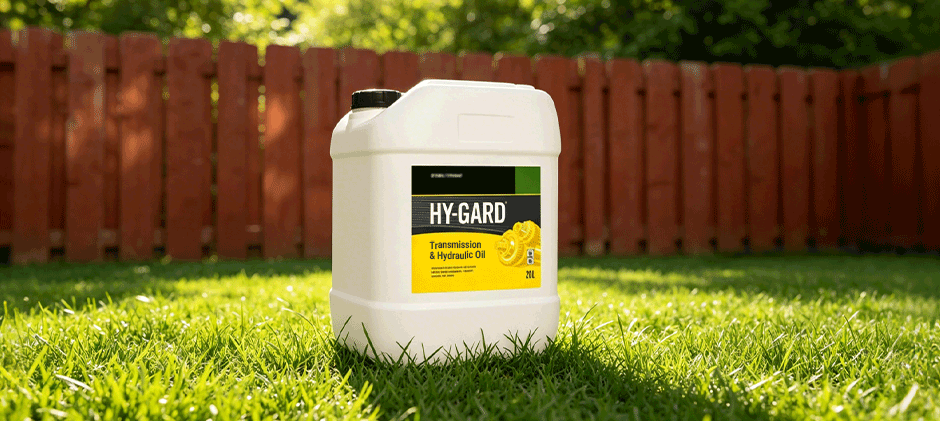
What Is John Deere Hy-Gard Fluid?
John Deere Hy-Gard isn’t just regular hydraulic oil. It’s a special Universal Tractor Transmission Oil, or UTTO. It’s made for tractors with the common sump system, so it lubricates several parts all at once:
- Transmission and final drives
- Hydraulic systems
- Wet brakes and clutches
Because it has so many functions, its unique blend contains targeted additives. These cut down component wear, stop brake chatter, and hold up under high pressure and heat. John Deere offers two main Hy-Gard grades built for different weather conditions:
- JDM J20C: The standard all-season fluid. This is the most widely recommended option and offers solid protection across typical operating temperatures.
- JDM J20D: The low-viscosity variant. It’s engineered for cold climates. It flows freely when starting up in freezing weather, avoiding pump cavitation and slow hydraulic response.
Knowing the difference between these two grades is the key first step to picking a suitable replacement. Even if you use premium fluid, choosing the wrong grade can cause operating problems.
What Specs Do I Look For in a Hy-Gard Equivalent?
The secret to finding a safe and effective John Deere Hy-Gard equivalent isn’t about finding a specific brand name; it’s about matching the performance specification. When you look at a container of tractor hydraulic fluid, ignore the marketing claims on the front and turn it around to find the technical data sheet or the list of specifications it meets.
- For a standard Hy-Gard alternative, the label must state that the fluid meets or is suitable for use in applications requiring John Deere J20C.
- For a low-viscosity Hy-Gard alternative, the label must state that it meets the John Deere J20D specification.
A fluid that meets these specs has been formulated with the correct base oils and additive packages to protect your equipment. If the container doesn’t explicitly list the J20C or J20D spec, it’s best to avoid it, as it may lack the critical additives your tractor’s shared system requires.
Common John Deere Hy-Gard Equivalent Options
Lots of tractor owners and mechanics use aftermarket oils that meet these standards with great results. From product specs and user forums, here are some common picks:
- Traveller® Premium Tractor Trans/Hydraulic Fluid: Easy to find, and its spec sheet clearly says it works for applications requiring John Deere J20C oil. It’s a go-to for people wanting solid performance at a reasonable price.
- Shell Spirax S3 TLV or S4 TXM: Shell makes these as direct replacements. The Spirax range has a good reputation and works well in newer tractor transmissions and hydraulic systems.
- NAPA Premium Tractor Hydraulic & Transmission Fluid: Most auto parts shops stock this house-brand UTTO. Many users recommend it, and the packaging lists the J20C specification.
- Chevron, Mobil, Castrol and other big oil brands: They all make premium universal tractor fluids. Just like always, double-check the label for J20C or J20D. For instance, Chevron Synthetic All-Weather THF is frequently recommended as a low-viscosity substitute matching J20D.
Keep in mind these brands aren’t available everywhere. But if an oil comes from a reputable maker and shows the correct John Deere spec on the label, it’s a suitable option.
How to Make the Right Choice for Your Tractor?
Picking between official John Deere Hy-Gard oil and a matching alternative comes down to a few personal points. So let’s talk about what you need to consider.
- Warranty coverage: If your tractor still has an active powertrain warranty, sticking with genuine OEM Hy-Gard is the safest route. Legally, manufacturers can’t cancel your warranty just because you use aftermarket fluid. However, they can reject repair claims if they prove the wrong fluid caused component damage. Using OEM oil avoids this hassle completely.
- Tractor age and model: Modern tractors place higher demands on hydraulic oil. Older, basic gear-driven tractors built in the 1980s can tolerate minor differences in fluid. By contrast, newer units with advanced hydrostatic or IVT transmissions, onboard electronics and high-pressure hydraulics are far less forgiving. For these complex newer machines, go with OEM fluid or a high-grade synthetic alternative that meets the required specs.
- Climate and working conditions: This ties back to choosing between J20C and J20D. If you’re based somewhere warm like Florida, low-viscosity J20D fluid isn’t necessary. On the flip side, if you operate in cold areas such as North Dakota and clear snow in January, a J20D equivalent is critical to keep your tractor running well.
- Your own view on risk and savings: Many long-time tractor owners keep using factory Hy-Gard just for peace of mind. They say saving $50 on oil isn’t worth risking a $10,000 transmission repair. That’s a fair stance. Other operators believe any fluid that hits the official specs works just as well, so there’s no need to pay extra for the John Deere brand. In the end, you need to decide which side you land on.
Can You Mix Hy-Gard With Other Hydraulic Fluids?
As a general rule, try not to mix different hydraulic fluids if you can avoid it. Two different oil brands that both meet J20C might technically work together, but their additive formulas can still differ slightly. Mixing them could cut down performance.
That said, never mix J20C fluid with cheap generic hydraulic oil (such as budget 303 fluid) or other oil types like engine oil or automatic transmission fluid. Lots of operators have run into serious issues from this: foaming oil, broken-down additives, damaged seals and sludge buildup.
The smartest approach is to fully drain the old fluid and replace the filter whenever you switch oil brands or types. This way, only one consistent, high-quality fluid stays inside to protect your equipment.
Conclusion
When shopping for an alternative to John Deere Hy-Gard oil, always check the specs first. If the oil meets your tractor’s required J20C or J20D standard, it will protect your equipment well. FridayParts supplies high-quality aftermarket parts for John Deere tractors at affordable prices with fast shipping.
FAQs
What oil works with John Deere Hy-Gard?
Any good Universal Tractor Transmission Oil (UTTO) is compatible if the label clearly says it meets John Deere J20C for regular Hy-Gard, or J20D for low-viscosity Hy-Gard.
Is J20C the same thing as Hy-Gard?
Not quite. J20C is the official performance standard created by John Deere. Hy-Gard is simply John Deere’s branded oil that follows this standard. Here’s an easy way to understand it: lots of brands make SAE 5W-30 engine oil, but each uses their own brand name. J20C is the rule, and Hy-Gard is just one oil that satisfies it. Other manufacturers also produce fluids that meet J20C requirements.
What viscosity is John Deere Hy-Gard?
John Deere Hy-Gard is a UTTO (Universal Tractor Transmission Oil), so it does not use the same viscosity grading system as engine oils. Generally, standard Hy-Gard (J20C) runs about the same viscosity as multi-grade SAE 10W-30. Low-Viscosity Hy-Gard (J20D) is thinner, similar to SAE 5W-20 to make sure better flow in extreme cold.
