

Understanding the choke symbols and position on a chainsaw is essential for a successful cold start of your Stihl chainsaw. Its system uses a four-position Master Control Lever, which includes choke, start, throttle lock and an on-off switch. For a cold start, most Stihl chainsaws often use the choke position. But is there anything to note to prevent engine flooding? Let’s move on and explore the Stihl choke position and how to use it for Stihl cold starts.
What Is the Choke on A Stihl Chainsaw?
When a chainsaw engine is cold, it needs a “richer” fuel mixture (more fuel, less air) to ignite. The choke restricts airflow into the carburetor, temporarily increasing the fuel-to-air ratio to help start a cold engine. On Stihl chainsaws, a four-position lever, the Master Control Lever, typically controls it. This ingenious design combines four essential functions: choke, start, throttle lock and on-off switch. The choke position is usually marked with a symbol that looks like a closed circle or a line with a diagonal slash. For a cold start, you move the lever all the way down to engage it.
Interested in choke symbols on a lawn mower? Click for details.
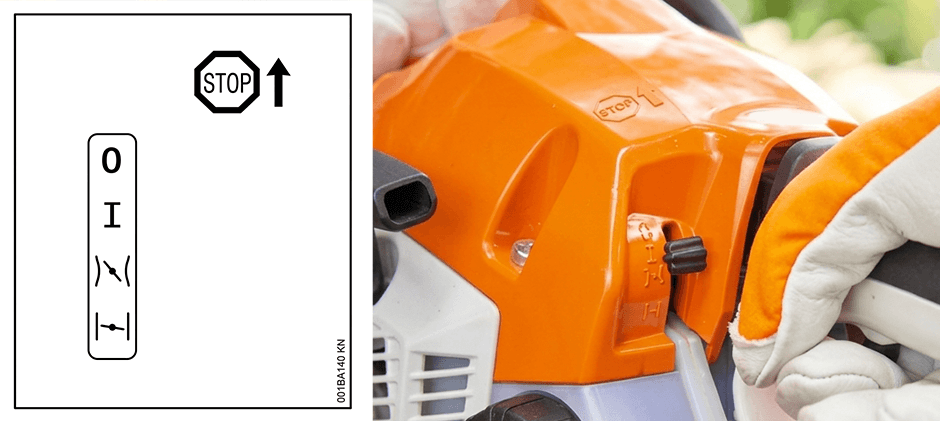
Understanding Stihl Choke Position: What Do the Choke Symbols Mean?
The lever itself is the main visual indicator rather than a separate icon on the housing. Here is what they mean:
Full Choke (Closed Choke)
- Symbol: |▲| or a closed circle with wavy lines
- Located at the very bottom of the lever’s path
- Completely closes the choke valve to restrict air
- Use only for cold starts
Half Choke (Warm Start / Starting Throttle
- Symbol: /▲\ or a diagonal slash
- One click up from the bottom
- Opens the choke slightly while keeping the throttle partially locked open to help the engine catch and idle
Run (Normal Operation)
- Symbol: I
- Standard position for cutting
- The choke is fully open, and the engine runs at normal idle
Stop (On-off Switch)
- Symbol: 0
- Located at the very top
- Flipping the lever here cuts the ignition and stops the engine.
The YouTube video clip helps you better understand the choke symbols on the Stihl Chainsaw.
How to Use the Choke for A Cold Start?
Starting the Stihl chainsaw when the engine is cold requires the use of the choke. You can follow the standard cold-start sequence:
- Depress the throttle lock and throttle, and move the Master Control Lever all the way down to the Full Choke Position. You may hear the engine briefly ignite, make a muffled “brrr” or “pop” sound, and then die immediately.
- Firmly press the primer (if fitted) 2 to 3 times. It’s impossible to over-prime as excess fuel is simply returned to the fuel tank.
- Place the chainsaw on the ground. With a firm grip (i.e., left hand on top handle and foot through rear handle), pull the starter cord 3–4 times, or until you hear the engine ‘fire’. NOTE: Do not pull the starter cord more than 3–4 times while on full choke to avoid engine flooding.
- Once the saw has ‘fired’, move the lever one click up to the“Half Choke” position and pull over. The saw should now start within 3 or 4 pulls. The first touch of the throttle will allow the choke to automatically move to the fully open position and the engine will idle.
- Once the engine is running, squeezing the throttle automatically disengages the throttle lock and pops the Master Control Lever up into the Run (I) position. Then, your chainsaw is ready to cut!
*NOTE: If the engine is warm, it is not necessary to commence the starting procedure on the full choke position. Instead, simply move the choke to the half-choke position. Some Stihl outdoor power equipment, like certain trimmers, feature an automatic choke that automatically returns to the run position the moment you squeeze the throttle.

How to Avoid Flooding Your Engine?
The most common mistake beginners make is pulling the starter rope too many times while the engine is on Full Choke. This draws too much fuel into the combustion chamber, “flooding” the engine and wetting the spark plug. Therefore, the rule of thumb is: Never pull the starter rope more than 3 times in any single choke position. If you pull 3 times on Full Choke and don’t hear a “brrr”, move it to Half Choke anyway; if you pull 3 times on Half Choke and it doesn’t start, you may need to check for other issues.
What If It Takes More Than 3 Pulls?
If you’ve pulled the cord 5 or 6 times on Full Choke without hearing that “brrr” sound, your engine is like flooded or there is an underlying issue:
- Engine is Flooded: If you smell strong gasoline, the engine is flooded. Turn the switch to “Stop,” remove the spark plug, dry it off, pull the starter rope a few times to clear excess fuel from the cylinder, put the plug back, and try starting directly in the Run or Half Choke position.
- Carburetor Issues: Old fuel can clog the tiny passages in your carburetor. If the chainsaw refuses to start even with the correct choke sequence, the carburetor may need a thorough cleaning or adjustment.
- Spark Plug or Fuel Filter: A dirty spark plug or a clogged fuel filter can prevent the fuel-air mixture from igniting, regardless of how perfect your choke position is.
Conclusion
Mastering the Stihl choke and understanding your choke positions is the secret to hassle-free cold starts while protecting your engine from flooding. Knowing when to transition from Full Choke to Half Choke, you’ll keep your chainsaw running smoothly season after season. However, worn-out components can still cause starting issues. If your chainsaw is struggling due to a clogged carburetor, a weak spark plug or faulty fuel, we can have you covered. At FridayParts, we are dedicated to providing a vast selection of quality replacement parts for Stihl chainsaws. Explore our wide chainsaw parts catalog at FridayParts today and keep your power tools running like new.
