

Let’s compare a bulldozer vs front-end loader (also called a wheel loader, bucket loader, or just loader). These two machines look similar at first glance—they both have a cab and a big blade or bucket at the front. But they do totally different jobs.
What Is a Front-End Loader?
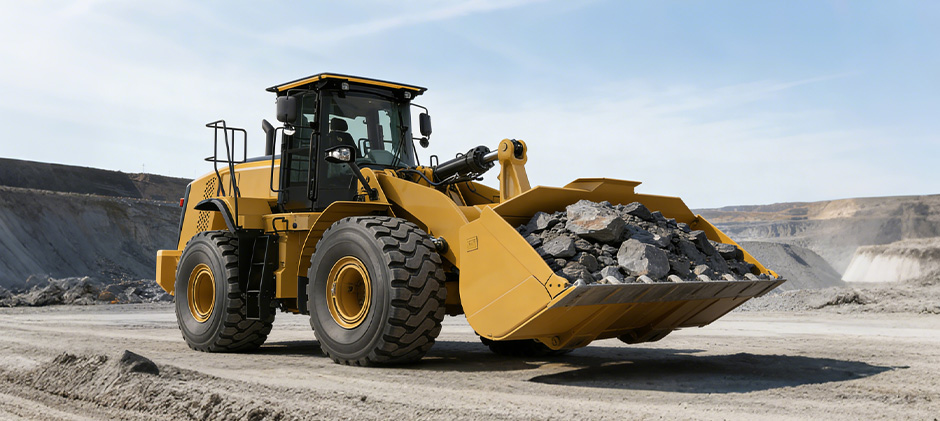
The wheel loader is the most common and representative type of front loader. For this comparison, we’ll use the wheel loader as our example of front loaders. Wheel loaders are mainly used to scoop and move materials. They have a large bucket at the front controlled by two strong hydraulic arms. At work, the bucket can scoop up lots of loose materials like gravel, sand or dirt, then lift them and dump them into a truck, a hopper or a pile.
Wheel loaders also have an articulated frame, meaning the middle of the machine can turn for steering. With its wheeled chassis, it’s very flexible and fast on job sites, and works best on fairly flat and smooth ground.
Common Applications
Wheel loaders are used for many purposes and have high efficiency. It can move quickly between locations, so it’s great for repetitive tasks.
- Material handling: This is what wheel loaders do best. It can load dump trucks, and can also send materials to equipment such as crushers and asphalt plants. It is also possible to organize and move piles in quarries or sand pits.
- Earthmoving operations: A wheel loader is not a device designed for digging, but it is well suited for moving loose soil. It can also be used to backfill trenches or do some simple ground leveling work.
- Site Cleaning: Because of its fast movement and large bucket capacity, it can quickly clear waste from construction or demolition sites and move the debris into piles.
- Mining and Quarrying: Wheel loaders are very important in mines and quarries. It is often used to load rock or ore after blasting. It can also feed a conveyor and do some daily general yard work on the site.
Pros:
- Mobility and speed: The wheeled design allows the machine to move quickly on the site, making loading and handling more efficient.
- Multifunctional: The bucket can be replaced with other attachments, such as a fork or grapple, which not only loads but also does more work.
- Strong lifting ability: It can lift heavy loads relatively high, which is very suitable for loading high-sided trucks or hoppers.
- Good vision: The cab is usually positioned high, allowing the operator to clearly see the front and bucket, making operation safer and more accurate.
Cons:
- Limited traction: Wheeled machines tend to slip on very soft, muddy or uneven surfaces, where tracked machines is often advantageous.
- Weak bulldozing ability: Compared to the Bulldozer, it doesn’t have enough thrust to be suitable for large-scale bulldozing or land preparation.
- High tire costs: Tires are expensive and can easily be scratched or damaged where there are sharp rocks or debris.
Related: Read more about front-end loader.
What Is a Bulldozer?
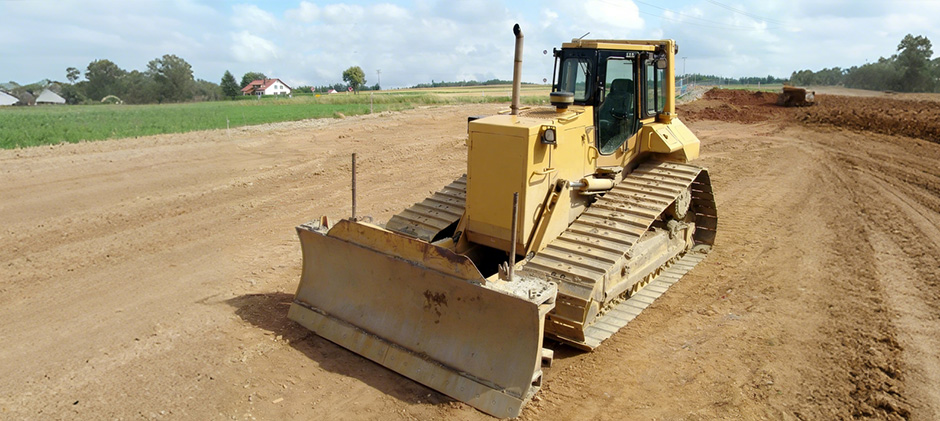
A bulldozer is known for its strong pushing power. Its blade at the front is a large, thick metal. Unlike a loader’s bucket, the blade is mainly used to push lots of material, level the ground, and clear obstacles.
The whole machine feels solid and powerful. Bulldozers use a tracked undercarriage that distributes the weight of the machine over a larger area of ground. This also maintains good traction and stability on mud, stone or uneven terrain. The advantage of a bulldozer is not to lift things up, but to keep pushing forward. It can apply a pushing force for a long time and is used to move earth, clear the site, and even change the terrain.
Common Applications
Bulldozer comes in handy when the ground needs clearing or reshaping. It is for large-scale earthmoving operations and site preparation.
- Site Cleaning: Bulldozers are often used to clear trees, stumps, stones, and old building debris from construction sites in preparation for new construction.
- Leveling the ground and repairing slopes: Bulldozers are very suitable for earth cutting and filling operations. They can flatten the ground and also repair the required slope. They are used in construction foundations, roads or reservoirs.
- Road construction: In the wild or unpaved areas, bulldozers can create temporary roads, build embankments, and prepare roadbeds in preparation for the subsequent paving of formal roads.
- Mining operations: In mines, bulldozers are often used to remove soil and rocks from the ore layer. They can also push materials near excavators or loaders, and can also be used for site maintenance and restoration in mining areas.
- Large-scale earthmoving: Bulldozers are generally highly efficient equipment if a large amount of earth needs to be moved over a short distance.
Pros
Bulldozers have a lot of pushing power, push a lot of earth and rocks and also clear hard obstacles.
- Good traction: On soft, muddy, sandy or uneven surfaces, the tracked chassis also maintains good traction and stability.
- Strong and durable: Bulldozers are specially designed for harsh working conditions and can perform bulldozing operations for a long time and withstand great pressure.
- Good leveling effect: If operated by an experienced operator, a bulldozer can push the ground very flat and have a smooth surface.
Cons
- Slow driving speed: The speed of the crawler track is slower than that of the wheeled equipment, so it is not suitable for transporting materials over long distances.
- Limited maneuverability: The machine is large and slow, and it is not very flexible to operate in small spaces.
- Cannot load material: The bulldozer’s blade is not raised high enough to load material into the truck.
- High chassis maintenance costs: The crawler chassis structure is relatively complex. For example, components such as crawlers, track rollers, and guide wheels are prone to wear and tear. Maintenance costs are relatively high.
Related: Read more about bulldozer track parts.
Front Loader vs. Bulldozer: Key Differences
Core Functionality
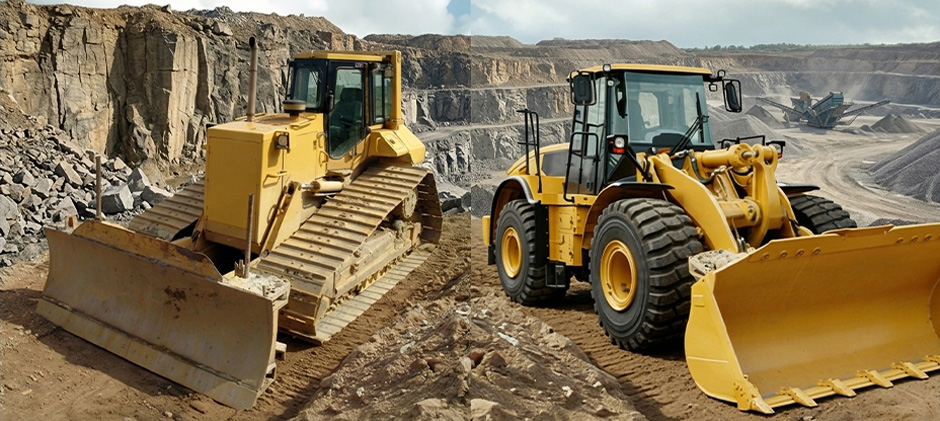
The main difference between them is how they move material.
- Wheel loaders are designed to scoop, lift, and carry materials, usually to load them into trucks or hoppers.
- Bulldozers are used to push, spread, and level the ground, and shape the terrain.
Wheel loaders are great for repeated loading and hauling work, while bulldozers are better for continuous jobs like moving dirt and grading large areas.
Attachment Options
While both wheel loaders and bulldozers can be paired with different attachments, these attachments actually reflect their respective primary uses. Wheel loaders are a real “all-rounder”. Its main tool is the bucket, but it can also be replaced with other tools:
- Fork: Used to carry pallets, pipes or other long strips of materials.
- Grab: Used to grab irregular objects such as logs, scrap metal or demolition waste.
- Special bucket: such as high-dump bucket (which can lift materials higher) or light material bucket (suitable for large-volume, low-density materials).
The main tool of a bulldozer is the blade, which comes in different types:
- Straight blade: suitable for fine leveling work
- U-shaped blade: suitable for large-scale transportation
Some key tools can usually be installed on the rear of the bulldozer:
- Rippa: Like a large claw, it is used to loosen compacted soil, frozen soil or soft rock in preparation for bulldozing operations.
- Winch: used to pull other equipment or drag heavy objects in forestry or rescue operations.
Size, Mobility, and Jobsite Considerations
This is the classic wheels vs. tracks debate.
Wheel loaders have tires and articulated steering, so they are fast and flexible. On level construction sites, it can move quickly. Ideal for quarries, asphalt mixing plants or large open sites. It needs solid ground, though. If you encounter deep mud or steep, soft slopes, you are prone to slipping or getting stuck.
Because crawler bulldozers have tracks, they have strong traction and are very stable. It can work on soft soils, steep slopes, and rough, rugged terrain. Wheeled equipment tends not to move in these places. But it is slow and has poor maneuverability. Also it may break the ground when turning, so it is not suitable for use in completed or finished surfaces.
Operating Costs
The operating costs of equipment are an important factor that owners must consider.
- Fuel consumption: Bulldozers require long and high-load operations, and the crawler system has high friction, so they usually use more fuel than wheel loaders of the same specification.
- Maintenance: This is where the difference between the two is greatest.
- The chassis system of a bulldozer is the most expensive. The tracks, track rollers, drive wheels and idlers are all wear parts that need to be inspected regularly and eventually replaced, which is both expensive and time-consuming.
- The most worn component of a wheel loader is the tire, and while tire changes aren’t cheap, the overall powertrain and chassis maintenance are much simpler than with a bulldozer.
Factors to Consider When Choosing Between the Two
How to choose between a wheel loader and a bulldozer? Ask yourself four questions about your project:
Main Task?
- If the task is loading trucks, moving piles, or handling materials, a wheel loader is the right choice.
- If the task is leveling ground, repairing slopes, or pushing large amounts of earth, choose a bulldozer.
Site Condition?
- If the ground is firm, flat, or prepared, and speed is important, go with a wheel loader.
- If the ground is soft, muddy, rough, or steep and strong traction is needed, a bulldozer is better.
Project Size and Workflow?
- For projects with short cycles where materials must be moved long distances (e.g., from a yard to a hopper about 100 yards away), a wheel loader’s speed is very useful.
- For large, continuous work (e.g., stripping topsoil from a 10-acre site), a bulldozer’s efficiency is irreplaceable.
The Long-Term Operating Budget?
- Bulldozers: High fuel consumption and costly undercarriage maintenance—plan ahead.
- Wheel loaders: Tire replacement is the main cost, but fuel consumption is generally lower.
Conclusion
Both wheel loaders and bulldozers are essential on construction sites. The loader offers flexibility and speed, while the bulldozer provides stability and power. Neither one is simply better than the other — they just suit different jobs.
We hope this comparison gives you a clear idea of which machine fits your needs. Whichever you choose, keeping your equipment running reliably is the key. FridayParts has a large stock of high-quality aftermarket parts for all major heavy equipment brands. We make sure you get durable, affordable parts for your loader or bulldozer to keep your machine working longer.
