

Front-end loaders include skid steer loaders, track loaders, and wheel loaders. You can see them everywhere, from large construction sites to farms. They load materials into dump trucks or move loose materials like rocks, soil, snow, wood chips, and feed. A loader has a bucket mounted on two hydraulic arms, and different attachments can be installed for different jobs. In this guide, we’ll cover the basics of front-end loaders: what a front-end loader is, its main parts, the most common uses, how they differ from dozers, and how to operate them.
What Is a Front-End Loader?
A front-end loader is also called a wheel loader. It’s mainly used for loading and moving all kinds of materials. It has a big bucket at the front, attached to two strong lift arms. Using the hydraulic system, the operator can raise or lower the bucket. When the bucket is full, the operator tilts it back a little so the material doesn’t spill out. When it’s time to dump, they tilt the bucket forward to unload where needed.
One big feature of most front-end loaders is articulated steering. Unlike cars, which steer with the front wheels, these loaders have a hinge in the middle. The front and rear frames turn around this joint to steer. This design makes the loader much more flexible, with a smaller turning radius. It’s easier to use in stockpiles or busy job sites.
Most front-end loaders use big tires, so they move faster and work more efficiently on hard ground. There are also track loaders, though. Track loaders work better on soft ground, mud, or rough terrain because they have better grip and stability. The downside is they’re usually slower than wheel loaders.
The Main Parts of a Front-End Loader
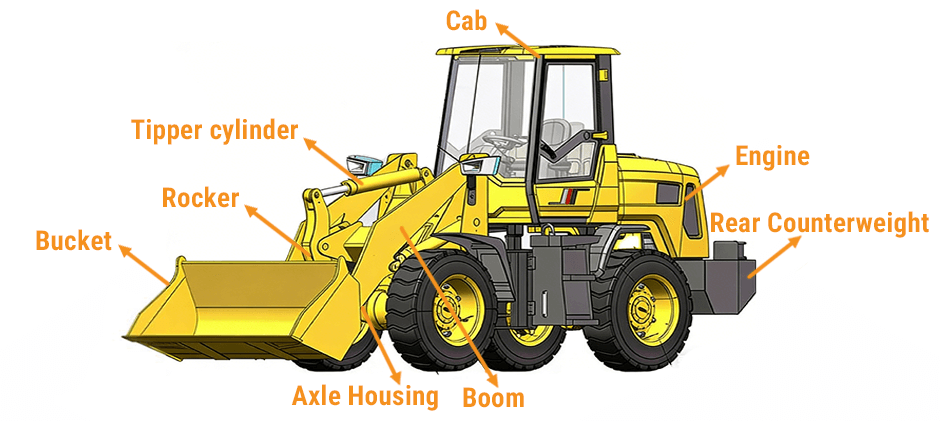
A loader may look complex, but it’s made up of several key parts. Let’s take a look at the main components of a wheel loader.
Bucket
The bucket is the most visible part of the loader, that is, the tool used to move the material. There are many different types of buckets, such as general-purpose buckets for loading soil and gravel, rock buckets with stronger edges (suitable for quarry operations), and light-material buckets with larger capacities for loading lighter materials such as wood chips and snow.
Lift Arms
These are the two large arms connecting the bucket and the loader body. Their main function is to lift or lower the bucket to complete the loading and unloading operations.
Hydraulic System
The hydraulic system uses pressurized oil to power the cylinders. This is why the lift arms can move up and down, and the bucket can tilt forward or backward. With a stronger hydraulic system, the loader can lift more and work more efficiently.
Chassis and Axles
The chassis is the main frame of the machine. It supports the whole loader and handles the heavy loads during operation. The engine and transmission are mounted on the chassis, and the axles transfer power to the wheels.
Engine
Loaders generally use powerful diesel engines. It provides power to move the machine and operate the hydraulic system, especially when lifting heavy objects, which require sufficient power and torque.
Cab
The cab is where the operator controls the machine. Cabs nowadays generally focus on comfort and safety, and have better visibility. Inside, there are control devices such as joysticks and instruments, and there are also ROPS (Roll-Over Protective Structure) to protect the safety of operators.
Counterweight
The counterweight is located at the rear of the machine. When carrying heavy loads, it balances the weight in the bucket to keep the loader stable, preventing it from tipping forward.
What are Front-End Loaders Used for?
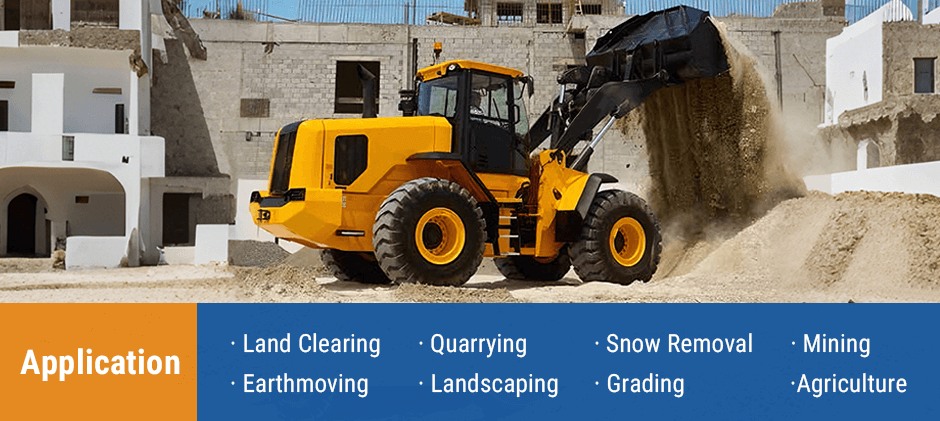
Front-end loaders are used in many different industries. They can move large amounts of material quickly, which makes them very useful in many kinds of work.
Construction and Site Development
On construction sites, loaders load excavated soil into dump trucks. They can also move sand and gravel, backfill trenches, and clear debris. They can handle many different tasks on job sites.
Agriculture
On the farm, it is easy to carry feed, clean up manure, transport fertilizer, and stack hay bales. After attaching attachments like forks or grabs, you can also carry pallets or large round bales of grass.
Material and Waste Handling
In recycling centers, scrap yards, and landfills, loaders are often used to sort and move materials. It is flexible in turning, can work in relatively narrow or uneven places, and can also feed the conveyor.
Maintenance and Snow Removal
Loaders are also useful in the routine maintenance of large sites or parks. For example, moving topsoil or mulch when doing greening. If you attach a snowplow or snow pusher, you can also quickly clear snow, which is more efficient than many small devices.
Bulldozers vs Front-End Loaders
Bulldozers and front-end loaders often work on the same site, but they do totally different jobs. The main difference is: Bulldozers push, loaders lift and carry.
Main Functions
There is a large blade in front of the bulldozer. It uses powerful pushing force to push the soil, level the ground, and clear obstacles. The strength is mainly to move forward horizontally. In front of the loader is the bucket, which is responsible for shoveling, lifting, and transporting materials. For example, loading sand and gravel onto the truck, the force is lift and carry materials.
Chassis and Mobility
Bulldozers are all crawler type, with distributed weight and strong grip, suitable for mud, soft ground and rough road surface, but slow speed and not flexible enough to turn. Most loaders are wheeled, run faster, can drive on hardened surfaces, and are great for running back and forth between piles and trucks.
Attachments and Multi-use
The loader is particularly strong. It has a quick connector and can replace the bucket with a fork, grapple bucket, broom, and snow pusher in just a few minutes. It can do a lot of work on one function. Bulldozers are more specialized and mainly use different blades, sometimes with a ripper installed at the back to break through hard soil or rocks.
Operator’s Field of View
The loader cab is high, so the operator can clearly see the bucket and the truck to be loaded. The bulldozer cab is low, so the operator can see the ground in front of the blade clearly, which is convenient for precise pushing.
How to Operate a Front-End Loader?
Operating a front-end loader requires skill, focus, and safety. Though specific controls differ a little, the basic operations are the same. Before, check tire pressure, hydraulic leaks, and fluid levels (engine oil, hydraulic fluid, coolant).
Familiarize Controls
Inside the cab, you’ll find:
- Steering: This may be a steering wheel or a joystick (often the left one).
- Boom and Bucket Controls: The right-hand joystick. Pushing/pulling it raises/lowers the lift arms. Moving it left/right tilts (curls) the bucket.
- Pedals: An accelerator and a brake pedal. Some systems have another brake pedal. When not moving, it disengages the transmission for maximum hydraulic power.
- Forward/Reverse Selector: A lever or switch to control the direction of travel.
The Basic Work Cycle
- Scooping: Drive straight toward the pile. Lower the bucket, the level just touches the ground. Move into the pile. As the bucket fills, start tilting it back (curling) and lift the arms.
- Carrying: Once the bucket is full and curled, back away from the pile. Keep the bucket low. Don’t carry it too high—this can tip the loader.
- Dumping: When you reach the drop-off spot (like a dump truck), raise arms over the target. Tilt the bucket forward slowly to dump the material.
- Shutting Down: After finishing, lower the bucket on the ground, set the parking brake, let the engine idle for a few minutes to cool down, then turn it off.
Final Thoughts
Front-end loaders are among the most efficient machines for material handling, boosting productivity in construction, agriculture, and other industries.
Need some essential maintenance parts for your loaders? FridayParts offers a wide range of loader parts from various brands at competitive prices. Contact us online today.
