

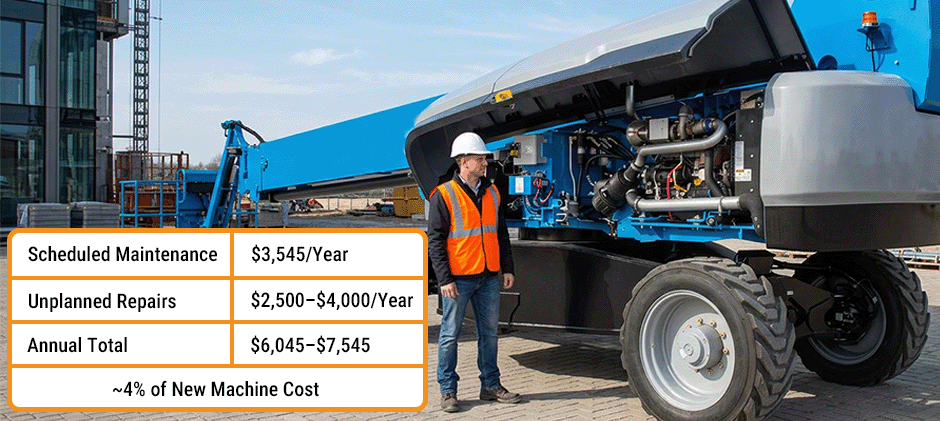
Budget $3,500 to $4,500 a year for routine upkeep on a mid-size telescopic boom, plus another $2,000 to $4,000 for repairs nobody plans for. In practice, that works out to roughly 4% of what the machine cost new—a useful benchmark for the real boom lift repair and maintenance cost. Further down, you will find real pricing on hydraulic rebuilds and electrical fixes, labor rates broken out by service type, and a five-year cost outlook. The last section turns to the small habits behind that difference—the ones that keep a $7,000 repair bill from becoming a $20,000 surprise.
What A Yearly Budget Looks Like
Keep scheduled maintenance and unplanned repairs in separate lines of the budget. You’ll forecast a yearly boom lift repair and maintenance cost more accurately, and the repair-or-replace decision on an aging machine makes itself.
One 60-foot telescopic lift makes a good example. Quarterly inspections, one annual inspection, and hydraulic fluid service spread across the year added up to $3,545 in planned maintenance.
| Cost Category | Annual Budget |
|---|---|
| Scheduled maintenance | $3,545 |
| Unplanned repairs | $2,500 to $4,000 |
| Estimated annual total | $6,045 to $7,545 |
The scheduled maintenance figure above is a case study. One specific 60-foot machine, not a national industry average. Your own boom lift repair and maintenance cost may fall below it. A newer electric unit often does. Or it may run much higher. Worn hydraulic hoses, aging electrical controls, a neglected service history—any of those on an older diesel machine will push it up.
Cost Per Hour Example
| Annual Hours | Cost per Hour at $6,045 | Cost per Hour at $7,545 |
|---|---|---|
| 400 | $15.11 | $18.86 |
| 800 | $7.56 | $9.43 |
| 1,200 | $5.04 | $6.29 |
For this comparison, annual spending remains constant so that the effect of utilization is clear. Actual annual costs may increase with heavier use.
What Changes Your Costs Most
No single rate applies to every boom lift. The following factors usually have the greatest influence on annual ownership costs.
Machine Age And Condition
Older units need more than fluid and filters. Wear pads. Boom cables. Hoses. Tires. Electrical connections. All of them ask for closer attention as the machine ages.
One case. A roughly 10-year-old 60-foot telescopic unit. Catch-up work: about $6,927. Annual inspection labor. Hydraulic fluid and materials. A wear pad kit. A cable kit. Installation labor. An initial catch-up budget, not a recurring annual cost.
Long periods parked. Bought at auction. Serviced irregularly. Any of those, and the first repair cycle can cost far more than a normal service year.
Hours Of Use
Operating hours can matter as much as age. A boom lift working 800–1,200 hours per year will generally require more attention than one used only occasionally.
Higher use often increases spending on:
- Engine oil and filters
- Hydraulic filters
- Grease points and wear surfaces
- Tires
- Batteries and charging components
- Boom cables and wear pads
This is why a low-hour machine with good records can sometimes cost less to keep than a newer unit that runs hard every week.
Labor Rate And Service Method
Labor rates can change a repair bill quickly. Shop labor may run about $150 per hour, while mobile service often falls in the $150 to $250 per hour range. Travel time, emergency calls, and after-hours work can push the invoice higher.
Final labor cost usually depends on:
- Shop or field service
- Region
- Technician skill
- Travel distance
- Urgency
- Time of day
The same job can be manageable in the shop and painful in the field.
Common Repair Areas To Watch
Planned service tends to cost roughly what you expected. Unplanned repairs are what make a budget move, and two systems account for much of that: hydraulics and electrics. Problems in either can affect how the machine operates and turn into expensive repairs. Tires, platform leveling components, and boom extension systems should be on the same regular inspection list.
Typical Repair Ranges
| Repair Item | Typical Cost Range |
|---|---|
| Hydraulic cylinder rebuild | $1,500 to $4,500 |
| Hydraulic pump replacement | $2,800 to $7,500 |
| Platform leveling system repair | $1,500 to $4,500 |
| Jib replacement | $4,000 to $18,000 |
| Rough-terrain tire replacement each | $400 to $1,200 |
Keep in mind these are ranges, not hard quotes. The real number depends on machine size, how long the job takes, parts pricing, and what got damaged.
Hydraulic And Electrical Trouble Spots
Hydraulic leaks are just part of life. Hoses, fittings, and seals sit under constant pressure, so things let go eventually. Dirty fluid chews through pumps, valves, and cylinders. Low fluid drags performance down, and in the worst cases it kills the pump. So keep your hydraulic fluid, seal kits, and boom lift parts in good condition — that’s what stops a cheap fix from becoming an expensive one.
Don’t give the electrical system any less attention. A corroded connector, a weak battery, a worn cable, a sensor on its way out — any of these can trigger startup faults, control errors, or a machine that just shuts down on you without warning. Replace battery cables, switches, or control modules early, and the diagnosis ends there. A long repair bill does not start.
On articulating units, jib functions and platform leveling systems deserve close review. On telescopic units, extension cables, wear pads, and boom section movement often need more attention.
Inspection Schedule That Controls Spending
A large share of boom lift repair and maintenance cost can be controlled by following the right inspection and service schedule. Pre-use checks, frequent inspections, annual inspections, and preventive maintenance are related, but they are not the same thing.
Inspection And Maintenance Timing
| Task | Typical Interval |
|---|---|
| Pre-use inspection | Before each shift or use |
| Frequent inspection | Every 3 months or 150 hours, whichever comes first |
| Annual machine inspection | At intervals not exceeding 13 months |
| Engine and hydraulic service | Follow the manufacturer’s schedule |
The machine manual should always control the exact maintenance steps and service intervals for your model.
Practical Service Routine
Pre-Use Inspection
Start every shift the same way: check for leaks, tire damage, loose hardware, missing or unreadable decals, and damaged parts. Then test the lift controls and emergency functions per the manufacturer’s instructions. It takes a few minutes and can save you a bad day.
Frequent Inspection
Every 3 months or 150 hours — whichever comes first — the machine needs a proper once-over. That means checking the structure, controls, hydraulics, cables, wear pads, and safety devices per the inspection procedure for that machine.
Annual Inspection
The annual is the big one: structure, controls, hydraulics, safety systems, everything. Have it done by someone who’s actually qualified on that machine type, not just whoever’s free.
Hour-Based Service
Service fluids, filters, and lube points on the schedule laid out in the manual. Heads up — not every item follows the same 150-hour interval, so check the schedule instead of guessing.
None of these items cost much. A clean air filter, a fresh oil filter, a healthy hose, and decent wear pads are pocket change next to what you’d pay for a failed pump, a damaged valve, or a seized component.
The Cost Many People Miss
The repair invoice is only part of the real boom lift repair and maintenance cost. Downtime often hurts more than the parts bill.
If a machine is down for several days, you may also face:
- Delayed work
- Emergency rental equipment
- Crew idle time
- Equipment hauling
- Rescheduled subcontractors
- Pressure on project deadlines
Once you factor in the effect on production, a moderately priced repair turns into a costly one. That is why preventive maintenance supports job scheduling as well as mechanical reliability.
Diesel And Electric Units Need Different Budgets
Power type changes your maintenance pattern.
Diesel boom lifts often need more spending on:
- Engine service
- Fuel system work
- Cooling system repairs
- Starting and charging parts
Electric boom lifts avoid some engine-related expenses, but they still require:
- Battery testing
- Charging system service
- Wiring inspection
- Hydraulic system care
- Tire and structural checks
So before comparing two machines, make sure they match in power type, use pattern, and job conditions.
How To Keep Repair Costs Lower
Reducing boom lift repair and maintenance costs does not mean postponing necessary work. It means addressing wear before it affects additional systems.
Practical Steps That Help
Inspect Before Each Use
Catch leaks, loose hardware, tire damage, and missing safety items early.
Follow The Hour Meter
Service should match actual use, not rough guesses.
Use Service Records
Track recurring faults, inspection dates, and parts replaced.
Protect Hydraulic Cleanliness
Dirty fluid can shorten the life of pumps, valves, and cylinders.
Watch Corrosion Closely
Rust can damage structure, lines, and electrical connections.
Act On Early Symptoms
Jerky movement, drift, slow response, and warning lights should not be ignored.
Replace Parts At The Right Time
A worn hose or seal rarely stays a local problem. Replace filters and worn hoses, switches, or seals when inspections or manufacturer guidelines call for it, and the fault stops before it reaches other components—which is where repair costs stay under control.
Warning Signs That Deserve Fast Action
You should expect costs to rise soon if you notice:
- Delayed or jerky boom movement
- Hydraulic drift
- Visible leaks
- Recurring fault codes
- Weak charging performance
- Uneven tire wear
- Platform leveling problems
- Excessive boom bounce or play
At that point, targeted replacement of hydraulic cylinders, control valves, charging components, or tires may prevent a larger breakdown.
Repair Or Replace
At some point, the better decision is not another repair. It is deciding whether the machine can still deliver safe, reliable work without draining the budget.
You may lean toward repair when:
- The structure is sound
- The service history is consistent
- Problems are limited to a few systems
- Parts are still easy to find
- Downtime has been manageable
At some point, keeping a machine in service is no longer a simple proposition. Major structural damage, repeated system failures, and parts that are difficult to source can each make safe and reliable operation hard to guarantee. That is the point at which replacement belongs on the table. Structural damage should be assessed by someone qualified to inspect that particular machine before the machine is cleared to return to service.
This matters because not every expensive year means the machine is finished. The real question is whether the next repair improves reliability or only delays the next failure.
Final Words
Keep your yearly spend predictable by sticking to the inspection schedule, running clean hydraulic fluid, and buying parts that match without overpaying. For most owners, that final piece makes the biggest difference. FridayParts offers a wide range of aftermarket aerial lift parts at prices that leave room in your budget for the fixes you cannot foresee. With broad compatibility across major brands and plenty of stock on common wear items, you can get back to work without waiting on a dealer order.
