

Finding the right battery for your John Deere machine is important, but not that difficult. This simple guide — with a clear John Deere battery size chart — helps you find the correct battery for your lawn tractor, Gator, or farm tractor. We’ll also explain what the battery labels mean so you can choose the right battery and get your machine running again fast.
Why the Right Battery Size Matters
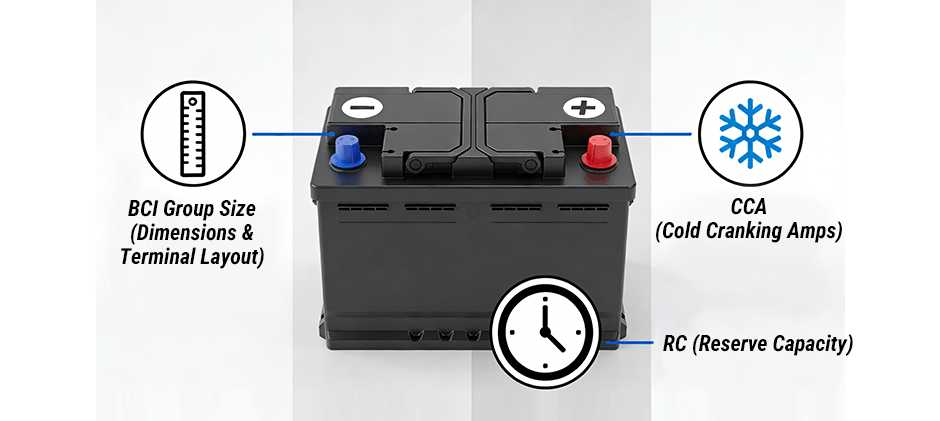
The right battery size keeps your machine safe, reliable, and easy to start.
A battery that doesn’t fit properly can vibrate loose or damage the cables, and an undersized one might not have enough power — especially on cold mornings.
As one farmer put it:
“A loose battery on a bumpy field is a recipe for a bad day and a dead tractor.”
Making sure your battery fits correctly prevents problems before they start.
What Do Battery Specifications Mean?
Every battery label includes a few numbers and letters that describe size and power. Here’s what they mean in plain language:
BCI Group Size
The most important number. It shows the battery’s physical dimensions (length, width, and height) and where the positive (+) and negative (–) terminals are located. This ensures the battery fits and connects correctly.
Voltage
All modern John Deere equipment uses a 12-volt system. This is standard across most lawn, utility, and farm machines.
Cold Cranking Amps (CCA)
This number shows how well the battery can start an engine in very cold weather (0°F / -18°C).
Diesel engines in larger tractors need higher CCA for strong starts.
Reserve Capacity (RC)
RC tells how long the battery can keep essential electrical systems running if the alternator stops working.
Machines with lights, cabs, or GPS systems benefit from higher RC ratings.
The John Deere Tractor Battery Size Chart
Here are the most common BCI Group Sizes found in John Deere machines.
Although John Deere sells its own “StrongBox™” batteries, the group size numbers follow the same international standards, so you can use them to find a match with any reliable battery brand.
BCI Group Size U1 / U1R
A small, lightweight battery made for lawn and garden machines.
The “R” means the terminals are reversed.
- Primary Use: John Deere 100 Series, S240, X300, and X500 Series Lawn Tractors
- Why it fits: Compact size and just enough power to start small gas engines. Fits easily under seats or hoods.
BCI Group Size 26 / 26R
A medium-sized battery that provides a good mix of power and size.
Common in utility vehicles.
- Primary Use: John Deere Gator™ Utility Vehicles (XUV, HPX, TS Series)
- Why it fits: Delivers reliable starting power while fitting neatly in the Gator’s battery tray.
Check for the “R” version if your cables need reversed terminals.
BCI Group Size 24F
A strong, reliable battery is often used in compact and utility tractors.
The “F” means a reversed terminal layout (positive on the right), standard on most John Deere tractors.
- Primary Use: John Deere 1, 2, 3, and 4 Series Compact Tractors (e.g., 1025R, 2038R, 3032E, 4044M)
- Why it fits: Provides high power for small-to-medium diesel engines. Fits perfectly in common John Deere tractor compartments.
BCI Group Size 27F
This battery is slightly larger and offers more power.
It’s best for tractors with bigger engines or more electronics.
- Primary Use: John Deere 5 Series Utility Tractors (e.g., 5075E, 5100M) and some older 6 Series
- Why it fits: Offers extra starting power and longer reserve for machines with cabs, fans, and lights.
BCI Group Size 31
A large, heavy-duty battery built for commercial and field equipment.
It usually has threaded stud terminals, which hold cables tightly, even during rough operation.
- Primary Use: John Deere 6, 7, 8, and 9 Series Ag Tractors (e.g., 6155M, 7R 230, 8R 370, 9RX 640)
- Why it fits: Designed for big diesel engines that need huge cranking power. Built tough to handle vibration and constant use.
- Secondary Use: John Deere Construction & Forestry Equipment (Skid Steers, Excavators)
Quick-Select John Deere Battery Size Chart
| Battery BCI Group Size | Machine Type | Common John Deere Series |
|---|---|---|
| Group U1 / U1R | Lawn & Garden Tractors | 100, X300, X500 Series |
| Group 26 / 26R | Gator™ Utility Vehicles | XUV, HPX, TS Series |
| Group 24F | Compact Utility Tractors | 1, 2, 3, 4 Series |
| Group 27F | Mid-Size Utility Tractors | 5 Series, some 6 Series |
| Group 31 | Large Ag & Construction | 6, 7, 8, 9 Series; Skid Steers |
How to Find Your Correct Battery in 3 Steps
Follow these easy steps to make sure you get the right replacement every time.
1. Check Your Owner’s Manual
It lists the exact BCI Group Size and minimum CCA your machine requires. If you can’t find your manual, using your machine’s serial number can help you look up the model year and find the right specs online. Always start here first.
2. Inspect the Old Battery
Look at the label for the group size and specs (e.g., “24F” or “U1R”).
If you’re replacing it, take a quick photo for later reference.
3. Measure and Match
If the label is missing, use a tape measure.
Record the tray size and note where each terminal sits.
Pick a new battery with the same dimensions and terminal layout.
Final Thoughts
Selecting the right battery keeps your John Deere machine starting strong and running safely.
Just remember these basics:
- Match the BCI Group Size
- Check the CCA rating
- Confirm the terminal layout
Using these three checks makes buying a battery simple — and prevents problems out in the field. When you’re ready for a replacement, you can explore FridayParts full battery accessories catalog for durable options that fit your machine perfectly. With the right battery, your John Deere will always be ready to work — no surprises, no delays.
