

10W-30 can sometimes replace 15W-40, but only if your equipment meets the required specifications and the oil matches the right API category. In newer or lighter-duty equipment, 10W-30 can work well and may improve cold-start flow and fuel economy. In older, high-hour, or heavily loaded machines, 15W-40 often remains the safer choice. The right answer depends on engine condition, operating temperature, and how the machine is actually used.
10W-30 vs 15W-40: What Do They Mean?
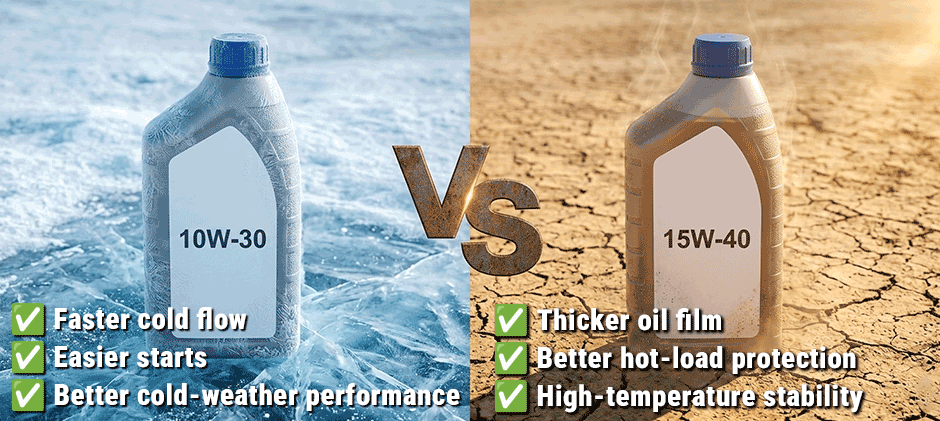
In the 10W-30 vs 15W-40 comparison, the first number with the W refers to cold-temperature flow. The second number tells you how thick the oil stays once the engine is hot.
- 10W-30 flows more quickly at startup and maintains a lower viscosity at operating temperature.
- 15W-40 flows a bit slower when cold and stays thicker at operating temperature.
That doesn’t automatically make one better in the 10W-30 vs 15W-40 debate. They just act differently. Out in real equipment, the right call depends on startup conditions, load, outside temperature, and how worn your engine is.
10W-30 vs 15W-40: Where Does Each Help?
Where does 10W-30 help?
For machines that start up in cool weather or do a lot of stop-and-start work, 10W-30 gets oil moving faster right away. That can be beneficial for compact excavators, skid steers, compact track loaders, and other newer gear — provided it meets the recommended specifications.
Some fleets also use it to improve efficiency without cutting back on protection. In the right application, 10W-30 isn’t a step down. It’s a perfectly good service fill.
Where 15W-40 still makes more sense?
In hot weather and non-stop heavy work, 15W-40 still has an edge. It keeps a thicker film once the engine is up to temperature. That’s why you still see it a lot in:
- Crawler dozers
- Large excavators
- Wheel loaders in quarry work
- Older, high-hour equipment
Some older engines simply tolerate a heavier oil better once they have wear on them. Certain older Cummins engines, for example, can get noticeably noisier with thinner oil in hot weather. And on worn machines, thinner oil may lead to lower hot idle pressure or higher oil consumption even when it technically meets spec.
Fuel Savings vs Protection Margin
One reason owners switch to 10W-30 is fuel economy. In approved applications, lower-viscosity oil can reduce internal drag and slightly improve efficiency.
But uptime usually matters more than a small fuel gain. If a machine already has high hours, runs hot, or works under constant load, many mechanics will stay with 15W-40 because it gives more protection margin. That is especially true in summer dirt work, quarry work, and other severe-duty conditions.
What Happens If You Use the Wrong One?
A wrong viscosity choice does not always cause immediate failure. More often, the problem shows up gradually.
We once saw a high-hour wheel loader switched to 10W-30 because another machine in the fleet was using it successfully. The oil met the required specification, but the loader had already accumulated enough wear that hot idle pressure dropped noticeably during summer operation. Nothing failed, but the machine ended up going back to 15W-40 after a few hundred hours.
If 10W-30 goes into a machine that really needs 15W-40
In an older engine or a machine that runs hard all day, 10W-30 may not maintain enough protection once fully hot. Possible results include:
- Lower oil pressure at idle
- Higher oil consumption
- Thinner oil film under load
- Faster wear on bearings and cam surfaces
That risk is higher in older backhoe loaders, high-hour dozers, and worn wheel loaders.
If 15W-40 goes into a machine designed around 10W-30
Using 15W-40 in a machine designed for 10W-30 can slow oil flow during startup and increase drag. Possible results include:
- Harder cold starts
- Slower lubrication on startup
- Reduced fuel efficiency
- Less ideal oil flow in cooler weather
One emergency top-off is not the same as long-term use. Shops do what they have to do in the field, but the machine should be returned to the correct oil as soon as possible.
Why Specs Matter in 10W-30 vs 15W-40?
This is where many oil discussions go wrong.
Viscosity matters, but it is only part of the requirement. The oil also has to meet the right API category and equipment specification.
Common diesel oil categories include:
- API CK-4
- API CJ-4
- API FA-4
Those ratings tell you how well an oil handles wear, oxidation, soot, and shear. The key point is that two oils can have the same viscosity grade and still not work the same way.
For off-road gear, keep it simple: if the viscosity matches but the spec doesn’t, it’s the wrong oil.
When Can 10W-30 Replace 15W-40?
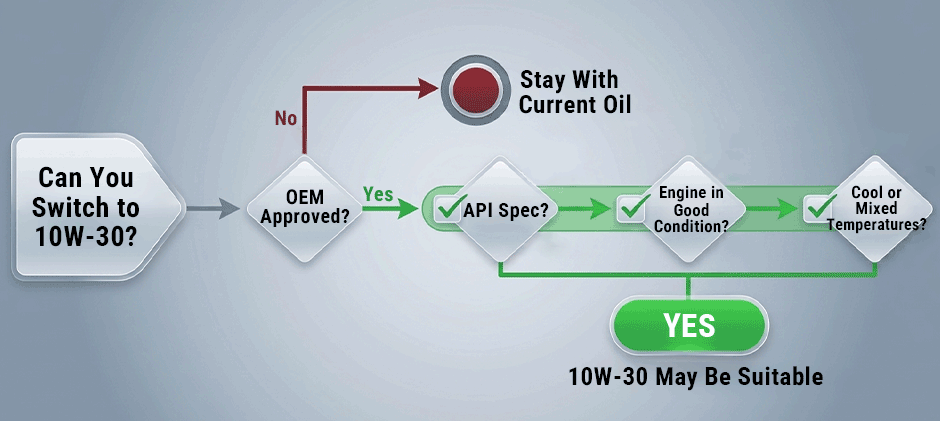
In many cases, 10W-30 can replace 15W-40 if all of the following are true:
- The owner’s manual lists 10W-30 as an approved grade
- The oil meets the required API category
- The oil meets the needed equipment specification
- The machine operates in cooler or mixed temperatures
- The engine is in good condition
- The application is not severe, continuous high-heat service
This often applies to newer compact excavators, skid steers, and similar equipment designed around lower-viscosity oils.
When 15W-40 Still Makes More Sense?
15W-40 is usually still the better choice when:
- The manual lists it as the primary grade
- The machine runs in high ambient temperatures
- The engine has high hours
- The equipment works under continuous heavy load
- The machine already shows oil consumption
- The job is hot, dusty, and severe-duty
That is common with dozers, large excavators, quarry loaders, and older machines that spend most of their time fully hot and fully loaded.
10W-30 vs 15W-40: Quick Comparison
| Oil Grade | Best Use | Column 3 |
|---|---|---|
| 10W-30 | Cold starts, approved newer engines, and possible fuel savings | Less margin in worn or heavily loaded machines |
| 15W-40 | High heat, high load, older engines, severe-duty work | Slower cold flow |
| 10W-40 | Mixed conditions where extra hot protection is needed | Must still meet equipment/API specs |
| 5W-40 | Cold climate plus strong hot protection | Higher cost |
| 5W-30 | Specific newer engines only | Should not be assumed to be interchangeable |
Can You Mix 10W-30 and 15W-40?
In an emergency, these oils can often be mixed if both are compatible heavy-duty diesel oils. That may be enough to finish a shift.
But it should not become a maintenance plan. Mixing can alter viscosity behavior and dilute the additive balance. If a machine is topped off with the wrong grade in the field, it should be returned to the correct oil at the next service opportunity.
Common Mistakes Owners Make
The most common mistakes are:
- Assuming thicker oil is always safer
- Assuming all diesel oils are interchangeable
- Ignoring API and equipment requirements
- Using on-highway truck advice for off-road equipment
- Treating a successful top-off as proof of compatibility
Service Tip: Watch the Machine After a Change
If you switch from 15W-40 to 10W-30, or the other way around, watch for:
- Oil pressure changes
- Startup noise
- Oil consumption
- Higher operating temperature
- Seepage from older seals
If the machine starts acting differently after the change, do not ignore it. Low oil pressure, unusual noise, rising temperatures, or new leaks may indicate an underlying issue that was already developing before the oil change. Check the oil pressure sensor, cooling system, and sealing components as needed.
FAQ
Can I use 10W-30 instead of 15W-40 in summer?
Sometimes, yes — but only if your owner’s manual says it’s okay, and the oil meets the right specs. For older machines or ones that work hard in summer heat, 15W-40 is usually the safer call.
Is 10W-30 too thin for a diesel engine?
Generally, no. Many modern diesel engines are designed to operate on 10W-30. The question isn’t whether it sounds thin — it’s whether your specific engine and application approve it.
Will 10W-30 improve fuel economy?
It can, in some applications. Thinner oil creates less drag inside the engine. But the gain is usually small, and it’s not worth sacrificing protection on a high-hour or heavy-duty machine.
Can mixing 10W-30 and 15W-40 damage the engine?
A little bit mixed in an emergency? Usually not, as long as both are compatible diesel oils. But you don’t want to run that way long-term. Get the machine back on the correct oil when you can.
Why does oil pressure drop after switching to 10W-30?
In a worn or high-hour engine, thinner oil may lower hot idle pressure, though the oil pressure sensor and related service parts are worth checking as well.
Is 15W-40 always better for older equipment?
Not always, but it usually gives you a greater margin of protection — especially in hot weather or under constant load. The real answer still comes down to your manual, your engine’s condition, and the kind of work you’re doing.
Final Checklist Before You Switch
Before changing from 15W-40 to 10W-30, check:
- Owner’s manual
- Ambient temperature
- Duty cycle
- Engine age and wear
- API category
- Meets equipment specifications
- Maintenance history
- Oil analysis
Conclusion
10W-30 can replace 15W-40 in some diesel equipment — but only when the equipment specifications are met, and the oil meets the required specifications. For newer machines in cooler or mixed conditions, 10W-30 can work well. For older, high-hour, or heavily loaded equipment, 15W-40 is usually the safer choice. Viscosity matters, but it is only part of the decision. If an oil change also reveals related maintenance needs, FridayParts can be a practical source for filters, seals, sensors, and other diesel equipment replacement parts.
