

Unexpected downtime is the single greatest threat to the profitability of any heavy equipment operation. When an excavator, wheel loader, or dozer sits idle due to a mechanical failure, it does more than just pause a project; it erodes your bottom line through lost labor hours and surging emergency repair costs. We have found through years of field experience that the vast majority of drivetrain failures are preventable through basic fluid management. Maintaining proper fluid levels is the most effective way to protect your machinery from total transmission failure. This guide provides the technical indicators necessary to identify low fluid levels early, enabling you to solve issues before they manifest into a catastrophic mechanical breakdown.
The Vital Functions of Transmission Fluid
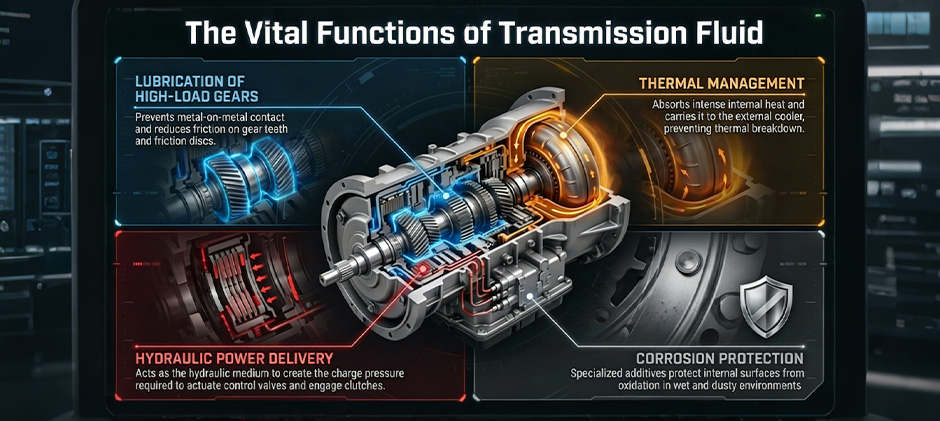
In the world of off-road machinery, transmission fluid is far more than a simple lubricant. It is the lifeblood of the entire drivetrain, serving as the medium for power, cooling, and internal protection. Because these machines operate under extreme loads and in harsh environments, the fluid must perform several high-stakes roles:
- Lubrication of High-Load Gear Sets: It provides a durable film between moving gears and bearings, preventing metal-on-metal contact and reducing the friction that leads to premature wear of the friction discs and gear teeth.
- Thermal Management and Heat Dissipation: The fluid absorbs the intense heat generated by the torque converter and moving parts, carrying it to the external cooler to prevent thermal breakdown.
- Hydraulic Power Delivery: In powershift and automatic systems, the fluid serves as the hydraulic medium that generates thepressure required to actuate control valves and engage internal clutch packs.
- Protection Against Corrosion: Heavy equipment often operates in wet or dusty conditions. High-quality fluid contains additives that protect internal metallic surfaces from oxidation and chemical degradation.
Common Causes of Low Transmission Fluid
Identifying the root cause of fluid loss is the first step toward a permanent mechanical solution. In off-road applications, fluid loss is rarely the result of a single event but rather a symptom of the harsh conditions these machines endure.
| Cause | Mechanical Impact |
|---|---|
| Worn Seals or Gaskets | Degradation of the output shaft seals or housing gaskets leads to fluid weeping, resulting in a steady drop in charge pressure. |
| Damaged Transmission Pan | Impact from site debris or rocks can crack the pan, causing a breach that leads to rapid fluid evacuation and immediate lubrication loss. |
| Faulty Cooler Lines | Vibration and thermal cycling cause lines to become brittle or loose, leading to a loss of cooling efficiency and a rapid drop in fluid volume. |
| Degraded or Burnt Fluid | Fluid that has exceeded its service life undergoes thermal evaporation and chemical breakdown, reducing the effective volume within the reservoir. |
| Loose Fittings and Connections | High-frequency engine vibration can loosen fittings on the transmission housing, leading to high-pressure misting or leaks during operation. |
10 Symptoms of Low Transmission Fluid
Symptom 1: Delayed Gear Engagement
One of the earliest indicators of a fluid deficit is a noticeable pause when an operator shifts from neutral into a working gear. This hesitation occurs because the transmission fluid is the primary medium for generating hydraulic force. When the reservoir is low, the transmission pump cannot instantly provide enough volume to actuate the internal clutch packs. Instead of immediate movement, you experience a two-to-three-second delay as the system struggles to build the required charge pressure. This symptom is a clear warning that the hydraulic circuit is compromised and requires immediate inspection.
Symptom 2: Slipping Gears
During high-load operations, such as pushing a heavy grade with a dozer or lifting a full bucket with a loader, you may notice the machine “slipping.” This manifests as a sudden spike in engine RPMs without a corresponding increase in ground speed. Without sufficient transmission fluid to maintain constant pressure on the internal friction discs, the clutch elements fail to hold their position. This erratic shifting behavior is dangerous on uneven terrain and indicates that the internal components are suffering from excessive heat and friction due to the lack of a firm hydraulic lock.
Symptom 3: Overheating Transmission
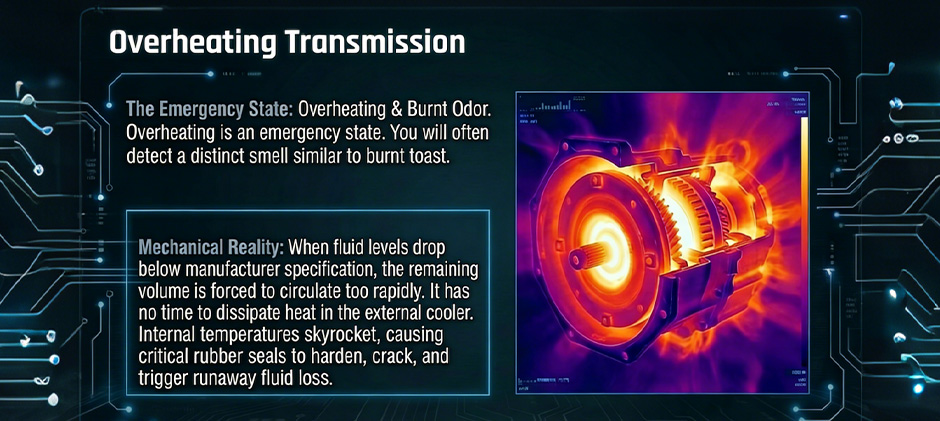
Transmission fluid is the primary cooling agent for the drivetrain. When fluid levels drop below the manufacturer’s specification, the remaining volume is forced to circulate more frequently, leaving no time for heat to dissipate in the cooler. This leads to a rapid rise in internal temperatures, often resulting in a smell like “burnt toast.” Overheating is an emergency state for off-road machinery; it causes internal seals to harden and crack, leading to further leaks, and can cause the torque converter to warp or fail under the intense thermal load.
Symptom 4: Transmission or Check Engine Light
Modern off-road equipment is engineered with a series of sensors that monitor charge pressure and temperature. When the fluid level drops, the reduction in pressure or the surge in heat will trigger a dashboard alert. While many operators are tempted to ignore a “check engine” or “transmission oil temp” light during a busy shift, doing so is a major risk. These sensors are calibrated to detect deviations before the operator feels them. Once these lights illuminate, the machine’s electronic control unit (ECU) may engage a “limp mode,” drastically reducing power to prevent a total drivetrain meltdown.
Symptom 5: Poor Acceleration or Hydraulic Lag
Operators may report that the machine feels “sluggish” or “lazy” when attempting to move under load. This is often caused by a torque converter stall or hydraulic lag. In a low-fluid state, the torque converter cannot efficiently transfer the engine’s rotational energy into the transmission because there is not enough fluid volume to create the necessary kinetic force. This results in poor acceleration and jerky, surging movements when the machine finally finds enough pressure to engage. This lack of smooth power delivery makes precision grading or loading nearly impossible and increases mechanical stress on the entire powertrain.
Symptom 6: Unusual Noises
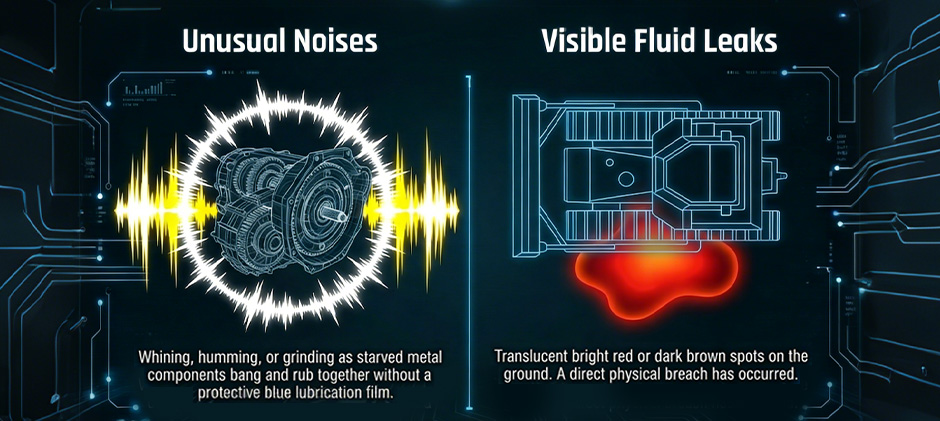
A healthy transmission should operate with a consistent, rhythmic hum. If you hear a high-pitched whining sound, you are likely hearing cavitation within the transmission pump. This happens when the fluid is so low that the pump begins drawing in air. These air bubbles collapse under high pressure, creating a sound often compared to “marbles in a blender.” In older gear-driven manual tractors, low fluid manifests as a deep grinding or clunking sound as the gears and bearings lose their protective oil film, leading to immediate metal-on-metal destruction.
Symptom 7: Noisy Neutral
If a machine produces clunking or whining sounds while the engine is running but the transmission is in neutral, it is a strong indicator of low fluid levels. Even in neutral, the input shaft and the transmission pump continue to rotate to maintain lubrication and standby pressure. If these parts are not submerged in the correct volume of oil, they will produce noise. A noisy neutral is a warning that the fluid is low enough to starve the primary moving components of lubrication, even when the machine is not performing work, leading to bearing failure over time.
Symptom 8:Visible Fluid Leaks
The most undeniable sign of a problem is the presence of fluid puddles beneath the chassis. Fresh transmission fluid for most off-road applications is translucent and bright red or pink. If someone subjected the fluid to extreme heat or neglect, it may appear dark brown or even black with a gritty texture. In heavy machinery, these leaks are commonly found near the transmission pump housing, the cooler line fittings, or the axle seals. Finding any amount of fluid on the shop floor or the job site ground necessitates a full pressure check of the system.
Symptom 9: Unpleasant or Burnt Odors
The scent of your machine is a vital diagnostic tool. Healthy fluid has a sweet, oily aroma. However, when fluid levels are low, the remaining oil is subjected to extreme friction and heat, causing it to burn. This results in a sharp, acrid odor that can often be smelled from the operator’s cab. This smell indicates that the fluid has reached its thermal limit and its chemical structure has collapsed. Once the fluid smells burnt, it has lost its ability to protect the clutch packs and must be drained and replaced after the leak is addressed.
Symptom 10: Complete Inability to Shift
This represents the final stage of drivetrain neglect. When the fluid level becomes critically low, the system can no longer generate any charge pressure at all. The operator may move the gear selector, but the control valves will not actuate, and the machine will remain stationary. This often happens after earlier signs, such as whining or slipping, were ignored. In gear-driven manual machines, this stage may manifest as the gear shifter locking or freezing due to heat-induced expansion of the internal components. At this point, the lack of pressure indicates that internal damage has likely already occurred.
Product Integration & Technical Solutions
When these symptoms manifest, the immediate priority is identifying the source of the fluid loss. If your machine is exhibiting the classic whining of cavitation or a total loss of pressure, the transmission pump is likely damaged and requires a detailed inspection. For fleet managers focused on minimizing downtime, maintaining a ready stock of high-quality transmission parts is a standard best practice. Whether you need a replacement transmission pump, new gaskets, or high-pressure seals, having these components on hand allows for a rapid return to service. Using premium aftermarket parts ensures that the repair meets the rigorous demands of off-road environments without the prohibitive cost of OEM-branded components.
How to Identify Low Transmission Fluid Levels?
Checking the fluid level in an excavator or loader is a specific technical procedure that differs from checking a standard passenger vehicle.
- Preparation and Safety: Ensure the engine is at normal operating temperature. Park the machine on level ground to ensure an accurate reading. Set the Parking Brake and engage the hydraulic lock lever to ensure the machine is immobilized.
- Locate the Dipstick: Open the access panel to find the transmission dipstick. Note that many modern machines may use a sight glass on the side of the housing or an electronic sensor viewed through the dashboard display.
- Inspect the Condition: Pull the dipstick and wipe it with a lint-free cloth. Reinsert it fully and pull it again. Check the color: Red/Pink is healthy; Brown/Black indicates thermal breakdown.
- Verify the Level: Observe where the fluid falls on the “Full” and “Add” markings. If the level is at or below the “Add” mark, you must replenish the fluid immediately with the specific oil type listed in the service manual.
How to Prevent Low Transmission Fluid?
A proactive maintenance strategy is the only way to ensure the longevity of your drivetrain. By following these steps, you can prevent minor leaks from becoming major failures:
- Perform Monthly Manual Checks: Do not rely solely on dashboard sensors. Manually check the dipstick or sight glass at least once a month to catch slow “weeping” leaks.
- Adhere to Hourly Service Intervals: Unlike cars measured in miles, off-road gear is tracked by operating hours. A full transmission service, including a fluid flush and filter replacement, should typically occur every 1,000 to 2,000 hours, depending on the manufacturer’s spec.
- Repair Minor Leaks Immediately: If you notice moisture around a seal or fitting, address it now. High-pressure hydraulic systems can turn a small “weep” into a catastrophic burst in a matter of minutes.
- Use Specified Fluid Only: Never mix fluid types. Use the exact viscosity and additive package recommended for your specific model to ensure the clutch packs engage correctly.
Conclusion
Maintaining the correct transmission fluid level is a fundamental pillar of heavy equipment care. By recognizing these 10 symptoms, you can protect your drivetrain, prevent expensive downtime, and ensure your machinery stays productive on the job site. When the time comes for repairs or routine maintenance, FridayParts is your reliable partner for high-quality
