

If your mower makes loud popping sounds, bangs on decel, or “gunshot” backfires when you shut it off, the engine is usually burning fuel at the wrong time or in the wrong place. That can feel alarming, but most cases come down to a short list: fuel that isn’t burning cleanly, extra air getting in, ignition parts that are worn, or valves that aren’t sealing. This guide walks you through what a mower backfire is, the most common causes of backfiring on off-road equipment mowers (zero-turn, riding, and commercial units), and how to tell backfiring from afterfiring so you fix the right system.
What Is a Lawn Mower Backfire?
A lawn mower backfire is a small combustion event that happens outside the cylinder—either in the intake tract or in the exhaust system—because fuel and air are ignited at the wrong moment.
Two common “backfire” sounds
1. Exhaust popping:
Unburned fuel enters the muffler and lights off there. This often happens on deceleration or right at shutdown.
2. Intake backfire:
A bang or “puff” through the carburetor/intake. This points to a lean mixture, ignition timing issues, or valve sealing problems.
Why it matters for off-road mower equipment
Commercial and off-road mowers work in dust, heat, and vibration. That environment:
- Restricts airflow faster (dirty filters)
- Loosens clamps and creates air leaks
- Accelerates ignition wear
- Exposes carburetors to varnish from stored fuel
A mower that “still cuts fine” can still be drifting toward a no-start, muffler damage, or a fire risk if fuel vapors ignite during troubleshooting.
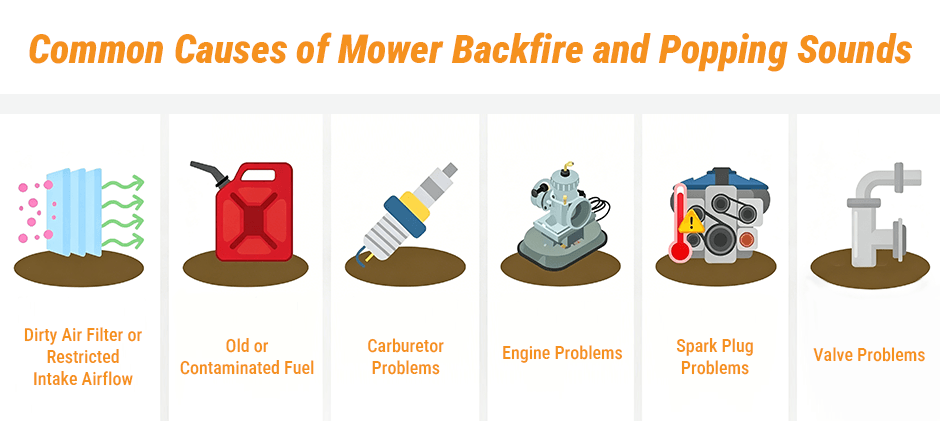
Common Causes of Lawn Mower Backfire and Popping Sounds
The engine needs three things to avoid popping: correct mixture, strong spark, and good valve sealing/timing. The causes below are written in the order that most owners should check them.
1) Dirty air filter or restricted intake airflow
A restricted air filter changes the fuel-air ratio and can lead to incomplete combustion. Depending on the engine and carb setup, restriction can also make throttle transitions messy—especially when you snap from load to idle.
What you’ll notice
- Loss of power under load
- Rich smell, dark exhaust
- Uneven idle
What to do
- Clean or replace the air filter
- Make sure the filter housing seals correctly (a bad seal can also create weird mixture issues)
Maintenance tip: dusty mowing conditions may require more frequent filter service than the calendar suggests.
2) Old or contaminated fuel
Stale gasoline can burn poorly and leave unburned fuel to ignite in the muffler. Storage issues also create varnish inside carb passages, which often shows up as popping on decel or shutdown.
Clues
- Starts only with choke
- Surging, hunting idle
- Popping increases after the mower has sat
What to do
- Drain old fuel (tank and carb bowl if applicable)
- Refill with fresh fuel
- If you store fuel, use a stabilizer, and avoid long storage in humid conditions
3) Carburetor set too lean
A lean mixture burns more slowly and can continue burning as the exhaust valve opens. That pushes heat and flame into the exhaust, causing popping—especially when the throttle closes quickly.
Where it shows up
- Popping during deceleration after mowing a heavy patch
- Occasional intake sneeze when snapping the throttle
What to do
- Return mixture screw settings to spec (if adjustable)
- Clean pilot/idle circuits and transitional passages
- Check gaskets and mounting surfaces for leaks (a leak can “act lean” even if jets are fine)
4) Intake air leak after the carb/throttle body
A cracked intake boot, loose clamp, or leaking gasket can lean out the mixture. On mower engines, vibration and heat cycles make this more common than people expect.
Symptoms
- Hanging idle (RPM stays high longer than normal)
- Popping on throttle blips
- Intake backfire in sharper cases
What to do
- Inspect the intake boot/manifold for cracks
- Tighten clamps and mounting bolts to spec
- Replace damaged boots/gaskets
5) Exhaust leak near the engine
An exhaust leak can pull extra oxygen into the hot exhaust stream. That oxygen helps leftover fuel ignite in the muffler—making pops louder and more frequent.
What you’ll notice
- Ticking noise near the exhaust port
- Soot marks around a gasket/joint
- Popping that seems worse when hot
What to do
- Inspect manifold/exhaust gasket area
- Repair the leak before tuning carb settings (otherwise, you may chase symptoms)
6) Worn, fouled, or incorrectly gapped spark plug
A weak spark or misfire leaves an unburned mixture in the cylinder. That mixture can ignite in the muffler—classic popping and bang-on-shutdown.
Common plug-related signs
- Hard starting
- Miss under load
- Poor fuel economy
- Visible deposits on the plug
A fresh spark plug is often one of the highest value fixes because it directly improves ignition quality. If you’re sourcing replacements for off-road equipment, start here: spark plug.
Quick plug checklist
- Correct part number/type for the engine
- Correct gap (follow engine spec)
- Clean, tight boot connection
- No cracked ceramic or heavy oil fouling
7) Shutdown at high RPM
Many owners shut down right after finishing a pass, while the engine is still hot and fast. If fuel continues moving briefly while the spark stops, raw fuel can enter the exhaust and ignite.
Fix
- Reduce the throttle and let it idle briefly
- Shut down from idle, not from high RPM
This is one of the simplest ways to reduce afterfire without changing any parts.
8) Anti-afterfire fuel shutoff solenoid failure
Many carbureted mower engines use a fuel shutoff solenoid to stop fuel flow when you turn the key off. If it sticks or fails, fuel can keep feeding and create an afterfire.
Clues
- Afterfire is the main symptom (mostly after shutdown)
- The engine may run on briefly or stumble oddly at key-off
What to do
- Listen/feel for solenoid actuation (click) at key-on
- Check wiring and connector condition
- Replace if confirmed faulty
9) Valve clearance, valve sealing, or compression problems
If valve clearance is off or a valve doesn’t seal, combustion can leak back into the intake or exhaust at the wrong time. Intake backfire is the bigger hint here.
Symptoms that point toward valves
- Persistent popping plus loss of power
- Hard starting, even with fresh fuel and a new plug
- Intake backfires at idle/light throttle
- Low compression reading
A leaking intake valve (or a valve train issue that keeps it from fully closing) can cause intake backfire and poor running. If valve work is needed, you can review compatible replacements here: intake valve.
Troubleshooting summary table
| Symptom | Most likely causes | First checks |
|---|---|---|
| Pop in the muffler on decel | Lean transition, exhaust leak, weak spark | Intake leaks, exhaust gasket, plug condition/gap |
| Loud bang when shutting off | High-RPM shutdown, rich condition, shutoff solenoid issue | Idle-down procedure, plug soot, and solenoid function |
| Puff/bang through carb/intake | Intake leak, lean mix, valve sealing | Intake boot/gasket, carb clean/adjust, compression/valve clearance |
| Runs OK but pops intermittently | Small mixture drift, mild ignition wear | Air filter, fresh fuel, plug replacement |
What’s the Difference Between Backfiring and Afterfiring?
People often say “backfire” for any bang, but separating the two saves time.
Backfiring
- Happens while the engine is running
- Often tied to throttle changes (snap open/closed), load changes, or misfire under load
- Can occur through intake or exhaust
Afterfiring
- Happens after shutdown
- Strongly linked to hot exhaust + leftover fuel
- Often improved by proper idle-down and fixing rich conditions or shutoff solenoid issues
Conclusion
A popping mower is usually telling you the mixture, spark, or sealing is off—often from stale fuel, a dirty air filter, intake/exhaust leaks, or a worn plug. Start with the fast checks, then move to carb and valve testing if the problem stays. When parts are needed, FridayParts offers aftermarket parts with high-quality products at affordable prices, a vast inventory, and wide compatibility across many heavy equipment brands—so you can fix the cause, not just the sound.
