

A Volvo fault code on your dashboard is a common reason for surprise downtime on a job site. The code is not “random.” It is your machine’s way of saying: what system has a problem, and what kind of problem it is.
This guide explains the Volvo fault code format in plain English, shows a quick table for urgent faults, and gives a practical list of common codes with safe first steps you can take.
What Are Volvo Fault Codes?
Volvo fault codes are built like an address. They help you find:
- which computer saw the problem,
- which part or system has the problem, and
- What type of failure is it?
A full code usually has three parts: MID + PID/SID + FMI.
1. MID (Message Identification Description): This tells you which control unit (computer/ECU) reported the fault.
- Example: MID 128 often refers to the Engine ECU.
2. PID (Parameter Identification Description) / SID (Subsystem Identification Description): This points to what item is involved.
- PID = a standard measurement or component (example: PID 100 = engine oil pressure)
- SID = a subsystem item within that ECU (example: SID 1 = injector for cylinder #1)
3. FMI (Failure Mode Identifier): This explains how it is failing.
Examples:
- FMI 3 = voltage above normal
- FMI 5 = current below normal or open circuit
- FMI 1 = below normal (often “too low”)
Why the full code matters:
The PID/SID tells you what, but the FMI tells you what kind of problem (low, high, open circuit, etc.). You need both to make good decisions.
How Do You Access and Interpret Volvo Fault Codes?
Most Volvo off-road machines show active fault codes on the in-cab display. The exact steps can change by model (wheel loader vs. excavator), but the idea is the same: open the fault menu and read the code.
What to do when a code appears:
- Write the full code down: MID + PID/SID + FMI
- Note what the machine is doing (hot? low power? smoking? rough idle?)
- Check if it is active (happening now) or stored (happened before)
- Use your operator’s manual for the exact menu path and safety steps
A fault code is like a warning sign. If you ignore it, the problem usually gets worse—and more expensive.
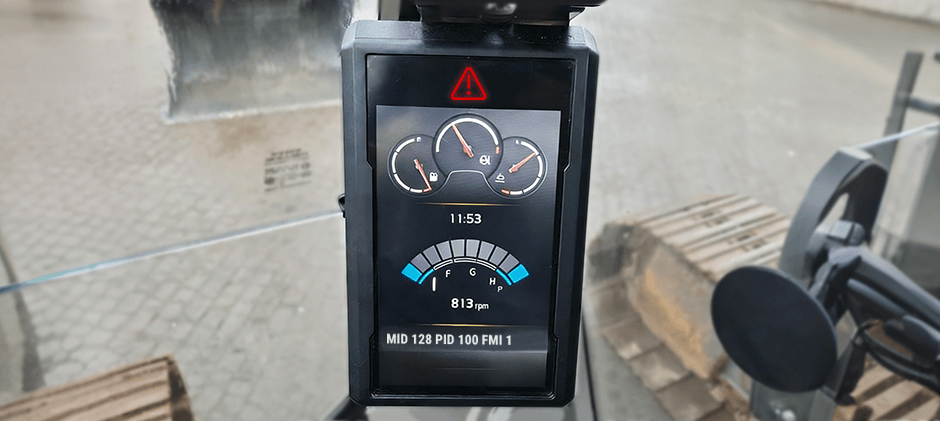
Quick Troubleshooting Table: 4 Critical Faults
This table covers four urgent faults. If you see one of these, take action right away.
| Fault Code Example | Common Symptoms | How to Fix It (Initial Steps) |
|---|---|---|
| MID 128, PID 100, FMI 1 (Engine Oil Pressure Low) | Red STOP light, engine derate/shutdown, alarm | Stop the engine as soon as it is safe. Wait 10–15 minutes. Check oil level. Do not restart until the cause is found. |
| MID 128, PID 110, FMI 0 (Engine Coolant Temp High) | Warning light, power loss, possible steam | Reduce load. Let the engine idle 3–5 minutes, then shut down. Check coolant level (only when cool) and clean blocked radiator/coolers. |
| MID 128, SID 1–6, FMI 5 (Injector Circuit Open) | Rough idle, misfire, smoke, low power | Inspect the injector wiring and connector for that cylinder (loose, broken, or corroded). Repair wiring/connectors first. |
| MID 128, PID 3251, FMI 0 (DPF Soot Level High) | DPF light, derate, regen request | Park safely and run a parked regeneration per the manual. If regen fails, the DPF likely needs professional cleaning/service. |
A Practical Volvo Fault Codes List and What to Do
Below are common and important Volvo fault code examples, what they usually mean, and safe first steps.
1. MID 128, PID 100, FMI 1 – Engine Oil Pressure
Meaning: Engine oil pressure is too low (valid reading, but below normal range). This is a serious warning.
What to Do:
- Shut down the engine immediately when it is safe. Low oil pressure can destroy an engine fast.
- Wait 10–15 minutes so the oil drains back to the sump.
- Check the oil level with the dipstick.
- If the oil is low, top up with the correct oil and look for leaks.
- If the oil level is normal, do not keep running the engine. The cause could be a bad sensor, a clogged oil filter, worn engine parts, or an oil pump issue. Get a proper diagnosis before restarting.
2. MID 128, PID 110, FMI 0 – Engine Coolant Temperature
Meaning: Coolant temperature is too high (most severe level). The engine is overheating.
What to Do:
- Reduce load and park in a safe place.
- Let the engine idle 3–5 minutes to cool down gradually.
- Shut down the engine after it cools a bit.
- Check for blocked airflow: dirt, mud, leaves, plastic bags on radiator/coolers.
- Check the coolant level in the expansion tank (do not open a hot cap).
- If overheating keeps coming back, stop work and investigate deeper (leaks, fan/belt issues, thermostat, water pump, radiator blockage).
3. MID 128, SID (1-6), FMI 5 – Fuel Injector
Meaning: Injector for cylinder #X has low current or an open circuit. The ECU cannot drive that injector correctly.
What to Do:
- Identify the cylinder: SID 1 = Cylinder 1, SID 2 = Cylinder 2, etc.
- Shut down and follow all safety lockout steps.
- Check the injector connector: Is it fully seated? Are the pins bent or corroded?
- Inspect the wiring harness near the injector: rubbing, cuts, crushed spots, oil contamination
- If the wiring and connector look good, the injector solenoid may be faulty and may need testing/replacement.
4. MID 128, PID 3251, FMI 0 – DPF Soot Load
Meaning: DPF soot load is too high (most severe level). The filter is heavily loaded.
What to Do:
- Expect power derate (limp mode). This is meant to protect the system.
- Run a parked/manual regeneration exactly as your operator’s manual says.
- If regen fails or the machine will not allow regen, the DPF may need removal for professional cleaning or replacement.
- Do not keep working in derate for long periods. It can lead to bigger exhaust and turbo problems.
5. MID 140, PID 158, FMI 1 – Ignition Key Switch
Meaning: The Key switch power signal is below normal. The vehicle ECU thinks the ignition circuit voltage is low.
What to Do:
- Check battery terminals: clean, tight, no corrosion.
- Check battery voltage (a weak battery can trigger this).
- Inspect the wiring and the connector at the ignition switch for looseness or damage.
- If the problem comes and goes, look for a bad connection or a frayed wire.
When Should You Call a Professional?
Basic checks can solve many issues (loose connectors, dirty coolers, low fluids). But call a certified technician if:
- Multiple codes show up at once, especially from different systems (engine + hydraulic + aftertreatment).
- The code comes back immediately after you fix something.
- You see communication/datalink faults (for example, J1939-related issues). These often need deeper wiring and network testing.
- The machine enters a severe derate or shutdown, and simple checks (fluids, filters, cooling airflow, connectors) do not help.
Conclusion
Volvo fault codes are a direct guide to your machine’s health. By knowing the MID, PID/SID, and FMI, you can quickly diagnose issues like low oil pressure or a clogged DPF. Often, the solution is a single part replacement. For reliable engine sensors, fuel injectors, DPF components, or ignition switches needed to resolve these faults, FridayParts has you covered. Diagnose the code, get the right part from FridayParts, and minimize your downtime to keep your projects moving.
