

We recognize that fleet owners and operators in the off-road sector face a relentless battle against machinery downtime and climbing fuel expenditures. In the brutal environments of construction sites and agricultural fields, your choice of power plant is the primary factor determining whether a project stays on schedule or stalls in the shop. The decision between Paccar and Cummins engines is more than just a brand preference; it is a technical choice that affects diagnostic complexity, part availability, and long-term durability. We have compiled this guide to provide an objective, data-driven comparison of these two powerhouses to help you identify which platform meets the specific demands of your heavy equipment fleet.
What are Paccar and Cummins Engines?
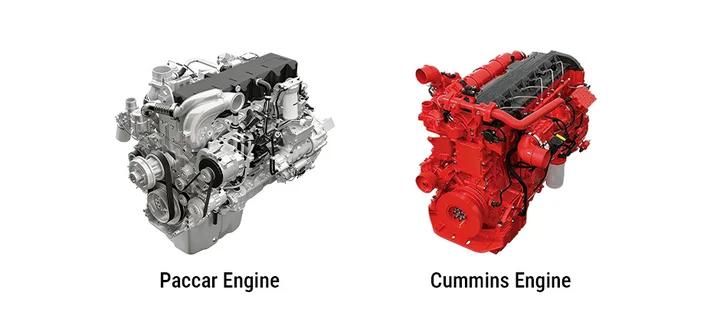
Paccar and Cummins represent the gold standard for heavy-duty power, yet they operate under different manufacturing philosophies that impact how you service and maintain your equipment.
Cummins Engines
Cummins is an independent global power leader. Unlike manufacturers that produce engines solely for their own vehicle lines, Cummins designs and distributes power solutions for a vast array of global brands and industries. Their reach is massive, covering construction, agriculture, marine, and power generation. You will find Cummins engines in Freightliner, Volvo, and International vocational trucks, as well as in specialized agricultural tractors and excavators. They have earned a reputation for providing raw pulling power and high-intensity reliability in the most punishing work environments.
Paccar Engines
Paccar is a global technology leader that specializes in the design and manufacture of high-quality light, medium, and heavy-duty engines. If you operate Peterbilt or Kenworth equipment, you are likely already utilizing their proprietary engine technology. Paccar focuses on high-level integration, meaning their engines are designed to work in perfect synchronization with the chassis and electronic systems of their own vehicle brands. When you choose a Paccar engine, you are selecting a powertrain where every sensor and component is optimized for a specific vocational application, aimed at achieving superior fuel economy and smooth performance.
Paccar vs Cummins Engines: A Comparison
Evaluating these engines requires looking past marketing materials and focusing on how they handle the thermal stresses and vibrations of daily off-road work.
Performance and Power Delivery
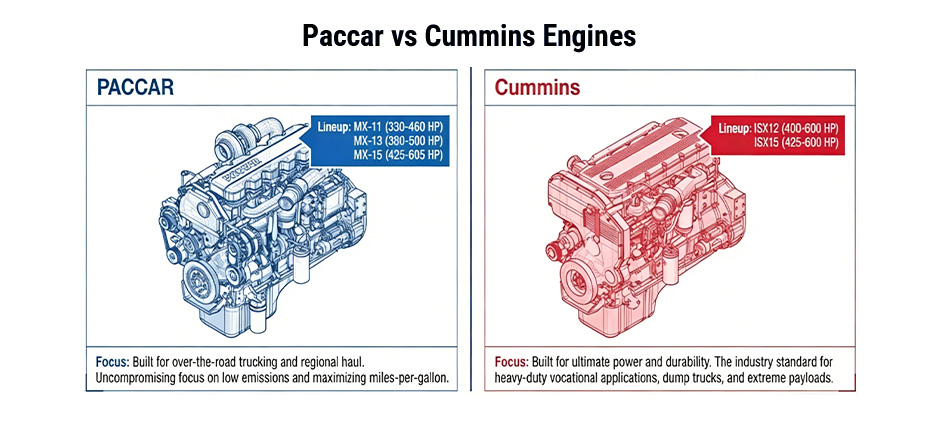
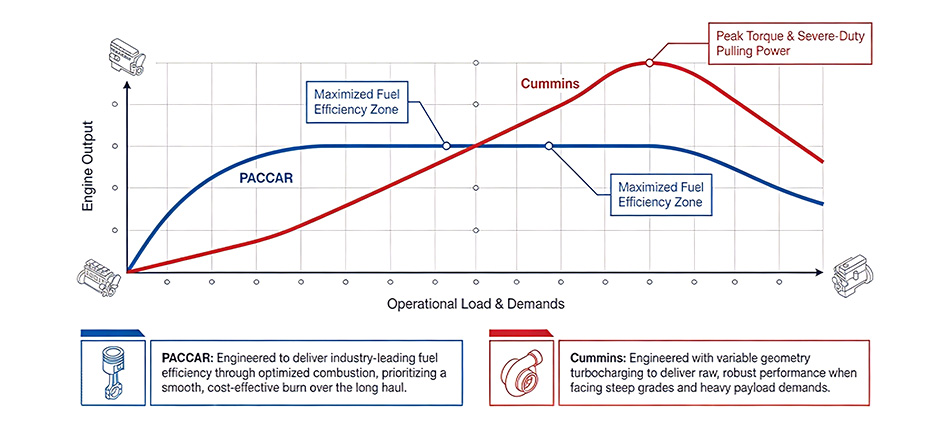
In terms of pure output, Cummins is often the top choice for high-intensity, heavy-haul vocational applications. These engines provide the massive torque needed for moving heavy soil or pulling loaded trailers through soft terrain. Paccar engines, meanwhile, are engineered for smooth, consistent power delivery. They excel in applications where fuel efficiency and reduced drivetrain wear are the priorities, offering a more refined experience for the operator while still maintaining competitive horsepower ratings.
Fuel Efficiency and Emissions Compliance
Both manufacturers utilize Electronic high-pressure common rail fuel systems to achieve precise combustion. This technology ensures that every drop of fuel is utilized, which is essential for managing daily operating costs. To meet EPA 2010 and Euro 6 standards, both brands rely on Selective Catalytic Reduction (SCR) and advanced aftertreatment systems. Paccar tends to focus on optimized combustion within the cylinder to reduce the burden on the exhaust system, while Cummins utilizes advanced variable geometry turbocharging to maximize air intake and efficiency across the entire RPM range.
Reliability and Durability
Reliability is born from the quality of the base components. Paccar engines use robust materials designed to withstand the high-vibration environments of vocational trucking. Their focus on proprietary integration means fewer “universal” parts and more specialized, long-lasting components. Cummins engines are legendary for their ability to survive high-intensity cycles. Their cooling systems are particularly advanced, designed to protect the engine block from the extreme heat generated during heavy-duty agricultural or construction tasks.
Comparison Table
| Feature | Paccar Engines | Cummins Engines |
|---|---|---|
| Manufacturing Type | In-house (Proprietary) | Independent / Outsourced |
| Design Focus | Fuel Efficiency & Integration | Power & Versatility |
| Primary Off-Road Use | Vocational (Mixers/Dump) | Heavy Construction & Ag |
| Diagnostic Tools | Paccar Proprietary Tools | Cummins INSITE / QuickServe |
| Fuel System | High-Pressure Common Rail | High-Pressure Common Rail |
Notable Engine Series for Off-Road Use
To truly compare these brands, we must look at the specific displacement and performance data for each engine series. Maintaining these systems requires a consistent supply of high-quality engine parts to ensure the hardware meets its intended service life.
The Paccar MX Series (Heavy-Duty)
The MX series is the backbone of Paccar’s heavy-duty vocational lineup.
- MX-11: An 11-liter inline six-cylinder engine (330–460 HP). It is popular in regional haul and medium vocational roles where weight savings are critical.
- MX-13: A 13-liter workhorse (380–500 HP) found in heavy-duty trucks, providing a balance of weight and power.
- MX-15: The heavy-duty king of the lineup (425–605 HP). It is specifically engineered for dump trucks and concrete mixers where massive torque is required to get a load moving from a standstill.
The Paccar PX Series (Medium-Duty)
These engines are the result of the Paccar and Cummins manufacturing alliance.
PX-6: 7.0-liter displacement (410 cubic inches).
- Bore x Stroke: 4.21 x 4.88 inches.
- Compression Ratio: 5:1 (per source data).
- Output: 200–325 HP and 520–860 lb-ft of torque.
PX-7: 7.2-liter displacement (441 cubic inches).
- Bore x Stroke: 4.21 x 4.88 inches.
- Compression Ratio: 5:1.
- Output: 200–350 HP and 520–860 lb-ft of torque.
PX-8: 8.3-liter displacement (505 cubic inches).
- Bore x Stroke: 4.96 x 5.79 inches.
- Compression Ratio: 5:1.
- Output: 300–350 HP and 1,000–1,250 lb-ft of torque.
PX-9: 9.0-liter displacement (549 cubic inches).
- Bore x Stroke: 4.96 x 6.61 inches.
- Output: 330–380 HP and up to 1,250 lb-ft of torque.
The Cummins Series
Cummins offers a wide range of independent power solutions.
- ISB Series: Available from 5.9L to 8.3L. The 6.7L variant features a 17.5:1 compression ratio and delivers 300–350 HP.
- ISL Series: A 9.0-liter (542 cubic inches) engine with an 18.2:1 compression ratio, offering up to 400 HP and 1,450 lb-ft of torque. It is a staple in heavy-duty vocational equipment.
- ISX12 G: A 12-liter natural gas engine (400–500 HP) designed for fleets looking to reduce emissions while maintaining heavy-duty performance.
- ISX15 / X15: The gold standard for heavy construction. These 15-liter engines deliver up to 600 HP and are known for their massive pulling power in off-road applications.
- L Series: Engineered specifically for agricultural and construction off-road environments.
How to Choose the Right Engine?
Selecting the correct engine requires a thorough evaluation of your operational environment.
- Match Power to Load: Do not over-specify or under-specify. For heavy construction hauling, the high torque of the Cummins X15 or Paccar MX-15 is necessary. For medium-duty vocational work, the PX-7 or ISB 6.7L may offer better ROI.
- Evaluate Operating Costs: Paccar engines often offer an edge in fuel efficiency for vocational fleets due to their integrated design. However, Cummins engines are available across more brands, which may simplify procurement for mixed fleets.
- Check Emissions Compliance: Ensure the engine is certified for EPA 2010 or Euro 6 to avoid regulatory penalties.
- Diagnostic Capabilities: If your shop is already trained on Cummins INSITE and QuickServe, sticking with Cummins can save thousands in software and training costs. Paccar’s proprietary tools may require a different technical setup.
Pro-Tip: Avoiding Limp Mode To prevent your engine from entering “Limp Mode,” you must prioritize the health of your aftertreatment sensors. Monitor your NOx, EGT, and Soot PM sensors regularly. A single faulty sensor in the SCR system can shut down a 600 HP engine regardless of whether it carries the Paccar or Cummins nameplate.
Maximizing Longevity with Quality Aftermarket Support
The engine you choose is only half of the equation; the maintenance strategy is the other. Both Paccar and Cummins have expansive service networks, but the cost of genuine parts can quickly erode your profit margins.
When you need Paccar parts or Cummins parts, you have options beyond the OEM dealer. Utilizing a high-quality aftermarket supplier allows you to maintain your fleet with components that meet or exceed original specifications without the premium price tag. For an aging fleet, this is often the only way to keep operating costs sustainable while ensuring the engine survives the vibrations and heat of heavy-duty work.
Conclusion
We have established that both Paccar and Cummins provide world-class power for the off-road and heavy-duty sectors. The decision ultimately rests on your specific priorities: if you require a highly integrated, fuel-efficient vocational machine, Paccar is an excellent choice. If you need versatile, high-torque power that can be serviced across a mixed fleet, Cummins remains the industry leader. No matter which engine powers your equipment, we are here to support your operation. We provide high-quality, affordable aftermarket parts with a massive inventory compatible with all major heavy equipment brands, ensuring your machinery stays out of the shop and remains productive in the field.
