

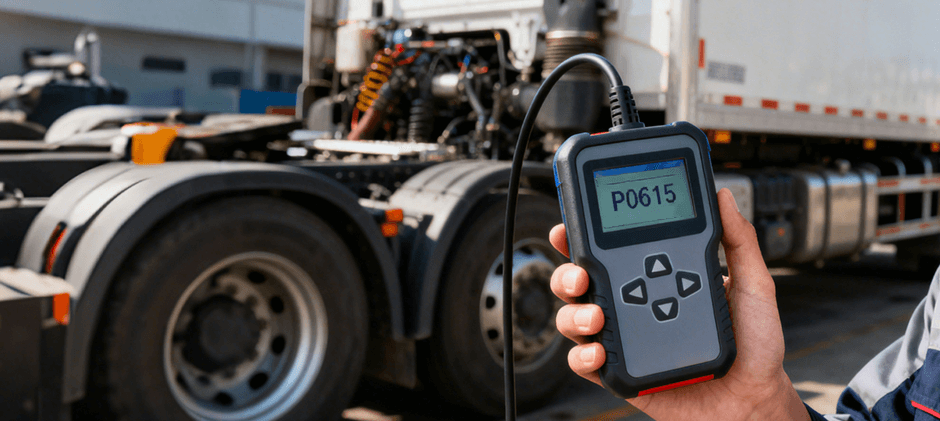
When your truck fails to crank but all lights and electronics are working, the fault often comes from a starter system electrical problem. One of the most common diagnostic trouble codes associated with this is the P0615 code—a warning that something is wrong in the starter relay circuit. This article walks you through everything you need to know: what the P0615 code means, what causes it, how to diagnose it accurately, and how to fix it with confidence.
What Does the P0615 Code Mean?
The P0615 is an OBD-II diagnostic trouble code that stands for “Starter Relay Circuit Malfunction.” When you turn the ignition key or press the start button, the truck’s Powertrain Control Module (PCM) monitors voltage signals between the ignition switch, starter relay, and the starter motor. If the PCM finds an incorrect or missing signal in that circuit, it logs P0615 and may prevent the engine from starting.
To understand this better, let’s break down how the starter system operates:
- The ignition switch sends a small current to the starter relay.
- The relay acts as an electronic switch, closing its high-current contacts to allow battery voltage to reach the starter motor.
- The starter motor turns the engine flywheel to begin combustion.
If the PCM detects resistance, abnormal voltage, or circuit interruption at any point in this sequence, the P0615 code is triggered. In simple terms, P0615 means that the system commanding your starter to engage isn’t communicating as it should — not necessarily that your starter motor is broken.
What Causes the P0615 Code?
The root causes of a P0615 fault are usually found in the starting circuit’s electrical path. Heavy trucks, which undergo higher vibration and more extreme temperatures, are particularly prone to these issues.
| Cause | Description | How It Happens |
|---|---|---|
| Faulty Starter Relay | Relay contacts fail to close or stick open. | Aging, corrosion, and internal wear due to heat. |
| Defective Ignition Switch | Fails to send current to the relay. | Worn internal contacts or loose wires. |
| Wiring Problems | Open, shorted, or corroded wires prevent voltage transfer. | Moisture, vibration, or poor insulation. |
| Blown Fuse or Fusible Link | The circuit protection device fails, cutting the current. | Short circuit or overvoltage. |
| Bad Starter Solenoid or Motor | The solenoid fails to engage the flywheel. | High resistance or internal wear. |
| Weak Battery or Corroded Terminals | Voltage drops below the start threshold. | Aging battery or poor maintenance. |
| PCM or Control Fault (rare) | Incorrect signal interpretation. | Internal failure or programming error. |
Trucks operating in humid or dusty environments should check for corrosion on connectors and frayed wiring near the starter relay — two of the top failure points observed in fleet inspections.
Symptoms of P0615 Code and Common Diagnostic Mistakes
Recognizing the right symptoms helps prevent unnecessary part replacements.
Common Symptoms
- The engine won’t crank when the key is turned.
- Check Engine Light (CEL) is illuminated.
- Occasional clicking noise from under the hood during start attempts.
- Engine starts intermittently — sometimes fine, sometimes dead.
- No dashboard dimming or voltage drop during a failed start.
Frequent Diagnostic Errors
1. Replace the starter motor immediately.
Many technicians assume the motor is faulty when the voltage isn’t even reaching it.
2. Skipping simple checks.
Blown fuses are often overlooked, even though they’re the cheapest fix.
3. Ignoring ground points.
Weak grounding between the starter and frame can mimic a failed relay.
4. Overlooking environmental effects.
Mud, water, and heat near the firewall or relay box can cause intermittent circuit breaks.
Always test outward from the battery before replacing internal components. Most P0615 issues are caused by incorrect voltage before the starter relay, not the motor itself.
How to Diagnose the P0615 Code?
Diagnosing P0615 requires logical, step-by-step testing to isolate the failure point.
Step 1 – Connect Diagnostic Scanner
Use an OBD-II scanner and record all codes.
If P0615 is accompanied by P0616 or P0617, they can indicate specific relay control or power circuit faults. Clear the codes and retest to confirm recurrence.
Step 2 – Inspect Fuses & Relay
- Locate the starter fuse using the fuse box diagram.
- Replace any blown fuse using the correct amperage.
- Pull out the starter relay and test it with a multimeter:
- Apply 12V power to the control terminals.
- Listen for a distinct click.
- Check continuity across load terminals when activated.
- No click or incorrect resistance? → Replace the relay.
Step 3 – Examine Wiring & Connectors
Inspect all connectors around the relay, ignition switch, and PCM.
Look for heat damage, broken insulation, corrosion, or loose terminals.
Use dielectric grease to protect connections after cleaning.
Step 4 – Battery & Cable Testing
- Measure resting battery voltage (≥12.6V).
- During crank, the voltage shouldn’t drop below 10V.
- Inspect both positive and ground cables — replace if corroded or swollen.
Step 5 – Check Ignition Switch Output
If the relay and wiring check out, test voltage at the ignition switch’s output side when turned to “START.”
- No output → replace or repair ignition switch.
- Output present but no relay response → recheck wiring continuity.
Step 6 – Test Starter Solenoid & Motor
If the voltage reaches the solenoid but the engine doesn’t crank:
Bypass the relay by manually applying 12V to the solenoid terminal.
If the starter runs, the issue lies upstream (wiring, relay, ignition).
If it doesn’t run, the starter assembly is defective.
Step 7 – Check PCM Signal (Last Resort)
If every other part functions correctly, the PCM might not be sending engagement signals. PCM failure is rare, but possible in water-damaged or remanufactured units.
How to Fix the P0615 Code?
Once you’ve confirmed the cause, choose the right solution for your truck:
| Repair Action | Typical Cost Range | Difficulty | Notes |
|---|---|---|---|
| Replace starter relay | Low | Easy | Most common and inexpensive fix. |
| Replace the ignition switch | Moderate | Medium | Common in older or high-mileage trucks. |
| Repair wiring or connectors | Low–Moderate | Medium | Reconnect and insulate corroded leads. |
| Replace the blown fuse | Very Low | Easy | Quick test, immediate effect. |
| Replace the starter solenoid or motor | High | Hard | Confirm failure before replacing. |
| Replace/reflash PCM | High | Hard | Only if all other components pass testing. |
For reliable, cost-effective replacements, always choose high-quality aftermarket parts designed for heavy-duty use. You can easily find affordable and durable truck parts from FridayParts — including starter relays, ignition switches, sensors, and wiring harnesses compatible with major truck brands like Freightliner, Kenworth, Mack, and Isuzu.
Preventing the P0615 Code in the Future
To keep your starter circuit healthy:
- Inspect wiring annually. Replace brittle or heat-exposed sections early.
- Clean and tighten battery connections every few months.
- Avoid moisture accumulation around the fuse box and relay housing.
- Run voltage checks during routine service. Minor resistance now can cause big problems later.
Preventative care minimizes downtime and avoids costly roadside repairs for work trucks operating under heavy loads.
Can You Drive with the P0615 Code?
If your engine still cranks and starts normally, you might continue driving temporarily. But since the relay circuit can fail without warning, delaying repair isn’t recommended.
Electrical faults tend to worsen gradually — and a no-crank condition during critical operation is more than inconvenient; it’s costly downtime.
Related Reading
While the P0615 code points to a specific starter circuit issue, your vehicle’s check engine light can be triggered by a wide range of problems. Understanding other common Diagnostic Trouble Codes (DTCs) can help you diagnose issues more effectively. Here are some guides to other codes you might encounter:
- What is the P0328 Code? How to Fix it: This code relates to the knock sensor circuit, which is crucial for preventing engine damage from pre-detonation.
- DTC P0523 – Engine Oil Pressure Sensor Circuit High: Learn what to do when your vehicle reports a problem with the engine oil pressure sensor, a vital component for engine lubrication monitoring.
- P0455 Toyota Code: Meaning, Diagnosis, and Fixes: A large leak in the evaporative emission (EVAP) system can trigger this code. Find out how to diagnose and fix it.
- What Is Code P0420 and How to Fix It: Often indicating an issue with the catalytic converter, this is one of the most common codes vehicle owners face.
Conclusion
The P0615 code is your truck’s way of alerting you that the communication between the ignition system and starter has failed. While it may sound complicated, diagnosing it step by step reveals that most issues come from simple components like relays, fuses, or connectors. For dependable replacements and a wide array of aftermarket truck components, visit FridayParts truck parts — your trusted partner for durable, affordable solutions tailored to heavy-duty vehicles.
