

When an off-road machine throws P0138, the problem is rarely “just a light.” It can mean your engine is running too rich, your sensor signal is stuck high, or you have a wiring fault that will keep coming back until it’s fixed. In this guide, we’ll explain what P0138 means on non-road equipment, what usually causes it, and a step-by-step repair plan you can use to stop the fault and protect fuel economy, power, and uptime.
What Does the P0138 Code Mean?
P0138 is an OBD-style diagnostic trouble code that generally means: “O2 Sensor Circuit High Voltage (Bank 1, Sensor 2)”
For off-road machinery that uses gasoline or LPG engines with catalytic converters (common examples include many forklifts, some utility vehicles, and other spark-ignited industrial equipment), the ECM monitors oxygen sensor voltage to check the air/fuel mixture and catalyst performance.
What “Bank 1, Sensor 2” means in the real world
- Bank 1: the engine bank that contains cylinder #1.
On many industrial inline engines, there is only one bank, so it’s effectively always Bank 1.
- Sensor 2: the downstream oxygen sensor (after the catalyst).
Sensor 1 is upstream (before the catalyst).
What “high voltage” means
Most zirconia-style O2 sensors output a voltage that changes with exhaust oxygen content:
- Higher voltage often indicates a rich condition (less oxygen in the exhaust).
- Lower voltage often indicates a lean condition (more oxygen in the exhaust).
So P0138 usually sets when the ECM sees the downstream O2 sensor signal staying too high for too long, beyond what it considers normal during its checks.
Why does this matter on off-road machinery?
Non-road machines live in harsh conditions—dust, vibration, moisture, heat soak, and pressure washing. That environment makes electrical issues and connector problems much more common than many owners expect, and it can also shorten sensor life. A “high voltage” code can be a sensor that failed, but it can also be a harness that’s intermittently shorting or corroded.
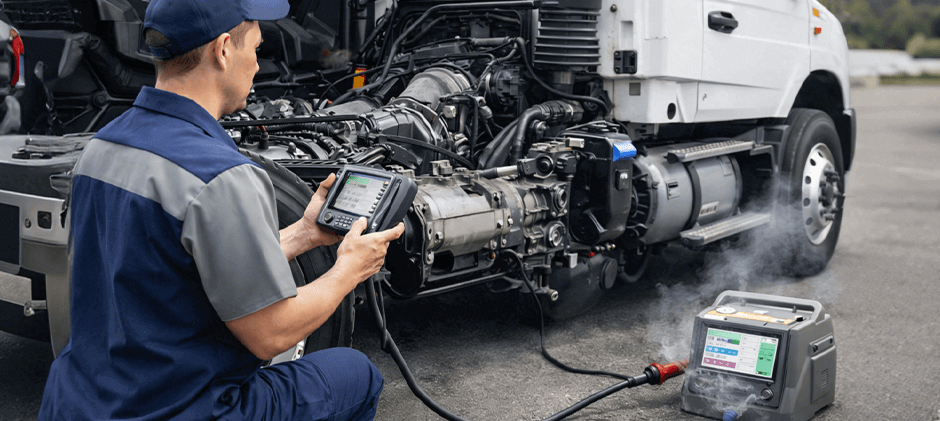
Common Causes of the P0138 Code
In the field, we group P0138 root causes into two buckets:
- The engine is actually running rich, so the downstream sensor reports high voltage.
- The downstream sensor signal is wrong (sensor or wiring fault), so the ECM thinks the engine/catalyst condition is wrong.
Here are the most common triggers on off-road equipment.
1) Failing downstream O2 sensor (Sensor 2)
Over time, oxygen sensors can age or become contaminated. On non-road machines, common contributors include:
- High exhaust heat cycles during long shifts
- Carbon buildup from rich operation
- Vibration damage inside the sensor
- Contamination from oil burning or coolant leaks
If the sensor becomes slow or biased high, the ECM may log P0138 even if the engine is running fine.
2) Wiring faults and bad connections (very common on jobsite machines)
A short-to-voltage, water intrusion in a connector, pin corrosion, rubbed-through insulation, or a weak ground can hold the signal high. This is especially likely when:
- The harness runs close to the exhaust
- The machine is washed often
- The wiring is under strain from engine movement
From a practical standpoint, if the code is intermittent, returns after rain/washing, or changes when you move the harness, wiring is a prime suspect.
If you’re doing a repair that needs a replacement harness/cable assembly (instead of repeated splices), start here: wiring connections.
3) Rich running condition (too much fuel / not enough air)
If the engine is truly rich, the downstream O2 sensor can stay high. Causes on off-road machines often include:
- Leaking fuel injector(s)
- Excessive fuel pressure (regulator issue, return restriction)
- Restricted air intake (clogged air filter, collapsed intake hose)
- Incorrect fuel type or fuel contamination
- EVAP purge faults (where applicable on certain systems)
4) Exhaust and catalyst-related problems
Even though P0138 is an “O2 circuit high voltage” code, downstream O2 behavior is tied to catalyst function. Conditions that can push readings abnormal include:
- Catalyst damage or overheating events
- Exhaust restrictions (can change engine load behavior and fueling)
- Exhaust leaks near the sensor (more often cause lean-type behavior, but can still confuse monitoring, depending on location)
5) ECM calibration/control logic issues (less common)
It’s not the first place you look, but if everything else tests good, software updates or ECM faults can’t be ruled out—especially on machines with aftermarket conversions or swapped engines.
How to Fix the P00138 Code?
You’ll see people type “P00138” by mistake. For the oxygen sensor high voltage, we’re talking about P0138. The fix approach below is the same idea: verify the cause, then repair what failed.
Step 1: Confirm the code and capture freeze-frame data
Before clearing anything:
- Confirm P0138 is active or stored
- Record freeze-frame conditions (RPM, load, coolant temp)
- Check for companion codes (misfire, fuel trim, MAP/MAF, heater circuit codes)
Why you do this: a P0138 that sets only at hot idle is a different problem than one that sets under load.
Step 2: Identify the correct sensor (Bank 1, Sensor 2)
On many off-road engines, access is tight, and sensors can be confused. Verify:
- Sensor 2 is downstream of the catalyst
- Wiring routing matches the correct connector (don’t swap upstream/downstream plugs)
Step 3: Quick visual inspection (fast wins)
Look for:
- Melted insulation near the exhaust
- Harness rubbing on brackets
- Loose connector locks
- Green/white corrosion on pins
- Signs of water intrusion
A key field clue from heavy equipment electrical work: intermittent faults often come from pin drag, oxidation, or a broken conductor inside the insulation—the outside can look fine.
Step 4: Check live data (the decision point)
Use a scan tool that can show O2 sensor voltage.
What you’re looking for:
- Does downstream O2 voltage stay stuck high even when conditions change?
- Does the reading react when you change engine speed/load?
- Does the signal drop if you create a controlled lean condition (only if you know safe procedures for your machine)?
If the signal is stuck high, you decide between:
- Real rich condition
- Signal forced high (sensor or wiring short)
Step 5: Rule out a forced-high signal (simple electrical checks)
Depending on your service manual pinout, common checks include:
- Backprobe signal wire voltage and reference/ground integrity
- Wiggle test harness while watching live voltage
- Inspect the connector pin tension and sealing
- Check for short-to-voltage on the signal wire
If you find repeated connection damage or a hacked harness, replacing the assembly is often more reliable than stacking repairs. That’s exactly why “uptime parts” like harnesses and cables matter on non-road machines (vibration + moisture + heat is a rough mix).
Step 6: If it’s truly rich, find the fuel/air cause
If live data and other signs point to rich operation, check:
1. Air intake
- Replace/inspect the air filter
- Check for collapsed intake hoses or blocked snorkels (dust-packed)
2. Fuel pressure
- Verify pressure is within spec for your engine system
3. Injectors
Look for leaking injector(s), flooding signs, strong fuel odor, wet plugs (if applicable)
4. Other inputs that drive fueling
- Coolant temp sensor reading plausible?
- MAP sensor reading plausible?
Step 7: Replace the downstream O2 sensor if it fails testing
If the sensor is biased, slow, contaminated, or internally failed, replacement is often the clean fix.
For aftermarket replacements matched to equipment applications (including industrial equipment like forklifts), you can shop here: O2 sensor.
Step 8: Clear codes, run a verification drive cycle (or work-cycle), and recheck
After repairs:
- Clear codes
- Run the machine through the same conditions that set the code (warm-up + steady load)
- Confirm P0138 does not return and that O2 readings behave normally
Quick reference table
| What you notice | Likely cause | Best first check | Common fix |
|---|---|---|---|
| Code returns after wash/rain | Water intrusion, corrosion | Connector inspection + wiggle test | Repair/replace the connector or harness |
| O2 voltage is stuck high all the time | Sensor failed high or short-to-voltage | Backprobe signal + harness inspection | Replace the sensor or fix the wiring |
| Fuel use increased, and the exhaust smells rich | Real rich condition | Fuel pressure + intake restriction check | Fix pressure/regulator, intake, injector |
| Intermittent cutouts + multiple sensor codes | Bad ground/harness issues | Ground voltage drop test | Replace cable/harness, clean grounds |
Where Parts Fit In
Once diagnostics point to the root cause, fast access to the right parts is what gets you back to work. For repairs tied to P0138, the most common “buy list” is:
- A correct-fit O2 sensor (when the sensor is biased/stuck)
- Replacement harnesses/cables/connectors from wiring connections (when the fault is intermittent or corrosion-related)
And if you’re maintaining a mixed fleet that includes jobsite support trucks (common in construction and field service), you can also source related components from truck parts.
FAQs
1) Can we keep running the machine with P0138?
Sometimes the engine will still run, but we don’t recommend ignoring it. A false “rich” signal or a true rich condition can raise fuel cost, foul plugs (on spark engines), and stress the catalyst. It also risks downtime if the issue worsens.
2) Is P0138 always the oxygen sensor?
No. A lot of cases are wiring and connections—especially on off-road machines, where vibration and moisture are constant. We treat the sensor as “suspect,” not “guilty,” until testing supports it.
3) What’s the most common real-world cause of non-road equipment?
For many owners, it’s either:
- A downstream sensor that aged and became biased, or
- A harness/connector problem (corrosion, rubbing, water intrusion)
4) Does diesel equipment get P0138?
Most modern diesel off-road equipment uses different emissions sensors and different code families (often J1939 faults). If you see P0138 on a diesel machine, confirm what controller is generating it and whether that engine actually uses O2 sensors in its strategy.
5) How do we tell “rich running” vs “signal forced high” quickly?
If the sensor voltage is stuck high and doesn’t react to changes in RPM/load, suspect wiring/sensor failure. If other data support rich operation (fuel trims, smoke/odor, fuel pressure issues), chase fueling/air problems.
Conclusion
P0138 usually means the downstream O2 sensor signal is stuck high for too long. On off-road machinery, the top causes are a failing O2 sensor, corroded/loose wiring, or a true rich-running condition from fuel/air issues. A clean diagnostic path—visual checks, live data, and basic electrical tests—prevents wasted parts. When replacements are needed, FridayParts offers high-quality aftermarket parts at affordable prices, with broad fitment and a deep inventory for heavy equipment.
