

When we search for Kubota KX71-3 info, we usually want two things fast: (1) the right Kubota KX71-3 Spec data for planning a job, and (2) a reliable way to confirm parts before we order. Specs tell us what the machine should be able to do. Parts lookup and maintenance habits decide whether it actually does it day after day. Our job here is to cover the “spec-adjacent” details owners care about: what to check, what typically wears, how to reduce downtime, and how to choose common add-ons (like a thumb) without buying the wrong size.
About Kubota KX71-3
- Compact excavator role: We typically use the Kubota KX71-3 for trenching, drainage work, light demolition, landscaping, and tight-access digging where a larger excavator is hard to move or won’t fit.
- Why “spec + parts lookup” belongs together: Operating weight, boom/stick geometry, and hydraulic flow drive attachment sizing, pin/bushing wear rate, and hose routing stress. That’s why a Kubota KX71-3 Spec section is most useful when it’s paired with real checks and fit rules.
- Systems that most often decide uptime:
- Undercarriage wear parts (tracks, rollers, idlers, sprockets)
- Hydraulic wear items (hoses, seal kits, filters)
- Cooling stack cleanliness (radiator/oil cooler airflow)
- Bucket linkage and pins (play = poor control + faster wear)
- What we confirm before ordering parts: machine ID/serial, photos of the current part, key measurements (pin diameter/spacing, hose length, and end fittings), and whether the machine has a quick coupler or other changes.
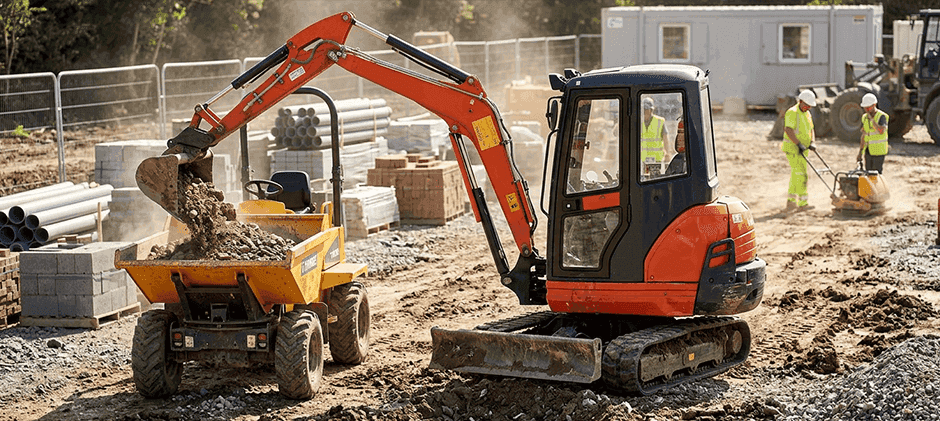
Kubota KX71-3 Spec
Engine
| Emissions Certification | Tier 4 |
|---|---|
| Oil Filtration | Spin on type |
| Air Filter Type | Dual element |
| Number Of Cylinders | 4 |
| Cooling Method | Liquid |
| Engine Make | Kubota |
| Engine Model | V1505-E4 |
| Engine Type | Water cooled |
| Gross Power | 24.4hp |
| Net Power | 26.4hp |
| Power Measured @ | 2300rpm |
| Displacement | 91.4cu in |
| Fuel Type | Diesel |
| Injection | Indirect |
| Model Name | KX71-3HGLS |
Dimensions
| Length Of Track On Ground | 5.25ft in |
|---|---|
| Ground Clearance | 0.94ft in |
| Height To Top Of Cab | 7.98ft in |
| Tail Swing Radius | 5.25ft in |
| Width | 4.93ft in |
| Height | 11.82in |
| Shoe Width | 0.99ft in |
Operational
| Operating Weight | 6547.8lb |
|---|---|
| Fuel Capacity | 11.9gal |
| Cooling System Fluid Capacity | 1.5gal |
| Hydraulic System Fluid Capacity | 13.4gal |
| Hydraulic Pump Flow Capacity | 8.6gal/min |
Related Kubota B2601 Parts
Maintenance Tips for Kubota KX71-3
Maintenance is mostly about three enemies: dirt, heat, and looseness. On compact excavators, small problems grow fast because the machine cycles constantly and works close to the ground, where debris is everywhere. If we want fewer surprise failures, we keep the routine short—but consistent.
Daily / pre-shift (10–15 minutes that saves hours later)
- Walkaround leak check
- Look under the house and along the boom/stick for fresh oil.
- Check hose rub points and clamp locations. A hose often fails where it touches metal, not where it looks “old.”
- Undercarriage clean-out
- Remove packed mud and rock around rollers and sprockets.
- Debris packing can cause accelerated roller wear and can push tracks off line.
- Track tension
- Too tight: higher wear and higher load on components.
- Too loose: higher risk of de-tracking, especially while turning or climbing.
- If your work switches between mud and dry ground, re-check tension more often.
- Cooling stack inspection
- Clear dust and debris from the radiator/oil cooler area so airflow stays strong.
- Overheating is often airflow-related on compact machines.
- Grease high-load points
- Focus on bucket linkage and boom/stick pins.
- Grease helps push out grit and water that acts like a grinding paste.
Weekly / scheduled habits
- Hydraulic filtration discipline
- Dirty hydraulic oil and clogged filters often show up as slower cycle times, noisy functions, or “notchy” control feel.
- Use clean containers and clean fill points. Most contamination happens during service, not during operation.
- Hose routing and protection
- Replace missing clamps and worn sleeves.
- If we see shiny “rub marks” on a hose cover, we treat it like a failure waiting to happen.
- Bucket linkage wear checks
- Measure pin/bushing play instead of guessing.
- If we wait until it’s metal-on-metal, the repair usually gets bigger (and more expensive) than it needed to be
- Cooling system condition
- Inspect belts, clamps, and hoses.
- If the coolant level drops repeatedly, we don’t “top off and hope.” We pressure-test and find the leak.
- Fuel cleanliness (common downtime trigger)
- Contaminated fuel can cause hard starts, stalling, and low power.
- Drain water separators if equipped and keep storage clean, especially in seasonal work.
Common Issues & Solutions
1) Slow hydraulics or weak digging force
Common causes: low hydraulic oil, clogged filters, suction-side air leak, worn pump, sticking valve, or a cylinder bypass issue.
First checks:
- Confirm oil level and visible leaks.
- Replace/inspect hydraulic filters; check for debris.
- Look for foamy oil or a “whine” that changes with load (can point to air or restriction).
Parts that often matter: hydraulic filters, hoses, seal kits (cylinders), and sometimes relief valve service parts.
2) Overheating during long cycles
Common causes: plugged cooling fins, low coolant, belt issues, and restricted airflow around the cooling stack.
First checks:
- Clean the cooling stack carefully.
- Inspect belt condition and tension.
- Inspect hoses and clamps; pressure-test if coolant loss repeats.
Parts that often matter: belts, hoses, clamps, thermostat, and radiator cap.
3) Track derailments or fast undercarriage wear
Common causes: wrong track tension, debris packing, worn rollers/idlers, misalignment, and damaged track.
First checks:
- Set tension to your spec/manual guidance.
- Clean daily in mud/rock.
- Spin/inspect rollers for roughness or leakage.
Parts that often matter: rollers, idlers, sprockets, tracks.
4) Excess play at the bucket / sloppy control
Common causes: worn pins/bushings, poor grease routine, abrasive dirt.
First checks:
- Measure the play at the linkage points.
- Check for uneven wear (often points to a pin/bushing set that should be replaced together).
Parts that often matter: pins, bushings, retaining hardware, and grease seals.
5) Hard starting, stalling, or rough running
Common causes: weak battery/grounds, fuel restriction, fuel contamination, air in fuel lines.
First checks:
- Clean and tighten battery terminals and grounds.
- Replace fuel filters; check for water/contamination.
- Inspect for damaged wiring or loose connectors from vibration.
Parts that often matter: fuel filters, battery cables/ends, relays, sensors (where used).
Conclusion
A solid Kubota KX71-3 Spec section is the best starting point for planning jobs, picking attachments, and preventing fit mistakes during parts ordering. But uptime comes from the basics: clean cooling airflow, correct track tension, clean hydraulic service, and early action on leaks and wear. As an aftermarket parts supplier, we support repairs with high-quality products at affordable prices, a vast inventory, and wide compatibility for many heavy equipment brands—so we can keep machines working with less downtime.
