

If you’re looking for replacement parts for a John Deere engine, the engine serial number ensures you get compatible parts. This guide shows you the John Deere Engine Serial Number Lookup and the common mistakes people make when ordering parts.
John Deere Engine Serial Number Location
Find the engine’s data plate. This small metal plate holds the engine’s identity. For most John Deere engines, you will find this data plate in the two primary locations:
- Engine Block: Look on the side of the engine block. The specific side (left or right, when viewed from the flywheel end) can differ by model, but it’s the most common location.
- Near the Valve Cover: The second place to check is the valve cover, which is at the top of the engine.
Tip: Over the years, this plate gets dirt, grease, and grime. We recommend using a degreaser and a soft brush to gently clean the plate to ensure all the numbers and letters are clear.
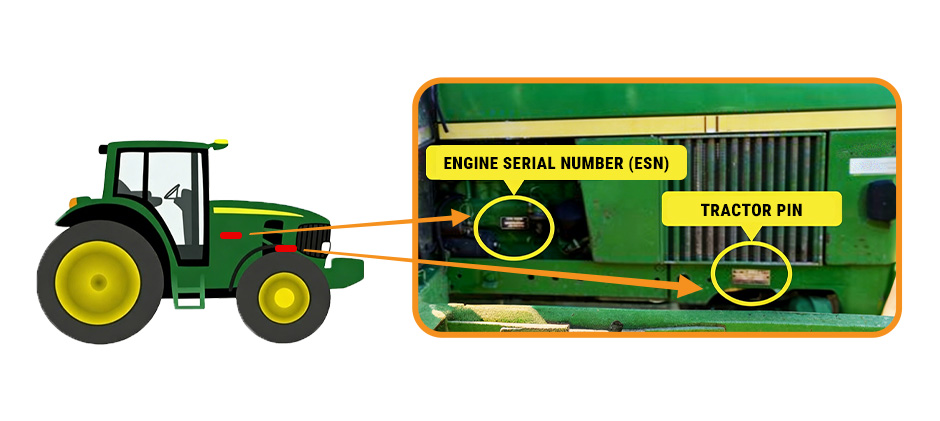
What’s the Difference Between the PIN and the ESN?
The PIN (sometimes called the machine serial number) identifies the entire piece of equipment. This number tells you details about the machine’s manufacturing year, factory, and original specifications.
The ESN is specific only to the engine itself. Why are they separate? Because engines are often treated as distinct components. The same machine model might be offered with different engine options over its production life. For any engine-related repair—from a simple filter change to a complete overhaul—the ESN is the number you need. It is the single source of truth for your engine’s build.
How To Read Your John Deere ESN?
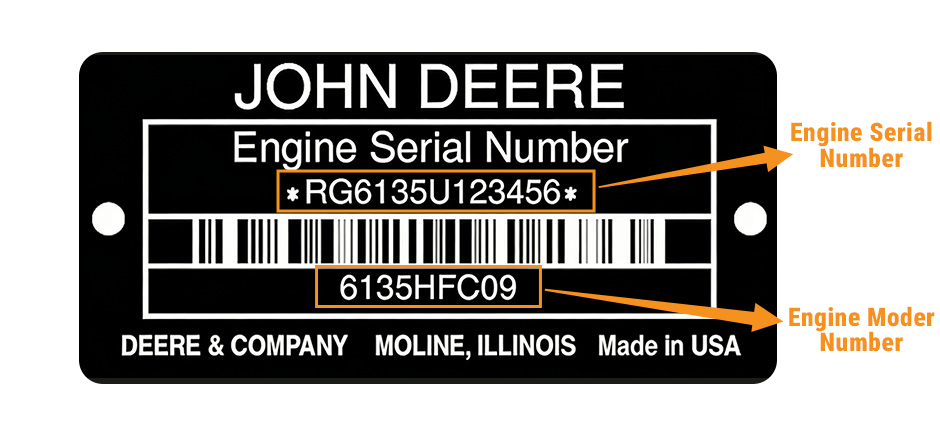
The data plate contains two pieces of information that you should record: the Engine Serial Number (A) and the Engine Model Number (B). These two numbers are crucial for repair parts or warranty information.
Think of Engine Model Number like the engine’s “product name.” It tells you the engine’s basic specs, such as displacement, fuel type, whether it has a turbo, and the engine series (like PowerTech™). Many engines can have the same model number.
The engine serial number is a unique ID for one specific engine. No two engines have the same serial number.
Engine Serial Number
The John Deere ESN is a 13-digit code that provides a wealth of information. Each engine has a unique number that will never be repeated. Let’s break down an example: RG6135U123456.
[RG] [6135] [U] [123456]
- RG: Manufacturing Factory Code
- 6135: Engine Model Designation
- U: Emissions Certification Level
- 123456: Sequential Production Number
Here is a detailed chart to help you decode your own ESN:
| Manufacturing Factory (RG) | The first two letters identify the factory where the engine was assembled. | CD = Saran, France
JX = Rosario, Argentina RG = Waterloo, IA, USA PE = Torreón, Mexico PY = Pune, India |
|---|---|---|
| Engine Model Designation (6135) | The next four digits relate to the engine’s size. The first digit is the number of cylinders, and the following three represent the total displacement. | 6180 = 6 cylinders, 18.0 liters
6135 = 6 cylinders, 13.5 liters 6090 = 6 cylinders, 9.0 liters 6068 = 6 cylinders, 6.8 liters 4045 = 4 cylinders, 4.5 liters 3029 = 3 cylinders, 2.9 liters |
| Emissions Certification (U) | This single letter indicates the emissions tier the engine was built to meet. | A, B, D, H, T = Non-emissions regulated
A, B, E, F, H, T = Tier 1/Stage I D, G, H, J, K, T = Tier 2/Stage II L, M, N, P = Tier 3/Stage III A R, U, V, W, X, Y, Z = Interim Tier 4/Stage III B and Final Tier 4/Stage IV/Stage V |
| Sequential Number (123456) | The final six digits are a unique number assigned to your specific engine as it came off the assembly line. | 123456 = The 123,456th engine of that model built. |
Engine Model Number
The Engine Model Number is like a detailed spec sheet. However, you need to know that John Deere has used two different naming systems over the years. Identifying which system your engine uses is crucial.
Previous Model Numbers
This naming convention was used for a long time, roughly from 1996 through the mid-2010s. It covers engines from non-regulated up to Tier 3 and early Tier 4. It’s a relatively straightforward system where letters often correspond to features. Let’s decode 6135HFC09:
| Number of Cylinders (6) | 3
4 6 |
|---|---|
| Displacement in Liters (135) | 2.9
4.5 6.8 9.0 13.5 |
| Air Intake System (H) | D = Naturally Aspirated
T = Turbocharged A = Turbocharged & Aftercooled (Air-to-Water) H = Turbocharged & Aftercooled (Air-to-Air) |
| User Type (F) | F = OEM (Original Equipment Manufacturer) |
| Application Type (C) | C = Industrial
G = Genset M = Marine |
| Emissions Certification (09) | 120, 160, 220, 425 = Non-emissions regulated
001, 150, 180, 250 = Tier 1/Stage I 270, 275, 070, 475 = Tier 2/Stage II 280, 285, 485 = Tier 3/Stage III A 281, 295, 92, 93, 94, 95 = Interim Tier4/Stage III B 96, 97, 98, 99 = Final Tier 4/Stage IV/Stage V New Designation: 04 = EWX 05 = PWL 06 = PVL 07 = PSL 08 = PVS 09 = PSS |
Modern Engine Model Numbers
As emissions rules became stricter (Tier 4 Final, Stage V), engines also became more complex. New systems like EGR, DPF, and SCR were added, so John Deere needed a clearer way to name and identify engines. That’s why the modern engine naming system was introduced. Let’s break down 6135CI440 and see what it means:
| Number of Cylinders (6) | 3
4 6 |
|---|---|
| Displacement in Liters (135) | 029 = 2.9L
045 = 4.5L 068 = 6.8L 135 = 13.5L 136 = 13.6L 180 = 18.0L |
| Aspiration (C) | A = Air-to-coolant cooled
C = Compound (Series) D = Naturally aspirated H = Air-to-air cooled T = Turbocharged S = Air-to-sea water cooled |
| Application Type (I) | I = Industrial
G = Generator Drive M = Marine P = Gen Set Power Unit V = Variable Speed Power Unit |
| Emissions Level (4) | 0 = Tier 0 or equivelant
1 = Tier 1 or equivelant 2 = Tier 2 or equivelant 3 = Tier 3 or equivelant 4 = Tier 4 or equivelant 5 = Stage V |
| Aftertreatment/Core Tech (4) | Aftertreatment:
0 = No ATD Mechanical 1 = No ATD Electrical ≥Interim Tier 4: 2 = Single Fluid, no DPF 3 = Single Fluid, with DPF 4 = Dual Fluid (DEF), no DPF 5 = Dual Fluid (DEF), with DPF Core Technology: 0 = Mechanical 1 = Electrical 2V. Fixed turbocharger 2 = Electrical 2V. WG or VGT ≤Tier 4: 3 = Electrical 4V. Fixed turbocharger 4 = Electrical 4V, WG or VGT 8 = Electrical 4V w/EGR, WG or VGT 5 = Electrical 2V w/EGR. Fixed turbocharger 6 = Electrical 2V w/EGR. WG or VGT 7 = Electrical 4V w/EGR. Fixed turbocharger 8 = Electrical 4V w/EGR. WG or VGT |
| Incrementation (0) | 0 = Parent
1—9 = Incremental assignation in case of significant change |
A Key Check Before Ordering Replacement Engine Parts
In 1996, John Deere® launched its new PowerTech™ engine line to meet Tier 1 emissions standards.
Many people mix up the older 300 Series engines (named by liter size) and the new PowerTech™ engines. That’s because the model numbers stayed the same. For example, both an old 300 Series engine and a new PowerTech™ engine might be labeled 4045T. Even with the same model number, they’re totally different engines. No parts are the same between them.
In theory, you should be able to find the right parts using just the serial number, since every one is unique. But Most parts suppliers organize their huge inventory using model + series, not just serial numbers.
Here’s a simple example. A machine operator has a 4.5L engine that needs repair. He sees “4045T” stamped on the engine and searches online for “John Deere 4045T piston kit.” He finds a product with the same model name and buys it.
But the kit he bought is for a 300 Series engine, while his engine is actually PowerTech™. The parts don’t fit at all. Now he has wasted money and lost time waiting for the right parts.
300 Series or PowerTech™?
So, how do you tell them apart for good? Here are the definitive checks:
- Check the Valve Cover Sticker: Some engines have a sticker that says “PowerTech™.” If you see this, the engine is likely a PowerTech model. But stickers can fade, fall off, or get covered in dirt, so don’t rely on this alone.
- Check the Engine Model Number: A better way is to look at the full model number on the engine data plate. If the number ends with codes like 150, 151, 180, 250, or 275, or any higher value, it usually means it’s a PowerTech™ engine. The older 300 Series engines normally don’t use these suffixes.
- Check the ESN Against Factory Codes: This is the expert-level check. You can use the engine’s factory of origin (from the ESN) to determine the series.
| Factory Code (from ESN) | Factory Name | 300 Series ESN Range | PowerTech™ ESN Range |
|---|---|---|---|
| CD | Saran, France | ESN up to 499999 | ESN 500000 and up |
| PE | Torreón, Mexico | (N/A) | ESN 001000 and up |
| TO | Dubuque, IA, USA | ESN up to 699999 | ESN 700000 and up |
Final Takeaway
Before you add a part to your cart, take a moment to check this. Don’t rely only on the basic engine model number. Make sure your engine is either 300 Series or a PowerTech™ so you can buy the right parts the first time. Still not sure? Share your engine serial number with our team, and we’ll quickly check your engine details to make sure the Jone Deere parts you need are compatible. Contact us today!
