

When you’re comparing the John Deere 1025R and John Deere 2025R, the hard part isn’t finding a spec sheet—it’s knowing which differences will actually change your results on dirt, gravel, slopes, and tight work areas. This guide breaks down the 1025R vs 2025R decision in practical terms: stability, lift, clearance, storage, and how each tractor behaves when you’re using real attachments and pushing through off-road chores.
About John Deere Tractor 1025R and 2025R
Both models sit in the sub-compact/compact utility space where one machine can mow, move material with a loader, run PTO-driven implements, and handle light ground engagement. They’re common in off-road work on acreage, small farms, equestrian properties, and job sites where we need tight maneuvering and straightforward transport.
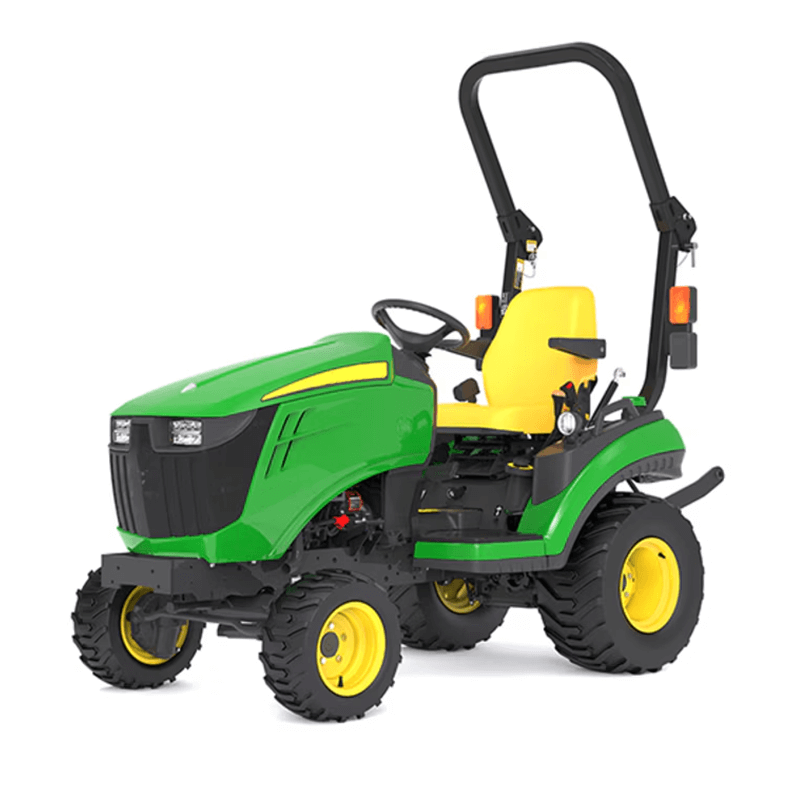
John Deere Tractor 1025R
We typically look at the John Deere 1025R when our priority is a smaller footprint and easy day-to-day handling, while still keeping real tractor capability (hydrostatic drive, PTO work, and 3-point use).
Where the 1025R usually makes sense
- Tight-space work: barns, gates, landscaping edges, and narrow paths
- Routine mowing and property upkeep where maneuverability matters
- Light-to-moderate loader tasks (within rated lift limits)
- Owners who want a tractor that’s easier to store and trailer because it’s lighter and shorter
What to keep in mind
- With a lighter platform (about 1444 lb) and shorter wheelbase (57.1 in), stability under a raised load can feel more “busy” on uneven ground.
- Depending on the configuration, the 1025R may be 2WD or 4WD, so we need to verify the drivetrain before planning for soft terrain or frequent loader pushing.
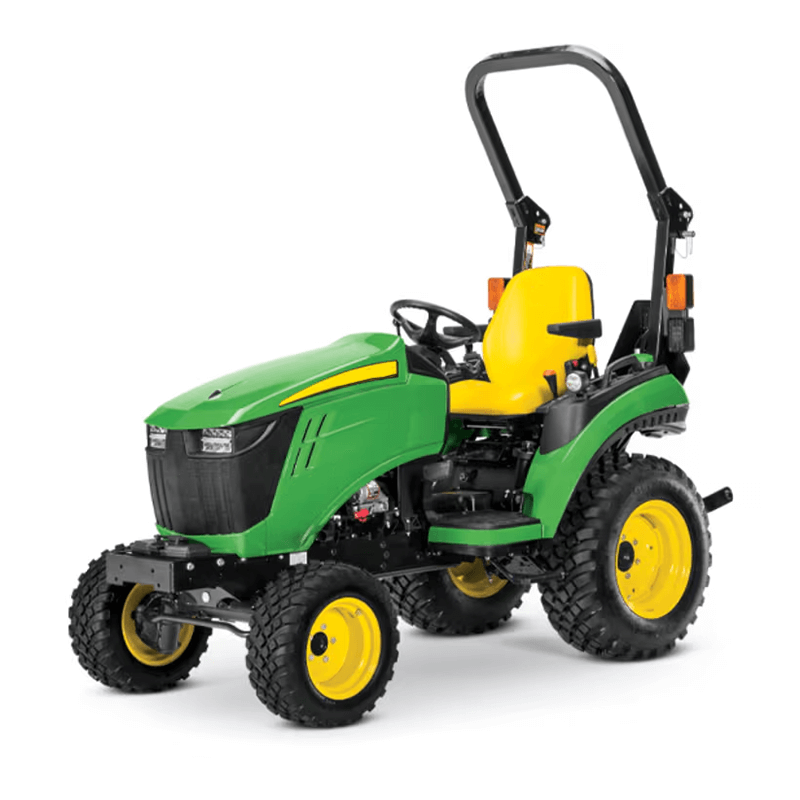
John Deere Tractor 2025R
We usually consider the John Deere 2025R when we expect more loader time, rougher terrain, or simply want a more planted feel with added margin in lift and stability.
Where the 2025R usually makes sense
- Frequent material handling (gravel, wet soil, pallet forks within safe limits)
- Uneven or rutted ground where extra clearance and stance reduce hang-ups
- Operators who want a steadier ride and less “tippy” feeling during loader cycles
- Situations where a higher lift capacity helps reduce extra trips
What to keep in mind
- The 2025R’s added weight (1793.4 lb) and longer wheelbase (63 in) typically translate into better stability and traction under load.
- Rated lift capacity is higher (about 915 lb vs 758 lb), which you’ll notice quickly if loader work is a weekly task.
- The spec set you provided lists the 2025R as 4WD, which is a practical advantage for off-road conditions.
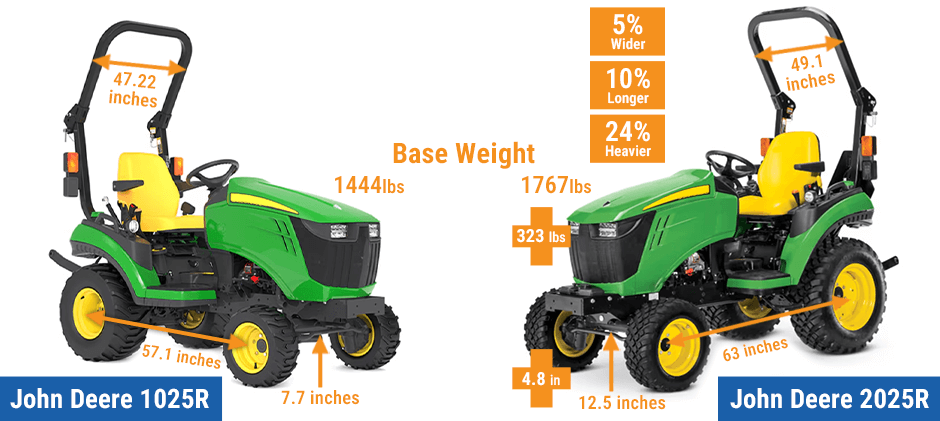
Key Differences: John Deere 1025R vs 2025R
The John Deere 1025R and John Deere 2025R share a lot: similar horsepower class, hydrostatic drive, and comparable PTO power. That similarity is exactly why buyers get stuck. To get unstuck, you need to focus on the differences that show up under load and on rough ground.
1) Horsepower and PTO power: close numbers, different feel under load
From the specs you provided:
- Engine horsepower: 1025R at 23.9 hp vs 2025R at 24.2 hp
- PTO horsepower: both at 18 PTO hp
- Transmission: both hydrostatic, 2-range
Because PTO power is essentially the same, you shouldn’t expect a night-and-day difference in running common PTO-driven attachments. Where the experience changes is how confidently the tractor holds traction and stays planted when you’re moving material or working on uneven ground.
What this means for you: if your main question is “which one has more power for attachments,” the answer is that power won’t be the deciding factor. The deciding factor is the platform that carries that power.
2) Weight and wheelbase: the core of stability
Here’s where the 1025R vs 2025R comparison starts to separate clearly:
- Weight: 1025R at 1444 lb vs 2025R at 1793.4 lb
- Wheelbase: 1025R at 57.1 in vs 2025R at 63 in
That extra weight and longer wheelbase on the John Deere 2025R usually translates into:
- less “light in the rear” feeling during loader work
- more predictable handling on slopes and ruts
- fewer moments where you have to compensate with extra ballast or repeated smaller bucket loads
What this means for you: if you regularly carry loads in the bucket or use forks, the heavier platform often feels calmer and more controlled. That can reduce fatigue and help you keep a safer pace.
3) Ground clearance and tire stance: fewer hang-ups on rough terrain
The John Deere 2025R is typically associated with larger tires and more ground clearance. More clearance helps when you’re working off-road, where you can’t “smooth the path” first—rutted driveways, field edges, drainage transitions, and uneven staging areas.
The John Deere 1025R sits lower, which can be helpful for certain maintenance tasks on smoother ground, but it can limit you when:
- You’re cresting uneven ground
- You’re crossing shallow ditches or ruts
- You need a little extra clearance to keep moving without scraping or getting hung up
What this means for you: if your property is rough or you work in unimproved areas, clearance is a daily advantage, not a “nice to have.”
4) Lift capacity: the difference you notice every week
Lift capacity is one of the most practical differences because it directly affects how often you have to make extra trips.
From the provided comparison:
- Lift capacity: 1025R at 758 lb vs 2025R at 915 lb
That extra capacity matters when you’re dealing with:
- wet soil (heavier than you think)
- gravel that packs into a bucket
- pallet forks, where leverage works against you
- Repeated loading cycles, where “near the limit” becomes your normal routine
What this means for you: if you routinely handle heavier material, the John Deere 2025R gives you more headroom. Headroom is not just speed—it’s less strain and fewer “I shouldn’t have done that” lifts.
5) Drivetrain and 4WD availability: what to verify before you buy
The specs you provided show:
- 1025R: “2WD or 4WD”
- 2025R: “4WD”
For off-road machinery use, 4WD is often the difference between controlled work and constant wheelspin—especially when you’re pushing into a pile, climbing a grade with a load, or working in soft ground.
What this means for you: confirm the exact 1025R configuration you’re looking at (2WD vs 4WD). If you’re buying for real off-road traction needs, 4WD is usually the safer choice.
6) Operator comfort: not a luxury when sessions get long
Comfort affects how precisely you control the tractor—especially when you’re doing careful loader placement or grading where small mistakes cost time.
In general, the John Deere 2025R is seen as a step up in operator space and “planted” feel. The John Deere 1025R is compact and easy to maneuver, which is valuable in tight areas and quick tasks.
What this means for you: if you run longer sessions or have rougher ground, comfort and ride feel can reduce fatigue and help you stay consistent.
Quick spec table
| Spec | John Deere 1025R | John Deere 2025R | Why it matters off-road |
|---|---|---|---|
| Engine hp | 23.9 | 24.2 | Nearly a tie for most real tasks |
| PTO hp | 18 | 18 | Similar PTO capability |
| Transmission | Hydrostatic, 2-range | Hydrostatic, 2-range | Easy direction changes for loader work |
| Drive | 2WD or 4WD | 4WD | Traction advantage on soft/uneven ground |
| Weight | 1444 lb | 1793.4 lb | Stability and traction under load |
| Wheelbase | 57.1 in | 63 in | More stable feel, especially with loader use |
| Lift capacity | 758 lb | 915 lb | Fewer trips, more margin with heavy materials |
How to Choose the Right One?
You’ll make the right call faster if you choose based on your most frequent “hard” task, not your easiest task.
Choose the John Deere 1025R if your priorities look like this
The John Deere 1025R usually makes more sense when:
- You need to maneuver tightly around buildings, gates, trees, and narrow paths.
- You store the tractor in a tighter space and want easier hauling logistics.
- Your loader work is light to moderate, and you rarely hit the edge of lift capacity.
- You spend more time on routine maintenance tasks than on heavy material handling.
Best-fit work profile: You want a compact machine that’s easy to live with day to day, and your heaviest tasks aren’t constant.
Choose the John Deere 2025R if your work profile is more demanding
The John Deere 2025R is often the smarter pick when:
- You do loader work regularly and want more lift margin and stability.
- You work on uneven ground and want more clearance and a steadier stance.
- You handle heavier materials and want fewer “take half a bucket” cycles.
- You run longer sessions and care about a more comfortable, controlled feel.
Best-fit work profile: You want more capability without jumping to a much larger tractor class.
Keep Either Tractor Reliable
Once you’ve picked your tractor, reliability becomes the real cost center. Compact tractors doing off-road work see dust, vibration, and repeated load cycles—exactly the mix that exposes weak maintenance habits.
Smart parts sourcing for common wear items
When you need replacements, you’ll typically look for parts across:
- engine components
- transmission components
- hydraulic system parts
- PTO-related parts
- electrical parts
- cooling system parts
- cab and operator-area accessories
If you’re stocking up for the season or fixing an issue fast, aftermarket John Deere tractor parts can be a practical route because the catalog covers compact through larger series, with a focus on precision fit, cost efficiency, and wide coverage. You’ll also find model-relevant items listed for compact tractors—such as glow plugs that fit 1025R and 2025R applications—so you can keep a small “downtime kit” on the shelf.
Oil filtration: protect the systems you stress most off-road
Off-road conditions accelerate contamination. Dust, metal particles, and general grime can enter:
- engine oil
- hydraulic oil
- transmission oil
That contamination can raise wear and reduce performance over time. The oil filter page you provided makes the key point: replacing filters is a core part of routine maintenance, and you should match the filter to the system.
To cover the basics without overthinking it, shop by system type:
- Engine oil filters: trap soot and metal particles to protect engine parts
- Hydraulic filters: protect pumps, valves, and cylinders
- Transmission oil filters: help keep shifting smooth, reduce heat, protect gears and clutch parts
If you want a direct place to start for filters across these systems, aftermarket John Deere oil filter listings are organized around the idea that “the right filter depends on the system,” which fits real-world maintenance planning.
Simple rule you can use: if your tractor spends time in dusty work zones or does frequent loader cycles, tighten inspection intervals and don’t stretch filter changes “just because it still runs fine.”
Conclusion
The John Deere 1025R and John Deere 2025R are close in horsepower and PTO output, but they differ in the areas that decide off-road productivity: weight, wheelbase, clearance, and lift capacity. If you value tight maneuvering and lighter routine work, the 1025R is often the better fit. If you do frequent loader work or rough-terrain tasks, the 2025R’s added stability and lift margin can pay back quickly.
