

When Jeep dashboard lights come on during trail work, site runs, or towing on rough ground, the problem is rarely “just a light.” It’s the vehicle telling you what system is at risk—and whether you should keep moving, slow down, or stop before damage happens. This 2026 guide explains the most common Jeep dashboard symbols in plain terms, then gives practical next steps that fit off-road and work-use conditions (dust, heat, water crossings, heavy loads).
What Do Jeep Dashboard Symbols Mean?
Jeep dashboards use a mix of warning symbols (something is wrong) and status symbols (something is on). Symbols can vary by model, year, and trim, so treat this as a field guide and confirm details in your owner’s manual when possible.
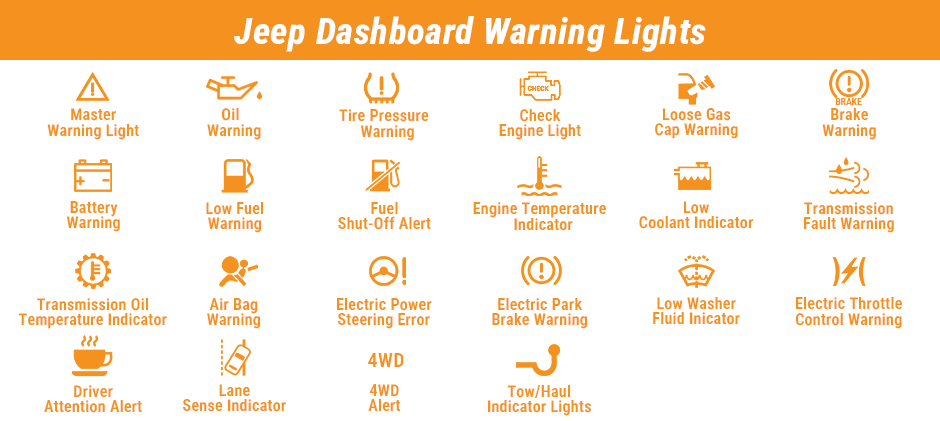
Below are the core symbols you’re most likely to see, what they mean, and why they matter in off-road use.
Master Warning Light
- Meaning: One or more issues detected. Often appears with another light that gives the real clue.
- Off-road impact: Common when multiple systems flag at once (battery + traction + ABS after a deep mud event, for example).
- Next move: Look for the second light; don’t treat the triangle alone as the diagnosis.
Check Engine / MIL
- Meaning: Engine/emissions-related fault stored in the computer.
- Off-road impact: Can be triggered by loose cap issues, sensor readings after water/dust exposure, or real drivability faults.
- Next move:
- Steady light: Drive gently and plan a scan soon.
- Flashing light: Reduce load immediately and stop as soon as safe—continued operation can cause damage.
Oil Warning
- Meaning: Low oil pressure (not just low oil level).
- Off-road impact: Hard angles on slopes, hot oil, or leaks can make this urgent fast.
- Next move: Shut the engine off and check oil level/leaks. Do not “limp it” under load.
Battery / Charging
- Meaning: Charging system problem (alternator output, wiring, belt-driven systems depending on platform).
- Off-road impact: Winching, lights, fans, and accessories can drain power quickly; low voltage can also trigger other warning lights.
- Next move: Minimize electrical load, check terminals, then diagnose charging output.
Coolant Temperature
- Meaning: Engine coolant temperature is too high.
- Off-road impact: Low-speed crawling + high load + debris in the cooling stack is a common cause.
- Next move: Reduce load, stop to cool down, and inspect for airflow blockage and coolant level once safe.
Low Coolant
- Meaning: Coolant level is below the expected range.
- Off-road impact: Vibrations can worsen small leaks; a low level can become overheated on the next climb.
- Next move: Check for leaks; top up only when safe and at the correct temperature.
Brake System
- Meaning: Brake system warning (fluid level, brake issue, or parking brake, depending on symbol set).
- Off-road impact: Mud/water can affect sensors; towing makes brake health non-negotiable.
- Next move: If braking feels different, stop and inspect. Don’t continue into steep terrain.
ABS (ABS text)
- Meaning: Anti-lock braking system fault.
- Off-road impact: ABS may be less critical at low speeds, but the system fault can change braking behavior on mixed traction.
- Next move: Drive cautiously; service soon—especially before towing or highway speeds.
Traction Control / Stability Control
- Meaning:
- Flashing: System is actively controlling wheel slip.
- Solid / with “OFF” / with “!”: System off or fault.
- Off-road impact: Some drivers disable traction control intentionally in sand/mud; a fault is different from “off.”
- Next move: Confirm the mode you selected. If it’s a fault, avoid aggressive driving until it’s checked.
Tire Pressure
- Meaning: One or more tires are low; sometimes indicates a sensor fault.
- Off-road impact: Airing down for traction is normal, but TPMS will still warn; low pressure at speed can destroy a tire.
- Next move: Set pressure for the terrain and speed you’re actually running; inspect for punctures.
Transmission Fault / “A/T” warnings
- Meaning: Transmission issue detected, or protection mode active.
- Off-road impact: Heat builds fast during towing, deep sand, or slow crawling.
- Next move: Reduce load, allow cool-down, and avoid repeated high-heat cycles.
Transmission Oil Temperature
- Meaning: Transmission fluid temperature high.
- Off-road impact: Overheating can shorten fluid life and damage internal parts.
- Next move: Stop, cool down, and review towing/gear selection; if it repeats, service is needed.
Airbag / SRS
- Meaning: Airbag system fault.
- Off-road impact: Safety system may not deploy as designed.
- Next move: Repair soon; don’t ignore.
Electric Power Steering
- Meaning: Power steering system fault or reduced assist.
- Off-road impact: Steering loads are highest off-road; reduced assist can become a control risk.
- Next move: Stop and restart once; if it stays on, drive carefully to service.
Immobilizer / Security
- Meaning: Anti-theft/immobilizer issue; key not recognized or system fault.
- Off-road impact: Can strand the vehicle at the worst time.
- Next move: Try a different key fob, check the fob battery, then diagnose.
Electronic Throttle Control
- Meaning: Throttle control system fault.
- Off-road impact: Can limit power or cause poor response—dangerous on climbs.
- Next move: Safely stop, cycle ignition; if it returns, service before hard use.
Loose Gas Cap / EVAP
- Meaning: Fuel cap not sealed or EVAP system issue.
- Off-road impact: Dust and vibration can prevent a proper seal.
- Next move: Re-seat and tighten cap; if the light remains, scan codes.
Low Fuel
- Meaning: Fuel level low.
- Off-road impact: Remote runs + steep angles can cause fuel pickup issues; running very low can pull contamination.
- Next move: Refuel soon and avoid steep angles if the tank is near empty.
4WD / SERV 4WD
- Meaning: 4WD engaged status or a 4WD system fault (depends on exact message).
- Off-road impact: A real 4WD fault can leave you stuck or stress the drivetrain.
- Next move: If it indicates service/fault, avoid binding situations and get it checked before the next trip.
Other Important Indicators on the Jeep Dashboard
Not every light is a failure. Some are simply “system active” confirmations—useful for off-road control.
- Turn signals (arrows): Status indicator.
- High beam (blue headlamp): High beams on.
- Fog lamps (lamp + beams): Fog lights are active.
- Cruise / Adaptive Cruise (ACC): Cruise functions active or faulted (often green = active, amber/orange = problem).
- Tow/Haul: Towing mode active; helps shift behavior and heat control.
- Lane/Forward Collision/Driver Attention icons: Driver-assist features active, off, or faulted (common on newer model years). In dusty trails, sensor blockage can trigger warnings.
Transition: Once the symbol is identified, the next step is deciding what to do right now—because off-road use punishes “wait and see.”
Common Jeep Warning Lights & What to Do
Use this table as a fast field reference for Jeep dashboard lights when time matters.
| Light / Symbol | Risk Level | What it usually means | What to do now |
|---|---|---|---|
| Oil pressure | Stop-now | Low oil pressure | Column 4 Value |
| Coolant temp / Hot coolant | Stop-soon | Overheating | Column 4 Value 2 |
| Battery/charging | Medium | Charging fault | Column 4 Value 3 |
| Check engine (steady) | Medium | Stored engine/emissions fault | Column 4 Value 4 |
| Check engine (flashing) | Stop-soon | Misfire/severe fault risk | Column 4 Value 5 |
| Brake warning | Stop-soon | Brake system issue/parking brake/fluid | Column 4 Value 6 |
| ABS | Medium | ABS fault | Column 4 Value 7 |
| TPMS | Medium | Low tire pressure/sensor issue | Column 4 Value 8 |
| ETC lightning bolt | Stop-soon | Throttle control fault | Column 4 Value 9 |
| Power steering | Medium-High | Reduced assist | Column 4 Value 10 |
| Transmission temp | Medium-High | Fluid overheating | Column 4 Value 11 |
| SERV 4WD | Medium-High | 4WD system fault | Column 4 Value 12 |
| Airbag/SRS | Medium-High | Safety system fault | Column 4 Value 13 |
| Low washer fluid | Low | Low washer fluid | Column 4 Value 14 |
| Low fuel | Low-Medium | Fuel low | Column 4 Value 15 |
A simple troubleshooting order
- Decide if it’s a stop-now light
Oil pressure and severe overheat warnings are the big ones. Protect the engine first. - Check for “stacked” warnings
Low voltage can trigger multiple systems. A charging issue can “light up the dash.” - Confirm what you changed
Traction control off? Tow/Haul on? 4WD engaged? Don’t treat a selected mode as a fault. - Do the easy checks that actually fix problems
- Tighten the fuel cap if the EVAP/cap warning appears
- Clear mud/debris from cooling airflow paths
- Verify battery terminals are tight and clean
- Inspect tires for cuts after rock trails
- Scan codes when a computer-controlled warning stays on
A small scan tool can save hours of guessing.
Parts note
Many recurring dash warnings trace back to wear items and service parts—filters, belts, sensors, switches, and electrical connectors that take a beating in dirt, vibration, and heat. When replacement is the right fix, sourcing compatible components quickly matters for uptime. For broad brand coverage in construction and farm equipment parts (including Jeep listings), browse aftermarket Jeep parts.
FAQs
1) Are Jeep dashboard symbols the same on every model?
No. Symbols and messages vary by model, year, and trim. Newer setups add more driver-assist indicators. Use this guide for the common set, then confirm in the owner’s manual for your exact vehicle.
2) What’s the difference between a steady and flashing light?
In general, steady means a stored fault or condition that needs attention soon; flashing often signals a more urgent problem (especially with the check engine light). If flashing appears with drivability issues, reduce load and stop safely.
3) Which warning light is most urgent for engine safety?
The oil pressure warning is the top priority. Low oil pressure can damage an engine quickly, especially under off-road loads.
4) Why do multiple lights come on after mud or a water crossing?
Mud, water, and low voltage can confuse sensors or reduce electrical contact quality. If you see several warnings at once, check battery connections, inspect wheel-speed sensor areas for packed mud, and scan codes if the lights stay on.
5) Can I keep driving with a 4WD warning?
If it’s a fault (often “SERV 4WD”), avoid situations that stress the drivetrain or require maximum traction. Get it checked before serious off-road use.
Conclusion
Jeep dash warnings are a fast way to prevent breakdowns—especially in off-road and work conditions where heat, dust, and towing load push systems harder. Identify the symbol, judge urgency (stop-now vs service-soon), and follow a simple check order that focuses on engine safety first. In the long run, fixing the root cause early costs less than recovering a vehicle from a trail or losing a workday.
