

For anyone who owns or operates diesel-powered machinery, understanding your fuel is crucial for safe and efficient work. Diesel is often misunderstood — some think it behaves like gasoline, others assume it’s completely harmless.
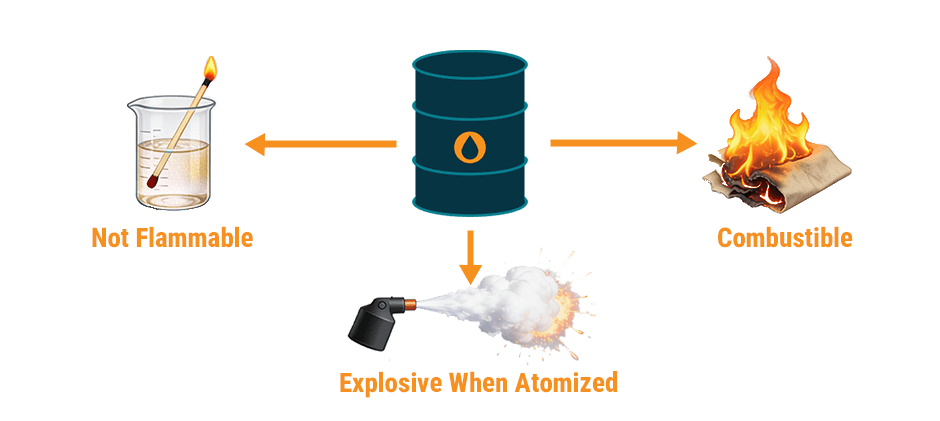
Here’s the simple truth: Diesel is combustible, not flammable, and it’s not explosive in liquid form under normal conditions. Knowing why that matters can prevent serious accidents and keep your operation running smoothly.
Is Diesel Flammable?
No, and the flash point is the reason.
A liquid’s flash point is the lowest temperature at which it produces enough vapor to ignite.
- Gasoline: Flash point ≈ -45°F (-43°C) – extremely low, so it gives off vapors even in cold weather. A tiny spark can set it ablaze.
- Diesel: Flash point between 126°F and 205°F (52°C–96°C) – meaning it must be heated before it can produce enough vapor to burn.
In practice:
At room temperature, diesel won’t ignite from a simple flame. Drop a lit match into a puddle of diesel, and it’ll likely go out.
That’s why OSHA and NEC classify diesel as non-flammable under normal handling conditions.
Is Diesel Combustible?
Yes — absolutely.
Diesel is officially a combustible liquid, meaning it can burn once it reaches a high enough temperature (its flash point).
How Diesel Burns:
- Requires heat: Diesel must be heated to produce ignitable vapors.
- Burns via a “wick effect”: On absorbent surfaces or in heaters, diesel vaporizes at the burning point — similar to kerosene.
In practice, Diesel is safer than gasoline but still dangerous. A spilled rag on a hot exhaust or welding area can catch fire easily. Always handle and store diesel carefully.
Is Diesel Explosive?
Only when atomized or compressed.
Liquid diesel is stable — but under certain mechanical conditions, it can become highly explosive.
Condition 1: Atomization
When diesel is forced through a tiny nozzle (as in an injector), it forms a fine mist. This mist mixes with the air and becomes extremely flammable.
A pinhole leak in a high-pressure fuel line can spray an aerosolized mist that can ignite instantly if it touches a hot surface — causing a fire or explosion.
Condition 2: Compression
Inside a diesel engine, air is compressed so tightly that it heats above 1,000°F (540°C). Atomized diesel fuel then self-ignites when injected — that’s how your engine runs.
In practice: Diesel itself won’t “explode” in a tank, but fuel system failures (like injector leaks) can create explosive aerosol conditions. Regular inspection of fuel lines and injectors is vital.
Practical Safety Takeaways for Machinery Owners
| Topic | Gasoline (Flammable) | Diesel (Combustible) | Safe Practice for Diesel |
|---|---|---|---|
| Vapor Hazard | High vapors ignite easily. | Low in liquid form. | Clean spills promptly; watch for high-pressure leaks. |
| Refueling | Dangerous while running. | Less vapor risk. | Always shut down before refueling. |
| Spills | Severe fire hazard. | Lower fire risk, but slippery. | Absorb and clean immediately. |
| Leaks | Hazardous vapor source. | High-pressure spray can ignite. | Inspect fuel lines regularly. |
Diesel is safe when handled properly — but dangerous if neglected. Respect it, keep heat sources controlled, and maintain your equipment regularly.
Maintenance and Prevention Tips
- Inspect fuel lines for wear, cracks, or leaks each month.
- Check injector seals and fittings for residue or misting – signs of leaks.
- Store diesel safely in approved, labeled containers, away from heat and sparks.
- Replace worn components before they fail — especially hoses, injectors, and pressure fittings.
If you ever need high-quality replacement components — such as fuel lines, injectors, or fittings for your diesel-powered equipment — you can find reliable options at FridayParts diesel engine parts. Their parts are designed for durability and compatibility with most major machinery brands, helping you maintain safety and performance on the job site.
Final Thoughts
Diesel may be less volatile than gasoline, but it still demands respect and routine care. Treat it as a combustible fuel, not a harmless liquid.
By understanding its characteristics — and keeping your machinery in good condition with properly fitted FridayParts diesel parts — you’ll maintain both safety and reliability across every job.
